
June 2, 2026
How to Find the Right Assertiveness Training for Your Career

Key Takeaways:
- Assertive communication sits between passive and aggressive styles and is a learnable skill
- Speaking assertively builds confidence, reduces stress, and improves relationships
- Practical tools like “I” statements, the DESC script, and role-play can help you develop this skill quickly
- Body language and vocal delivery are just as important as the words you choose
- Starting with low-stakes situations builds momentum toward bigger conversations
What is confident assertive speaking practice?
| Element | What It Means |
|---|---|
| Assertive communication | Expressing your needs clearly and respectfully without aggression or passivity |
| Core skills | “I” statements, direct language, confident body language, active listening |
| Key benefits | Less stress, stronger relationships, higher self-esteem, better career outcomes |
| How to start | Practice in low-stakes situations, use scripts, seek feedback |
| Who it helps | Anyone who struggles to speak up, set limits, or feel heard |
Confident assertive speaking practice is one of the most practical skills you can build for your career and your relationships. Yet most people were never taught how to do it.
Have you ever stayed quiet in a meeting, even though you had something important to say? Or agreed to something you didn’t want, just to avoid an awkward moment? That feeling of frustration afterward is your signal that assertiveness is worth working on.
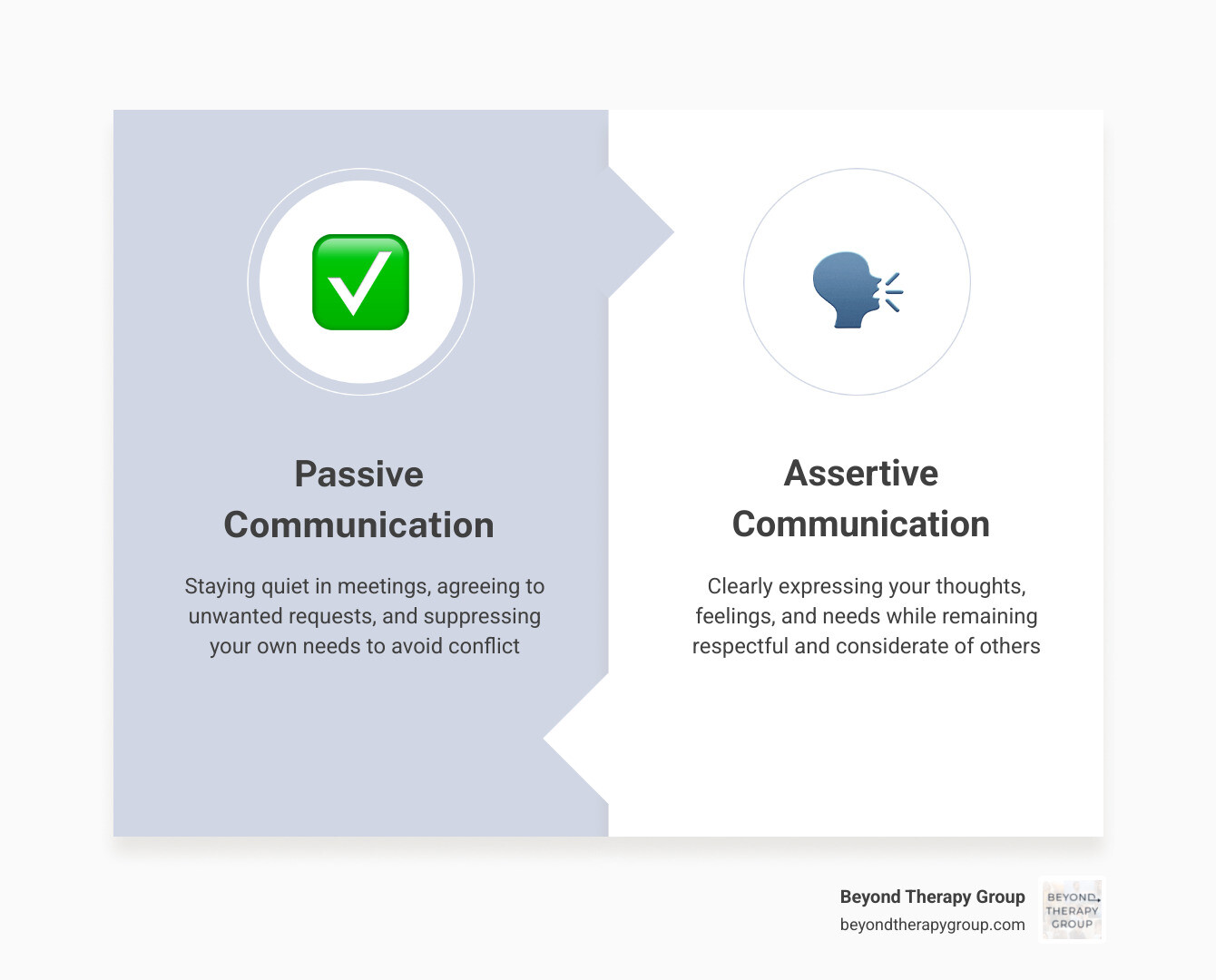
Assertiveness is not about being loud or forceful. It is the middle ground between being passive (saying nothing) and being aggressive (steamrolling others). It means expressing what you think, feel, and need in a way that is honest and direct while still being respectful to the other person.
The good news is that assertiveness is a skill, not a personality trait. It can be learned, practiced, and improved by anyone regardless of how shy or conflict-averse you currently feel.
A lack of assertiveness is linked to increased anxiety, lower self-esteem, and even depression. On the other hand, developing this skill is associated with healthier relationships, reduced stress, and greater confidence in both personal and professional settings.
Whether you find it hard to speak up in meetings, struggle to say no without guilt, or feel like your voice gets lost in the crowd, building your assertive speaking skills can shift all of that.
Confident assertive speaking practice vocab to learn:
- Effective Communication
- effective communication in schools
- to be an effective communicator it is important to be
Understanding the Spectrum of Assertive Communication
A lot of us think we only have two choices when tension shows up: stay nice and quiet, or finally explode like a microwave burrito. In reality, there is a third option.
Assertive communication means we stand up for our rights while also respecting the other person’s rights. That balance is what separates it from passivity and aggression. Resources like Assertive communication explain this middle ground well, and it is also closely connected to Mastering the Art of Speaking Up for Yourself.
Here is a simple comparison:
| Style | What it sounds like | What it looks like | Typical result |
|---|---|---|---|
| Passive | “Whatever you want is fine” | Avoids eye contact, apologizes a lot, hesitant voice | Resentment, unmet needs, low confidence |
| Aggressive | “You need to do this now” | Hard stare, sharp tone, invading space | Conflict, defensiveness, damaged trust |
| Passive aggressive | “No worries” while clearly upset | Mixed signals, sarcasm, withdrawal | Confusion, tension, indirect conflict |
| Assertive | “I am not available for that, but I can do this instead” | Calm tone, steady posture, clear language | Respect, clarity, healthier boundaries |
Assertive communicators understand a few important personal rights:
- We have the right to say no
- We have the right to ask for what we need
- We have the right to change our minds
- We have the right to make mistakes
- We have the right to be treated with respect
That does not mean we always get what we want. It means we stop acting like our needs need a permission slip.
Why does this matter so much? Because assertive communication improves relationship satisfaction, reduces interpersonal conflict, and supports healthier self esteem. It is also widely recognized in mental health work as an important skill for people dealing with anxiety, depression, and substance related struggles. In short, speaking up respectfully is not a bonus skill. It is a life skill.
Core Techniques for Confident Assertive Speaking Practice
Once we understand what assertiveness is, the next step is practicing what it sounds like.
Three tools do a lot of heavy lifting.
I statements
I statements help us express feelings and needs without blaming the other person.
Instead of:
- “You never listen”
Try:
- “I feel frustrated when I get interrupted because I want to finish my thought”
This shift matters because blame usually triggers defensiveness. Ownership lowers the temperature.
A simple formula:
- I feel…
- When…
- Because…
- What I need is…
Example:
- “I feel stressed when plans change at the last minute because I need time to adjust. I would appreciate more notice next time.”
DESC script
The DESC method is one of the most useful frameworks for confident assertive speaking practice.
- Describe the situation
- Express how it affects us
- Specify what we want
- Consequences or outcome
Example:
- “When meetings start late, we lose time for decisions. I feel rushed and less prepared to contribute. I would like us to start on time or send an update if there is a delay. That would help everyone participate more effectively.”
This structure works especially well for work conversations, boundaries, and feedback.

For more tips on sounding direct without sounding harsh, How to Sound Assertive Quickly – Speak Confidently At Work – Enhance Training offers practical delivery advice.
Verbal Strategies for Confident Assertive Speaking Practice
Words matter, but so does how much we soften them. Many people undercut their message before it lands.
Try these verbal upgrades:
- Replace “I just think maybe” with “I recommend”
- Replace “Sorry, can I say something?” with “I would like to add a point”
- Replace “If it is not too much trouble” with “What I need is”
Other useful verbal strategies:
Use direct language
Direct does not mean rude. It means clear.
Examples:
- “I cannot take on another project this week”
- “I disagree with that approach”
- “I need some time to think before I answer”
Reduce verbal deference
Many of us over soften because we are trying to sound polite. But too much hedging can make a message disappear.
Common phrases to trim:
- just
- maybe
- kind of
- sort of
- I was wondering if
- this might be silly but
Stick to facts
Especially in workplace situations, factual language tends to be easier to hear and harder to argue with.
Example:
- “The last three deadlines were missed” works better than “You are always unreliable”
This approach pairs well with The Secret Sauce of Effective Communication for Work and Life, which reinforces clarity, listening, and respectful delivery.
Non-Verbal Skills in Confident Assertive Speaking Practice
A surprising amount of assertiveness has nothing to do with vocabulary.
Research and training materials consistently point to nonverbal behavior as a core part of assertive communication. If our words say “I am confident” but our body says “please ignore me,” people often believe the body.
Focus on:
- Eye contact that is steady, not intense
- Upright posture with relaxed shoulders
- Open hand gestures instead of crossed arms
- A clear, calm voice
- Slightly slower pace than usual
- Pauses before key points
Strategic pausing is especially powerful. People often rush when nervous, which weakens their authority. A short pause makes us sound more grounded and gives our words space to land.

If we want to sound assertive, alignment matters too. Our face, tone, and body should match the message. Saying “I am not comfortable with that” while smiling nervously and looking at the floor sends mixed signals.
Top Training Methods and Exercises for Assertive Speaking
Assertiveness gets stronger with reps. Reading helps, but practice changes behavior.
Here are some of the most effective methods.
Role-play
Role-play is one of the best tools because it lets us rehearse real situations before they happen.
Practice scenarios like:
- Telling a colleague, “I would like to finish my point before we move on”
- Saying to a friend, “I cannot make it tonight”
- Telling a partner, “I would like us to keep phones away during dinner”
Role-play works best when we keep the script short, repeat it a few times, and get feedback on both words and body language.
Mirror practice
This may feel awkward at first. That is normal. Looking at ourselves while speaking helps us notice:
- nervous smiling
- disappearing volume
- weak posture
- filler words
A simple drill:
- Pick one sentence
- Say it three ways, passive, aggressive, assertive
- Watch which version feels grounded and respectful
Visualization
Mental rehearsal can reduce anxiety and make assertive responses easier to access in the moment.
Try this:
- Picture the conversation
- Imagine staying calm
- Hear yourself speaking clearly
- Visualize the other person reacting however they react
- Picture yourself staying steady anyway
The goal is not to control their response. It is to train our nervous system to tolerate speaking up.
Saying no practice
If assertiveness had a gym exercise, this would be squats.
Start small:
- “No, thank you”
- “I am not available”
- “That does not work for me”
- “I can help next week, not today”
Notice what is missing: a ten minute apology speech.
Boundary setting is a huge part of assertive speaking. How to Set Boundaries in Your Relationship Without Being a Jerk is a helpful next read if this is an area we struggle with.
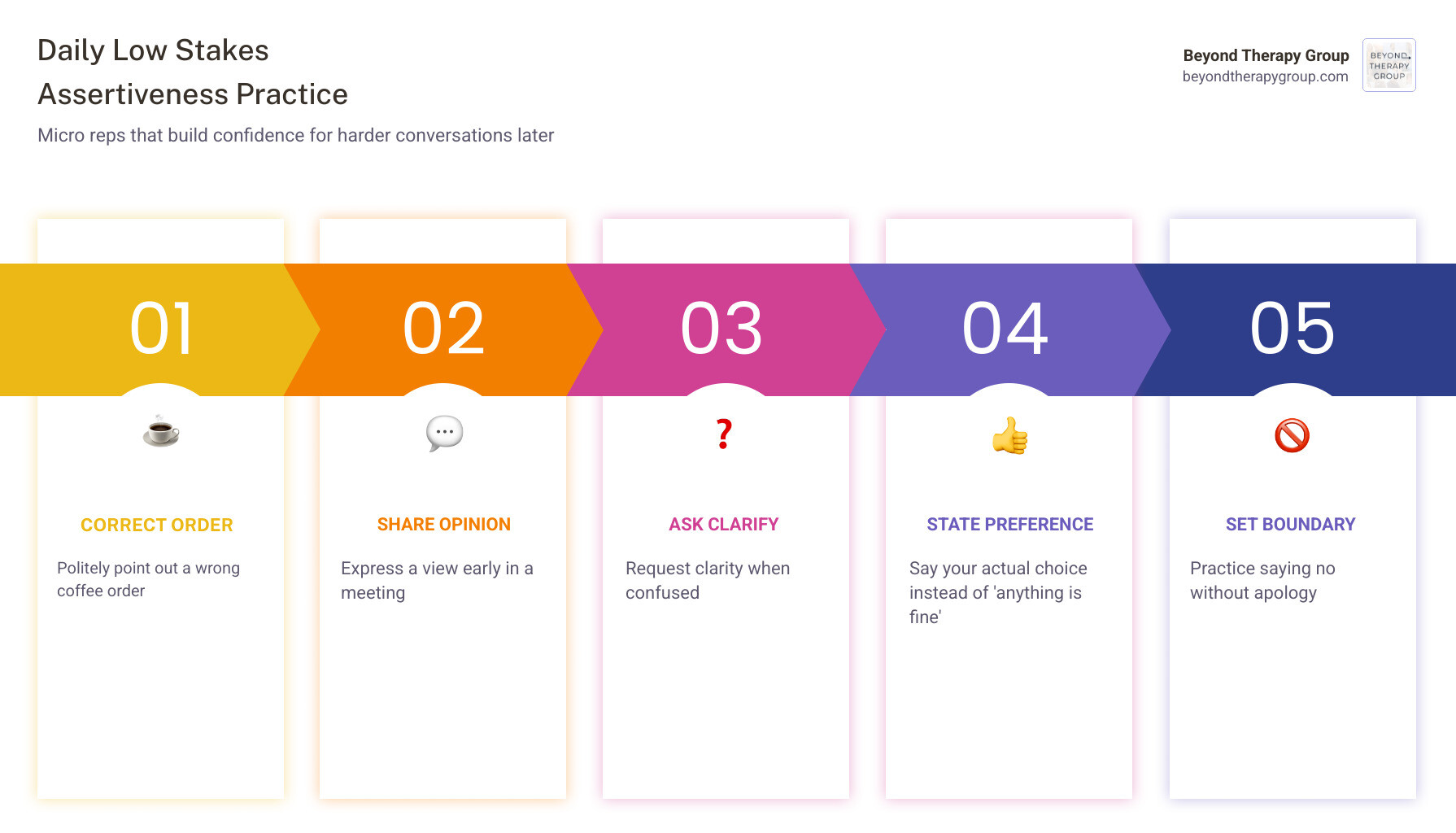
Daily low stakes reps
The fastest way to improve is to practice in situations that are a little uncomfortable, not terrifying.
Examples:
- Correct a wrong coffee order politely
- Share an opinion early in a meeting
- Ask for clarification when confused
- Tell someone your actual preference instead of saying “anything is fine”
These micro reps build confidence for the harder conversations later.
Overcoming Barriers to Assertiveness
If assertiveness were easy, we would all be doing it without pep talks and practice scripts.
Most people struggle for understandable reasons.
Fear of rejection
A common belief is:
- “If I speak up, people will be upset”
- “If I say no, they will stop liking me”
Sometimes people do react badly. But that reaction does not automatically mean we did something wrong. Often it means the other person was benefiting from our lack of boundaries.
People pleasing
People pleasing often looks kind on the outside and exhausting on the inside. We say yes, over explain, smooth things over, and then quietly resent everybody. Assertiveness interrupts that cycle.
A helpful mindset shift:
- Being considerate is healthy
- Abandoning ourselves to keep the peace is not
Cultural norms
Culture influences how directness is viewed. In some families and communities, speaking plainly may be seen as disrespectful, especially toward authority figures. That does not make assertiveness impossible. It simply means the style may need nuance.
Assertiveness can still be respectful, warm, and culturally aware. It is not about copying the loudest person in the room. It is about expressing ourselves clearly without violating our values.
Gender stereotypes
Many people, especially women, are taught contradictory rules:
- Be confident, but not too confident
- Speak up, but do not seem difficult
- Lead, but stay likable
Research in workplace settings shows many people find it harder to speak up in meetings, especially virtual ones, and interruptions can complicate that even more. This is one reason assertiveness training matters. It helps us communicate with steadiness instead of shrinking or overcompensating.
Low confidence and old conditioning
Some of us grew up learning that our needs were inconvenient, conflict was dangerous, or silence was safer. Assertiveness can feel uncomfortable because it is unfamiliar, not because it is wrong.
That is why practice should include mindset work:
- “My needs are valid”
- “I can be respectful and still be clear”
- “Discomfort does not mean danger”
For relationship specific communication, Speak Your Truth and Save Your Relationship is a strong companion resource.
Frequently Asked Questions about Assertive Speaking
What is the main difference between assertive and aggressive communication?
Assertive communication respects both people. Aggressive communication focuses on winning, controlling, or overpowering.
Assertive:
- clear
- calm
- direct
- respectful
Aggressive:
- blaming
- intimidating
- dismissive
- harsh
A simple test is to ask:
- Am I expressing my needs clearly?
- Am I also leaving room for the other person’s dignity and perspective?
If both are true, we are probably being assertive.
How can I practice being assertive in workplace meetings?
Meetings are one of the most useful places for confident assertive speaking practice.
Try this plan:
- Prepare two or three key points in advance
- Speak within the first few minutes if possible
- Use direct phrases like:
- “My view is…”
- “I recommend…”
- “I want to build on that idea…”
- If interrupted, calmly say:
- “I would like to finish this point, then I am happy to hear your perspective”
- Follow up important contributions in writing if needed
For virtual meetings:
- keep camera on when possible
- sit upright
- stay unmuted during active discussion if appropriate
- use chat strategically to reinforce a point
Practice with low stakes meetings first. We do not need to become the loudest person in the room. We need to become clear, timely, and steady.
Can assertiveness training help with anxiety and stress?
Yes. Research and clinical resources consistently show that assertiveness training can reduce stress and improve self esteem. It is also recognized as an important element in addressing anxiety, depression, and some substance related disorders.
Why? Because passivity creates buildup. We swallow feelings, avoid conflict, overcommit, and live with chronic internal tension. Assertive communication reduces that pressure by helping us express needs earlier and more clearly.
It can also improve relationships, reduce conflict, and lower the helpless feeling that comes from not saying what we mean.
Conclusion
Confident assertive speaking practice is not about becoming pushy, polished, or weirdly robotic. It is about learning to express ourselves with honesty, steadiness, and respect.
When we practice assertiveness, we build more than better communication. We build self trust. We become more capable of setting boundaries, resolving conflict, asking for what we need, and showing up more fully in work and relationships.
If you want more support, we invite you to explore The Ultimate Checklist for Healthy Boundaries and learn more about therapy services.
At Beyond Therapy, we offer a free 15 minute consultation to help guide booking and answer questions. If you are in Redondo Beach or the South Bay and want support building healthier communication patterns, reaching out can be a strong first step.
Recent Posts