
March 17, 2026
Finding Your Perfect Match: How to Find a Therapist Online

Why Finding the Right Therapist Can Change Everything
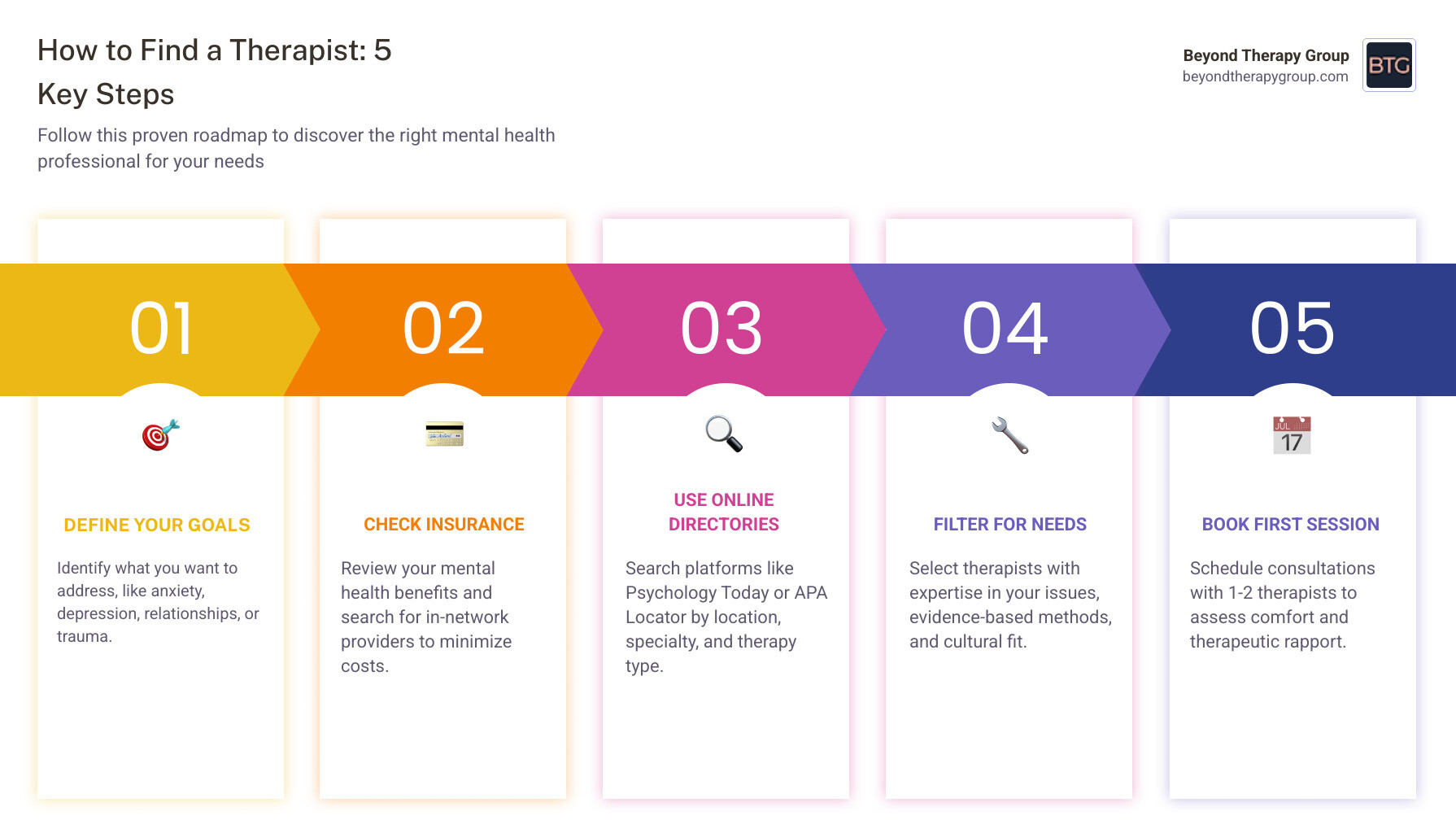
Knowing how to find a therapist is the first step toward getting real support for stress, anxiety, or whatever you’re navigating right now. Here is a quick overview of the process:
- Define your goals – Think about what you want to work on, such as anxiety, stress, or relationship issues.
- Check your insurance – Look up your mental health benefits and search for in-network providers.
- Use an online directory – Search platforms like Psychology Today or the APA Psychologist Locator by location and specialty.
- Filter for your needs – Look for therapists who specialize in your concern and offer the right therapy type.
- Ask the right questions – Verify licensing, experience, and whether they use evidence-based treatments.
- Book a first session – Meet with one or two therapists to see who feels like the right fit.
Finding a good therapist takes effort. In fact, a 2022 Healthline survey found that nearly half of people met with two or more therapists before finding one they felt comfortable with. That is completely normal.
The good news? With the right roadmap, the process is much less overwhelming than it seems.
I’m Rodman Walsh, LMFT, a Licensed Marriage and Family Therapist with experience helping individuals and couples across multiple levels of care, including mental health, trauma recovery, and addiction. My background gives me a clear picture of what to look for when figuring out how to find a therapist who is truly the right match for you.
Understanding Different Types of Mental Health Professionals
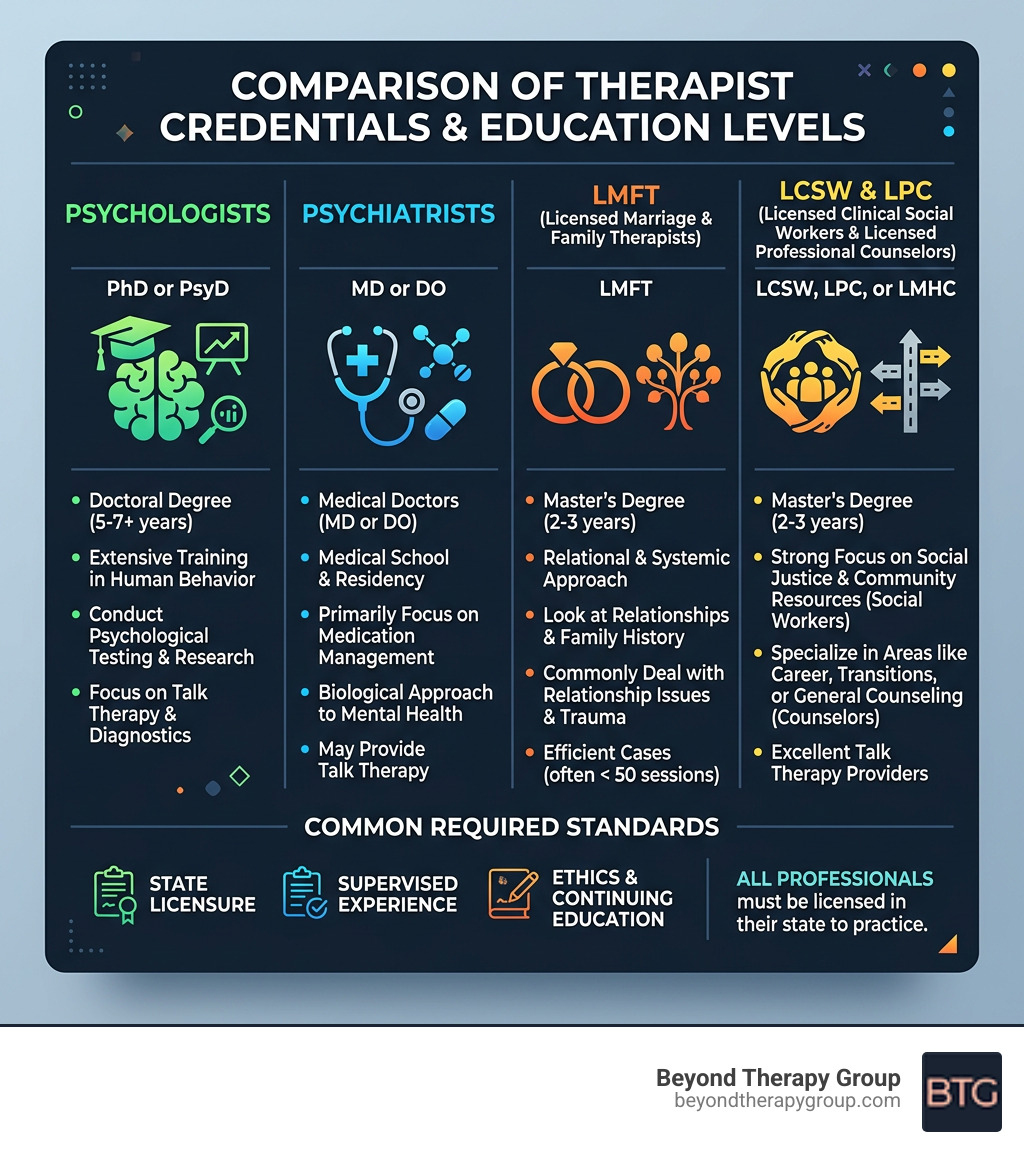
When you start looking into how to find a therapist, you will quickly notice a lot of alphabet soup after people’s names. It can be confusing to know the difference between an LMFT, a PhD, and an MD. Each type of professional has a different focus and level of training.
Psychologists usually have a doctoral degree such as a PhD or a PsyD. They are experts in human behavior and often conduct psychological testing. They use talk therapy to help you change your thoughts and behaviors. If you are looking for someone with deep academic training in research and clinical practice, a psychologist is a great choice. You can find many through the Psychologist Locator provided by the American Psychological Association.
Psychiatrists are medical doctors (MDs or DOs). Their primary role is often managing medication. While some psychiatrists do provide talk therapy, many focus on the biological side of mental health. If you think you might need medication for something like severe depression or bipolar disorder, you might see a psychiatrist in addition to a therapist.
Licensed Marriage and Family Therapists (LMFTs) focus on the big picture. We look at how your relationships and family history affect your current mental health. This is called a relational or systemic approach. We believe that mental health problems are often symptoms of the systems we live in rather than just individual issues. Interestingly, MFTs are known for being efficient. Research shows that over 65 percent of MFT cases are completed within 20 sessions and over 87 percent are finished by 50 sessions.
Clinical Social Workers (LCSWs) and Licensed Professional Counselors (LPCs or LMHCs) also provide excellent talk therapy. Social workers often have a strong focus on social justice and connecting you with community resources. Counselors often specialize in specific areas like career issues or general life transitions.
All of these professionals must be licensed by the state to practice. This ensures they have met strict standards for education and supervised experience.
How to Find a Therapist Who Meets Your Specific Goals
Before you start clicking through directories, it helps to know what you want to achieve. A 2018 study found that when you and your therapist work together toward the same goals, your results are much better. Are you trying to stop panic attacks? Are you struggling with a recent breakup? Or are you dealing with deep-seated trauma?
Different goals require different types of therapy. For example, if you are struggling with therapy for anxiety and depression, you might look for Cognitive Behavioral Therapy (CBT). CBT focuses on identifying and changing negative thought patterns. It is very practical and goal-oriented.
If you have Obsessive Compulsive Disorder (OCD), the gold standard treatment is Exposure and Response Prevention (ERP). This is a specific type of CBT where you gradually face your fears without doing your usual compulsions. It is incredibly effective. However, it can take up to 14 to 17 years from the start of OCD symptoms for a person to get the right diagnosis and effective treatment. Knowing to look for “ERP” specifically can save you years of searching.
Dialectical Behavior Therapy (DBT) is another popular option. It was originally created for borderline personality disorder but is now used for anyone who has trouble regulating their emotions. It teaches skills like mindfulness and distress tolerance.
Identifying Specific Needs and Preferences
Beyond the type of therapy, you should think about who you will feel most comfortable talking to. This is where cultural competence comes in. You might want a therapist who understands your background, identity, or specific community needs.
For many, finding an LGBTQ+ specialized therapist is a priority to ensure they do not have to explain the basics of their identity during a session. Others may prefer a therapist of color or someone who shares their religious background. There are specialized directories for this. For example, you can use Therapy for Black Girls or Therapy for Latinx to find providers who prioritize cultural identity in their care.
The National Asian American Pacific Islander Mental Health Association and Inclusive Therapists are also fantastic resources for finding a professional who truly gets your lived experience.
Navigating Insurance and Affordable Care Options
Cost is one of the biggest hurdles when learning how to find a therapist. The first step is to call your insurance company or log into their portal. You want to ask about your “outpatient mental health benefits.”
Specifically, ask if they have a list of in-network providers. These are therapists who have a contract with your insurance to provide services at a lower rate. You should also ask about your deductible. This is the amount you have to pay out of your own pocket before your insurance starts covering the cost.
Some plans have session limits, meaning they will only pay for a certain number of visits per year. It is also important to check if you need a referral from your primary care doctor first.
If you choose an out-of-network provider, you will likely pay more. However, some therapists provide a “superbill” that you can submit to your insurance for partial reimbursement.
Low-Cost Resources and Community Clinics
If you do not have insurance or your plan does not cover therapy, there are still ways to get help. Many therapists offer what is called a “sliding scale.” This means they adjust their fee based on your income. You should never be afraid to ask, “Do you offer a sliding scale for clients with financial need?”
University counseling centers are another great option. They are often staffed by interns who are finishing their graduate degrees. These interns are closely supervised by experienced licensed professionals and often provide high-quality care for a very low cost.
You can also look for community mental health centers or non-profit organizations. Some groups offer support groups which can be a more affordable way to get help while connecting with others who have similar experiences.
Evaluating Fit and Avoiding Red Flags During Your Search
Finding a therapist is a bit like dating. You might meet someone who has a great resume, but the “vibe” just isn’t there. This is called therapeutic rapport or the therapeutic alliance. It is actually one of the biggest predictors of whether therapy will work for you.
You want someone who makes you feel safe and heard. If you have a history of trauma, seeking trauma-informed therapy benefits you by ensuring the therapist understands how trauma affects the brain and body. They will be careful not to re-traumatize you during your sessions.
You should also decide if you want to meet in person or via teletherapy. Teletherapy has become very popular because it is convenient. You can talk to your therapist from your couch or during your lunch break. For many, this makes it easier to stay consistent with appointments. However, some people prefer the physical presence of a therapist in a dedicated office space to help them focus.
Questions to Ask During Your Search for How to Find a Therapist
Most therapists offer a brief initial phone call or consultation. This is your chance to interview them. Here are some questions you should consider asking:
- Are you a licensed professional in this state?
- What is your experience working with people who have my specific concerns?
- Do you use evidence-based treatments like CBT or ERP?
- How long do you expect treatment to last?
- What is your philosophy on the use of medication?
- How do you handle emergencies outside of session hours?
If you are looking for help with your relationship, you might ask about relational therapy suitability to see if they specialize in working with couples or families.
Be on the lookout for red flags. If a therapist is dismissive of your concerns, talks too much about themselves, or seems to have poor boundaries, they are likely not the right fit. A good therapist should be empathetic but also professional. They should have a clear plan for your treatment and be able to explain it in a way that makes sense to you.
Frequently Asked Questions about Finding a Therapist
How long does therapy typically take?
This is a common question when people are researching how to find a therapist. The answer depends on your goals and the type of therapy you choose. Some issues can be addressed in short-term therapy. For example, many therapists today schedule just six to 12 sessions for specific, focused problems.
As mentioned earlier, Marriage and Family Therapists often practice short-term therapy, with an average of 12 sessions. However, if you are working through deep-seated trauma or complex personality issues, you might be in therapy for a year or longer. Progress isn’t always a straight line, but you should feel like you are gaining tools and insights as you go.
What should I do if my therapist is not a good match?
If you have had a few sessions and you just don’t feel a connection, it is okay to move on. In fact, it is better to find a new therapist than to stop going altogether. You can be honest with the therapist and say, “I don’t feel like this is the right fit for me.” Most professionals will appreciate the honesty and can even provide referrals to someone who might be a better match.
48 percent of people in the Healthline survey had to see at least two therapists. Do not let one bad experience discourage you from getting the help you deserve.
Where can I find immediate help in a crisis?
If you are in a crisis and need help right now, you do not have to wait to find a long-term therapist. You can call or text the 988 Suicide and Crisis Lifeline at any time. They provide free and confidential support 24 hours a day.
There are also crisis text lines and local emergency rooms if you feel you are in immediate danger. Therapy is a journey, but crisis resources are there to keep you safe in the moment.
Conclusion
Finding the right mental health professional is a powerful act of self-care. It might take a bit of research and a few phone calls, but the impact on your life can be profound. Whether you are dealing with a major life change or just want to understand yourself better, there is a therapist out there who can help.
At Beyond Therapy Group, we understand that the search can feel daunting. That is why we offer a free 15-minute consultation with our therapists. This allows you to ask questions, get a feel for our style, and ensure we are the right match before you book a full session. We are committed to providing personalized care that fits your unique needs in Redondo Beach and the South Bay.
If you are ready to take that first step, we invite you to start your journey with our therapy services. You don’t have to navigate this alone.
Recent Posts