August 28, 2026
How to Become Trauma-Informed Certified in 5 Easy-to-Follow Steps

How to Become Trauma-Informed Certified: A Quick Overview
Key Takeaways
- Trauma-informed care certification is available to both clinical professionals and non-clinical workers
- Programs range from free online courses to structured professional credentials
- Most certifications can be completed in as little as 5 hours or up to 16 weeks
- Renewal is required every one to four years depending on the program
- Certification improves career outcomes and helps organizations better support people affected by trauma
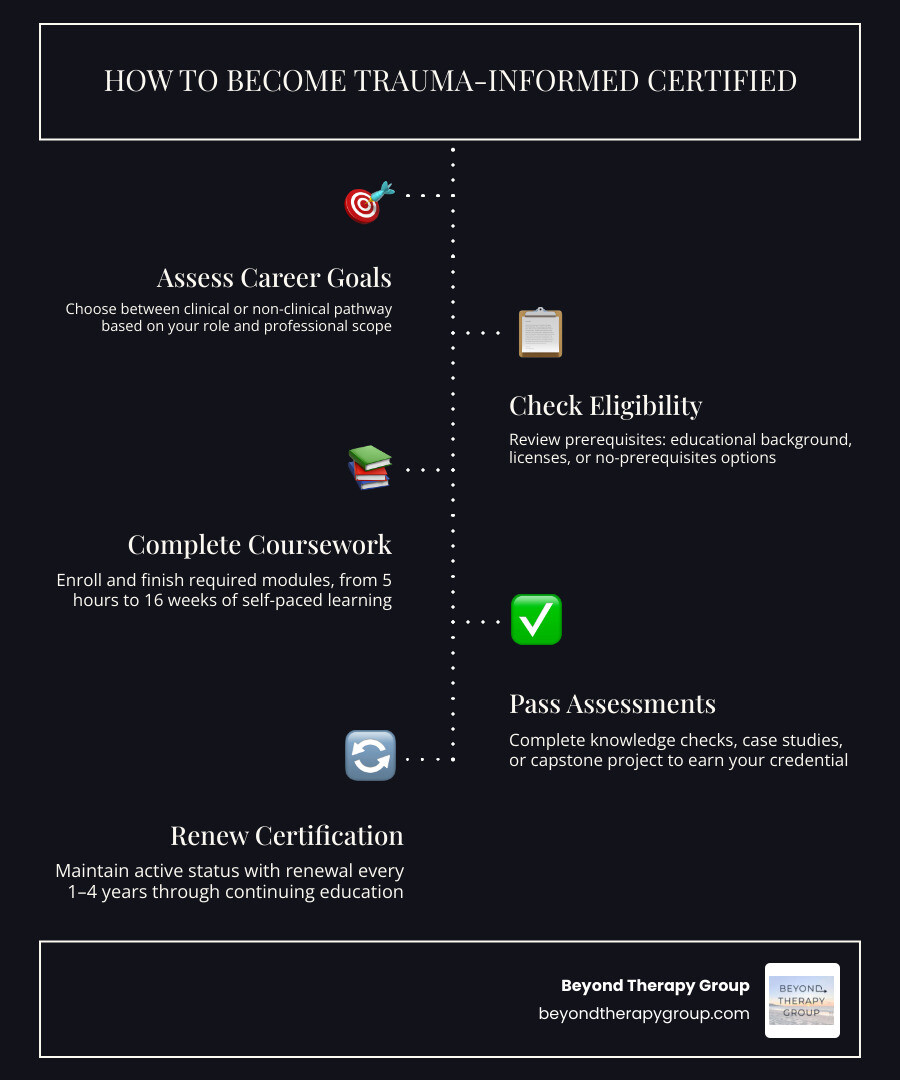
Learning how to become trauma-informed certified comes down to five core steps:
- Assess your career goals and choose between a clinical or non-clinical pathway
- Check eligibility requirements for your chosen program
- Enroll and complete the required coursework (ranging from a few hours to several months)
- Pass the assessments to earn your credential
- Renew your certification on a regular cycle to stay current
Around 70% of adults experience at least one traumatic event in their lifetime, according to the World Health Organization. That is a staggering number. And yet, most workplaces, schools, and healthcare settings still lack the trained professionals needed to respond effectively.
That gap is exactly why trauma-informed care certification matters.
Whether you are a therapist, a nurse, a teacher, or a frontline worker, getting certified gives you a recognized framework for supporting people who have experienced trauma. It also signals to employers and clients that you take this work seriously.
The good news? There are more pathways than ever to get certified, including several free options backed by major universities.
Understanding Trauma-Informed Care and Why Certification Matters
To build a truly supportive environment, we must first understand what this framework actually means. This approach shifts the central question from “What is wrong with you?” to “What happened to you?”
Earning a formal credential in this field is not just about adding letters to your email signature. It is about acquiring the practical skills to make a real difference in your community. Let us explore the foundational principles and see who can benefit most from this training.

What is Trauma-Informed Care?
Trauma-informed care is an organizational and clinical framework designed to recognize and respond to the pervasive impact of trauma. The Substance Abuse and Mental Health Services Administration outlines this approach through the four Rs.
First, we realize the widespread impact of trauma and understand potential paths for recovery. Second, we recognize the signs and symptoms of trauma in clients, families, and staff. Third, we respond by fully integrating this knowledge into policies, procedures, and daily practices. Finally, we actively resist retraumatization.
This framework is also built on three Es, which are the events, the experience of those events, and the long-lasting effects. By focusing on these elements, we can establish physical safety and emotional safety for everyone involved.
Rather than using rigid scripts that ignore a person’s readiness or consent, this approach prioritizes safety, trustworthiness, peer support, collaboration, and empowerment. To learn more about how this framework operates in practice, you can read our detailed guide on Certification In Trauma Informed Care | The WMHI .
Who Should Learn How to Become Trauma-Informed Certified?
This training is not reserved solely for licensed mental health professionals. While therapists, psychologists, and social workers certainly benefit from advanced credentials, the framework is highly applicable across many other fields.
Educators and school staff can use these principles to understand student behavior as a form of communication rather than simple non-compliance. Healthcare professionals, including registered nurses and physicians, can improve patient cooperation and clinical outcomes by creating a more predictable, safe environment.
In corporate settings, human resource managers and team leaders can implement these practices to support diverse staff. This can lead to a healthier workplace culture, with studies showing that trauma-informed care can decrease workplace absenteeism by up to 33%.
Frontline workers, such as emergency responders, shelter staff, and community advocates, also find these tools invaluable for de-escalating tense situations. If you are curious about how these practices are utilized locally in the South Bay area, you can explore our article on Understanding the Benefits of a Trauma-Informed Therapist in Redondo Beach.
Comparing the Top Trauma-Informed Certification Programs
With so many options available, it helps to compare the top programs to find the one that fits your professional goals. Below is a conceptual comparison of the leading certification pathways.
| Program Name | Target Audience | Key Features | Format |
|---|---|---|---|
| Evergreen Certifications (CTP) | Licensed clinicians, educators, nurses, clergy | Multi-disciplinary, clinical focus, pre-approved third-party courses | Online, self-paced |
| AIHCP (TIC-CSp) | Registered nurses, counselors, social workers, LMFTs | Focuses on clinical intervention, compassion fatigue, and advocacy | Online, self-paced |
| Workplace Mental Health Institute | HR professionals, managers, corporate teams | Workplace application, mental health support focus | Online, interactive |
| Trauma Recovery Certification (TRCP) | Frontline workers, coaches, chaplains, mentors | Non-clinical, readiness-first, disaster spiritual care guidelines | Online or in-person intensive |
| University Continuing Ed (MSU / UNT / IU) | Public, undergraduates, social service professionals | Academic backing, non-degree certificates, free options available | Virtual, hybrid, or self-paced |
Clinical and Professional Certification Pathways
For licensed professionals looking to deepen their clinical skills, highly structured credentials are the gold standard.
One prominent option is the Certified Trauma Professional credential offered by Evergreen Certifications. This program is designed for registered or credentialed professionals who hold at least a bachelor degree. It provides foundational knowledge related to the assessment and treatment process of trauma. To explore this option further, you can visit CTP: Certified Trauma Professional (EU) .
Another excellent clinical pathway is the Certified Trauma-Informed Care Specialist program through the American Institute of Health Care Professionals. This program requires applicants to complete core continuing education courses that cover both the principles of care and the management of compassion fatigue.
This dual focus helps protect the mental health of the professional while they advocate for vulnerable populations. For more details on this specific credential, check out Trauma Informed Care Specialist Certification | AIHCP .
Non-Clinical and Academic Certification Pathways
If you do not have a clinical license, there are still excellent pathways to gain a respected credential.
The Trauma Recovery Certification Program is a non-clinical, practitioner-ready training program. It is designed specifically for frontline workers, coaches, and leaders who support people through crisis and recovery. This program emphasizes ethical boundaries and scope of practice, ensuring that helpers do not overstep into clinical therapy. You can find more information about this pathway at Trauma Recovery Certification Program Overview .
Academic institutions also offer accessible continuing education certificates. For instance, Michigan State University provides a certificate program that is open to the general public globally, requiring no formal university application.
Similarly, Indiana University offers a professional development certificate program developed in partnership with its schools of public health and social work. This program includes specialized modules for working with youth, veterans, and individuals within the justice system.
Additionally, the University of North Texas provides an online undergraduate certificate that explores how systemic trauma intersects with family violence and substance use.
How to Become Trauma-Informed Certified in 5 Steps
Now that we have covered the landscape of available programs, let us break down the exact process to earn your credential. Following these five steps will help you navigate the journey smoothly.

Step 1: Assess Your Career Goals and Choose Your Pathway
Before enrolling in any course, you must clarify what you hope to achieve. Ask yourself whether your daily work requires clinical intervention or non-clinical support.
If you are a licensed therapist in Redondo Beach looking to offer advanced somatic or bilateral stimulation therapies, a clinical certification is appropriate. If you are an educator, an HR specialist, or a community volunteer, a non-clinical professional development certificate is the better fit.
Choosing the right pathway ensures that you do not spend time and resources on clinical training that falls outside your legal scope of practice.
Step 2: Review Prerequisites and Eligibility Requirements
Every certification program has its own set of entry requirements.
For clinical credentials like the Certified Trauma Professional, you must hold at least a bachelor degree and maintain an active license in a field such as counseling, social work, marriage and family therapy, or nursing. You will need to submit proof of your professional registration during the application process.
For non-clinical and academic certificates, the requirements are much more flexible. Programs like the Indiana University certificate or the Michigan State University continuing education pathway have no educational prerequisites. Anyone with a valid email address and a desire to learn can enroll.
Be sure to review these details carefully so you do not encounter unexpected barriers after starting your coursework.
Step 3: Enroll and Complete the Required Coursework
Once you select your program, it is time to complete the educational modules.
The time commitment varies significantly depending on the depth of the program. Some foundational programs require around five hours of study, while more comprehensive university certificates require up to 32 continuing education hours or several academic credit hours spread over one to two semesters.
Many programs are offered in a virtual, self-paced format, allowing you to study around your existing work schedule. During your studies, you will cover essential topics such as brain development, nervous system regulation, and the prevention of secondary traumatic stress.
Step 4: Pass the Assessments and Earn Your Credential
To prove your mastery of the material, you must pass the required assessments.
Most programs include knowledge checks or unit tests at the end of each module. These tests typically require a passing score of 80% or higher. Some advanced programs, such as the Trauma Recovery Certification Program, also require a capstone project or case study submissions.
These projects allow you to demonstrate how you would apply the framework to real-world scenarios while maintaining ethical boundaries. Once you pass these assessments, you will receive your official certificate of completion and a digital badge to share with your professional network.
Step 5: Maintain and Renew Your Certification
A professional certification is not a lifetime achievement. To keep your credential active, you must commit to ongoing education.
Most certification bodies require renewal every one to four years. For example, the Certified Trauma Professional credential through Evergreen Certifications offers renewal options for one, two, or three years, requiring a corresponding number of continuing education hours.
Other programs require a set number of documented practice hours alongside renewal fees. Keeping your certification active ensures that you remain up to date on the latest research and best practices in the field.
Frequently Asked Questions
As you consider your options, you might have a few practical questions about the certification process. Here are some of the most common questions we hear from professionals in the South Bay area.
How long does it take to complete a trauma-informed care certification?
The time commitment depends entirely on the program you choose.
- Short-format courses: Basic introductory certificates can be completed in approximately five hours of online study.
- Mid-range professional programs: Standard professional certifications typically require 20 to 40 hours of coursework, which can easily be completed over a few weeks of flexible pacing.
- Academic certificates: University-backed programs generally take one to two semesters to complete, as they require multiple credit hours or extensive continuing education modules.
Most online programs offer generous completion windows, often giving you up to 90 days or even several years to finish the work at your own pace.
How much does trauma-informed care certification cost?
The financial investment varies based on the level of certification and the institution offering it.
Academic courses and comprehensive clinical credentials generally require tuition fees, textbook purchases, and initial application fees. There are also ongoing renewal fees to maintain your active status.
On the other end of the spectrum, there are completely free professional development certificates offered by state agencies and major public universities. These free programs are excellent options for frontline workers and educators who want high-quality training without a financial burden.
What is the difference between trauma-informed care and trauma treatment?
This is a crucial distinction to understand.
Trauma-informed care is an overall framework and organizational philosophy. It is designed to create a safe, supportive environment and avoid retraumatization. Anyone can practice this care, including teachers, managers, and administrative staff.
Trauma treatment, however, is a clinical intervention. It is designed to actively process and resolve traumatic memories. This treatment must only be conducted by licensed, trained mental health professionals who specialize in evidence-based modalities.
To explore this topic in greater detail, you can read our article on Trauma-Informed Care Versus Trauma Treatment.
Conclusion
Becoming certified in this essential framework is a powerful way to advance your career and better serve those around you. By understanding the impact of difficult life events, you can help build communities that prioritize safety, trust, and healing.
Your Next Steps on How to Become Trauma-Informed Certified
If you are a professional in Redondo Beach or the wider South Bay area, we are here to support your journey. Whether you want to understand how these principles apply to clinical therapy or you are seeking professional guidance for your own growth, connecting with experienced specialists is a great next step.
For those interested in advanced clinical recovery methods, you can read The Ultimate Guide to EMDR Therapy in Redondo Beach.
At Beyond Therapy, we provide tailored consultations to help you navigate your mental health and professional development goals. We invite you to reach out to us today to schedule a free 15-minute consultation with one of our expert therapists.
To learn more about our services and how we integrate these principles into our practice, visit our page on Trauma-Informed Therapy.
Recent Posts