
March 27, 2026
Mastering the Art of Speaking Up for Yourself

Defining Self Advocacy and Its Core Components
Key Takeaways
- Self-advocacy is the ability to communicate your needs, rights, and goals effectively.
- It requires a combination of self-awareness, knowledge of rights, and clear communication.
- Legal protections like the ADA and IDEA support individuals in education and the workplace.
- Practicing small steps in daily life builds the confidence needed for larger advocacy efforts.
- You are the expert on your own life, and speaking up is a tool for personal empowerment.
- Self advocacy means speaking up for your own needs, rights, and goals
- It is a learnable skill that grows with practice
- It applies in healthcare school work and daily life
- Knowing your rights and communicating clearly are the two biggest factors
- Anyone can become a stronger self-advocate starting with small steps
Self advocacy is the ability to communicate your needs, speak up for your rights, and make decisions that shape your own life. At its core, it means you are the one driving the conversation about what you need and why it matters.
It sounds simple. But for many people, especially those managing stress, chronic illness, a disability, or a demanding career, speaking up can feel uncomfortable or even risky.
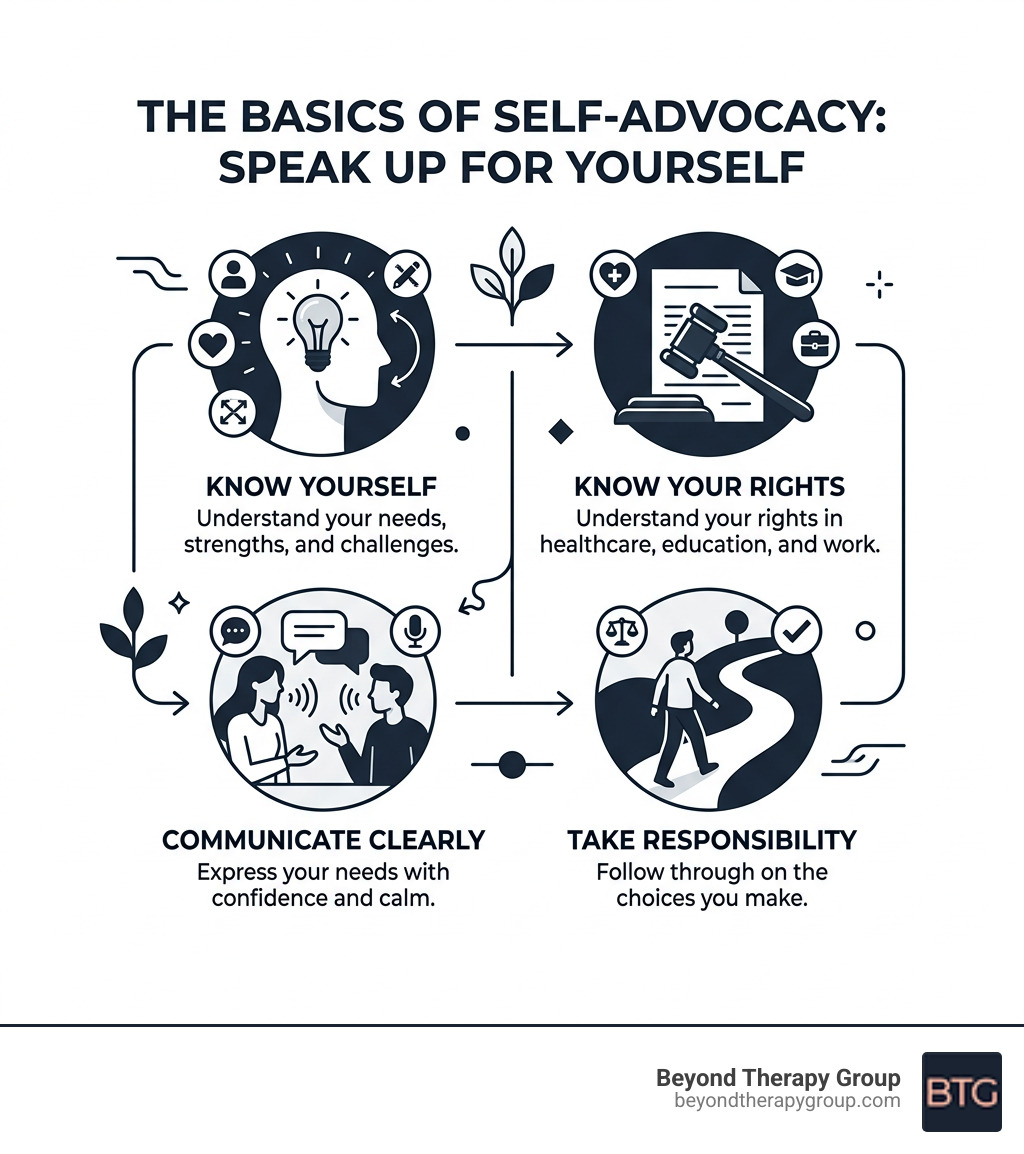
Here is a quick breakdown of what self advocacy actually involves:
- Know yourself – understand your needs, strengths, and challenges
- Know your rights – in healthcare, education, and the workplace
- Communicate clearly – express your needs with confidence and calm
- Take responsibility – follow through on the choices you make
These four steps apply whether you are asking your doctor to explain a diagnosis, requesting an accommodation at work, or simply setting a boundary with a colleague.
The stakes are real. Research shows that people with learning disabilities drop out of high school at nearly three times the rate of all students, and a large share of college students who qualify for accommodations never receive them, often because no one taught them how to ask. Self advocacy is not just a personal skill. It is a tool for changing outcomes.
I am Rodman Walsh, a Licensed Marriage and Family Therapist based in Redondo Beach, CA, with experience supporting individuals through mental health challenges, trauma recovery, and the kind of daily stress that makes self advocacy harder than it should be. In my work with individuals, I have seen how learning to speak up for yourself can be one of the most transformative steps toward lasting well-being.
When we talk about Self Advocacy, we are talking about the ultimate form of self-determination. It is the process of representing your own interests and speaking up for yourself to ensure your needs are met. This is not just about being loud or demanding. It is about being an expert on the most important subject in your life: you.
At Beyond Therapy Group, we often see how a lack of Self Advocacy can lead to burnout and resentment. When you do not speak up, you are essentially letting others make a map for a journey only you are taking. By embracing Empowering Wellness: Discovering Your Path, you begin to see that your voice is your most powerful tool for health.
Effective Self Advocacy requires a blend of several internal skills:
- Self-awareness: Knowing your personal values and what is actually important to you.
- Confidence: Believing that your needs are valid and worth mentioning.
- Responsibility: Accepting that while you have the right to ask for help, you also have the responsibility to follow through on the plans you help create.

The Three Pillars of Self-Advocacy
To make the concept of Self Advocacy easier to digest, we like to break it down into three specific pillars. Think of these as the legs of a tripod. If one is missing, the whole thing might topple over.
- Understanding Your Needs: You cannot ask for what you do not know you need. This starts with recognizing your challenges. For example, if you have a learning disability, you might realize that you struggle to take notes while a teacher is speaking. Recognizing that “I cannot do two things at once” is the first step.
- Knowing Your Support Options: Once you know the problem, you need to know the possible solutions. In the note-taking example, a solution might be using a recording device or asking for pre-printed notes.
- Communicating Effectively: This is the “speaking up” part. It involves clearly and calmly explaining the challenge and the requested support to the person who can help make it happen.
Rights and Responsibilities
A major part of being a strong advocate for yourself is understanding the “rules of the game.” This means having a solid grasp of your legal rights and the context of your situation.
In the South Bay area, whether you are navigating the halls of a local college or a corporate office in Redondo Beach, you have specific protections. However, rights always come with responsibilities. For instance, you have the right to “reasonable accommodations” at work under the ADA, but you have the responsibility to disclose your disability and request those accommodations. You do not have to share every private detail of your medical history, but you do need to explain how your condition affects your ability to perform your job.
The Evolution of the Movement and Its History
The Self Advocacy movement did not start in a vacuum. It was born out of a desperate need for civil rights and human dignity. For a long time, organizations meant to help people with disabilities were run almost entirely by parents and professionals, not the individuals themselves.
The roots of the movement can be traced back to Sweden in the late 1960s. Dr. Bengt Nirje, a pioneer in the field, helped start clubs where people with intellectual disabilities could meet, socialize, and eventually, speak up for themselves. Nirje is famous for the concept of the “dignity of risk.” He argued that everyone has the right to make mistakes and take risks, as this is an essential part of being human.
In the United States, the movement gained steam in the 1970s. A pivotal moment occurred at a 1974 conference in Oregon when a man stood up and declared, “I want to be known as a person first!” This led to the formation of “People First” groups, which emphasized that a disability is just one part of a person, not their entire identity.
From Institutions to Independence
One of the darkest chapters in the history of disability in America involves the institutionalization of thousands of people. Facilities like Willowbrook in New York and Pennhurst in Pennsylvania were often overcrowded and abusive. Senator Robert Kennedy once famously described such places as “snake pits.”
The The Self Advocacy Movement was instrumental in the fight for deinstitutionalization. Leaders like Roland Johnson, a former resident of Pennhurst, fought tirelessly to shut these institutions down and promote community living. They argued that people with disabilities deserve to live in their own homes, work in their communities, and have control over their daily lives. This shift from “being cared for” to “living independently” is the very heart of Self Advocacy.
The Rise of Neurodiversity
More recently, the movement has evolved to include the concept of neurodiversity. This perspective, championed by groups like Autism Network International, suggests that conditions like autism or ADHD are not “deficits” to be cured, but rather natural variations in the human brain.
This shift has brought about a debate between person-first language (“person with autism”) and identity-first language (“autistic person”). Many in the neurodiversity movement prefer identity-first language because they see their neurodivergence as an inseparable part of who they are. The internet has played a massive role here, allowing neurodivergent individuals to connect across the globe, share strategies, and organize for change without the barriers of traditional face-to-face communication.
Navigating Rights and Legal Protections
Knowing the law is like having a shield. It protects you when things get difficult. There are several key federal laws that every self-advocate should know:
- IDEA (Individuals with Disabilities Education Act): This ensures that children with disabilities receive a free and appropriate public education. It requires schools to provide “transition services” to help students move from high school to adulthood.
- Section 504 of the Rehabilitation Act: This protects individuals from discrimination based on disability in any program receiving federal financial assistance (like public schools and most colleges).
- ADA (Americans with Disabilities Act): This is a broad civil rights law that prohibits discrimination in all areas of public life, including jobs, schools, and transportation.
- RISE Act (Respond, Innovate, Succeed, and Empower Act): This newer legislation aims to make it easier for students to transition to college by requiring institutions to accept existing documentation (like an IEP or 504 plan) as proof of disability.
Education and the Transition to Adulthood
The transition from high school to college or the workforce is a major hurdle. In K-12, the school is responsible for identifying students who need help. But once you turn 18 or graduate, the burden of Self Advocacy shifts entirely to you.
Statistics show that while nearly 15% of all students are served under IDEA, only about one-third of college students with learning disabilities actually receive accommodations. Many feel intimidated or simply do not know the process. Participating in IEP meetings while still in high school is great practice. It allows students to learn how to speak up in a structured environment before they have to do it on their own in a large university setting. For younger children, a Child-friendly rights guide can be a great way to start the conversation about personal agency.
Workplace Protections and Disclosure
In the workplace, Self Advocacy often centers on the concept of “reasonable accommodations.” These are changes to the work environment or the way things are usually done that allow an individual with a disability to perform the “essential functions” of their job.
Common workplace accommodations include:
- Noise-canceling headphones for those with sensory processing issues.
- Speech-to-text software.
- Written rather than verbal instructions.
- Flexible scheduling for medical appointments.
When it comes to disclosure, you do not have to tell your boss everything. Focus on the impact on your performance and the solution you need. For those managing recovery, understanding that Addiction: More Than Willpower is crucial for framing your needs as a health-related accommodation rather than a character flaw.
Practical Strategies for Success
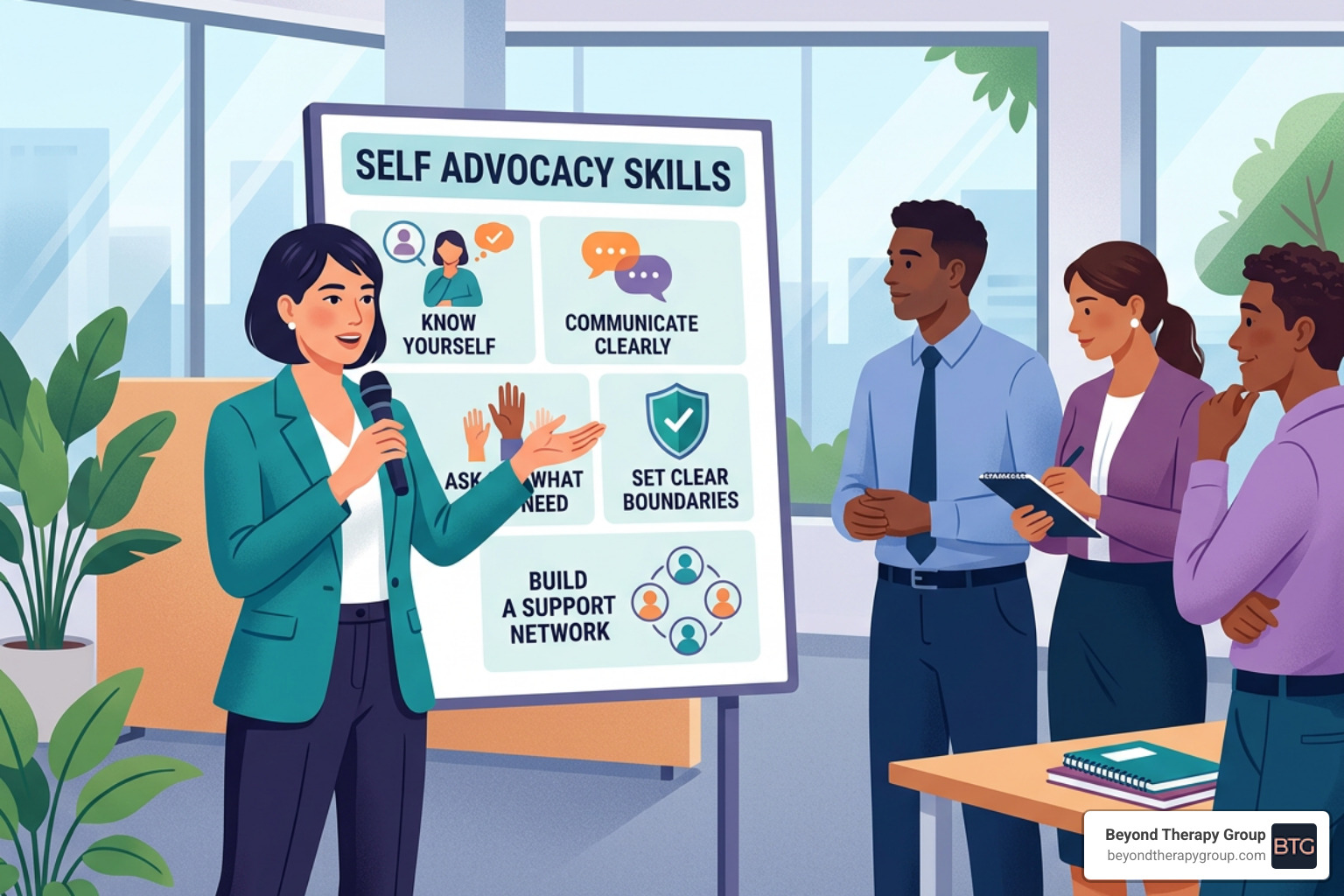
So, how do you actually do it? Self Advocacy is a skill, and like any skill, it requires practice. We often recommend starting small. Maybe you ask a waiter to put the dressing on the side, or you tell a friend you need to reschedule a dinner because you are feeling overwhelmed.
Mastering Self Advocacy in Healthcare and Employment
Healthcare is one of the most important arenas for Self Advocacy. No one knows your body better than you do. If you are living with a chronic illness like lupus, you must be able to provide your doctor with detailed information about your symptoms and how you are feeling.
- Prepare for Appointments: Write down your questions and symptoms beforehand.
- Be Specific: Instead of saying “I feel bad,” say “I have sharp pain in my joints every morning for about two hours.”
- Ask for Clarification: If a doctor uses a term you do not understand, ask them to explain it in simple language.
In employment, the Accommodation and Compliance Series from the Job Accommodation Network is an incredible resource. It provides sample situations and solutions for almost every type of disability. When requesting an accommodation, be professional, be on time for the meeting, and always follow up with a thank-you email that summarizes what was agreed upon.
Communication Techniques for Every Context
Strong communication is the “how” of Self Advocacy. Here are some techniques we teach at Beyond Therapy Group:
- Active Listening: Make sure you truly understand what the other person is saying before you respond.
- Assertiveness: Use “I” statements. Instead of “You never give me enough time,” try “I need at least two days’ notice for new assignments to ensure they are completed accurately.”
- Role-Playing: Practice difficult conversations with a friend or a therapist. This helps reduce anxiety and allows you to “find your words” before the actual event.
- Record Keeping: Keep a log of all your interactions. This includes dates, who you spoke with, and what was discussed. This is vital if you ever need to escalate a request.
Overcoming Challenges and Finding Support
Even the best self-advocates face barriers. Intimidation is a big one. It can be scary to speak up to a doctor, a boss, or a professor. Sometimes, executive functioning challenges make it hard to organize your thoughts or follow through on a plan.
There is also the issue of “tokenism,” where organizations include people with disabilities just for show but do not actually listen to their input. Economic barriers can also play a role, as some people may not have the resources to attend conferences or access specialized training.
Building a Support Network
You do not have to do this alone. In fact, some of the most successful advocacy happens in groups. Peer support is incredibly powerful. Connecting with others who have similar experiences can provide you with new strategies and the emotional boost you need to keep going.
Organizations like The Arc and the Learning Disabilities Association (LDA) have local chapters that offer workshops, resources, and community. The National Council of Self-Advocates is another great group that is run by and for people with disabilities. In the South Bay and Redondo Beach area, looking for local disability resource centers can provide a more localized layer of support.
Professional Guidance and Resources
Sometimes, you might need a bit more help than a peer group can provide. This is where professional resources come in:
- Vocational Rehabilitation: State agencies can help with job training and finding employment.
- Protection and Advocacy Agencies: Every state has a federally mandated system to protect the rights of people with disabilities.
- Disability Offices: If you are a student, the disability services office on your campus is your primary point of contact for accommodations.
- Formal Advocates: In some cases, you might hire a professional advocate to go with you to meetings or help you navigate complex systems.
Frequently Asked Questions about Self-Advocacy
What is the difference between an advocate and a self-advocate?
An advocate is someone who speaks up on behalf of someone else (like a parent speaking for a child). A self-advocate is someone who speaks up for themselves. While both are important, the goal of the Self Advocacy movement is to empower individuals to represent their own interests whenever possible.
Can children learn to advocate for themselves?
Absolutely! In fact, it is better to start young. You can help a child practice by letting them order their own food at a restaurant or choose between two different activities. As they get older, you can involve them in their IEP meetings and help them plan how to ask their teacher for help with homework.
How do I disclose a disability to an employer without oversharing?
You are not legally required to disclose a specific diagnosis. You only need to disclose that you have a medical condition that requires an accommodation. Focus the conversation on your ability to do the job. For example: “I have a condition that makes it difficult for me to process large amounts of verbal information quickly. I would like to request that all project instructions be provided in writing so I can ensure I meet every requirement.”
Conclusion
Mastering the art of Self Advocacy is a lifelong journey. It is about more than just getting what you need in the moment; it is about building a sense of personal growth and independence. When you speak up for yourself, you are not just changing your own life—you are helping to change society’s perception of what people with disabilities and chronic illnesses can achieve.
At Beyond Therapy Group, we believe that everyone deserves to be heard. Whether you are navigating a new diagnosis, struggling with workplace stress, or trying to find your voice in your personal relationships, we are here to support you. We offer a warm, supportive environment right here in Redondo Beach and the South Bay area.
If you are ready to take the next step in your journey toward empowerment, we invite you to Book a free 15-minute consultation with one of our therapists. We can help you answer questions about the process and guide you toward the support that fits your life. The best person to advocate for you is you, but you don’t have to start that journey alone.
Recent Posts
- « Previous
- 1
- 2
- 3
- 4