
March 24, 2026
Talk the Talk: Essential Traits of Great Communicators

Key Takeaways
- To be an effective communicator it is important to be an active listener, self-aware, and empathetic.
- Nonverbal signals like body language and tone often carry more weight than your actual words.
- Clarity and conciseness help prevent misunderstandings in both personal and professional life.
- Adapting your style to your audience helps your message land the way you intend.
- Emotional intelligence is the foundation of meaningful connection.
What It Really Means to Be an Effective Communicator
To be an effective communicator it is important to be more than just a good talker. It means listening well, reading the room, and making sure the other person actually understands what you meant to say.
Most of us assume we communicate well. But research tells a different story. Nonverbal cues alone can have between 65 and 93 percent more impact than the spoken word. And nearly 80% of employers say strong communication skills are a top priority when hiring.
The good news? Communication is a skill. That means it can be learned, practiced, and improved.
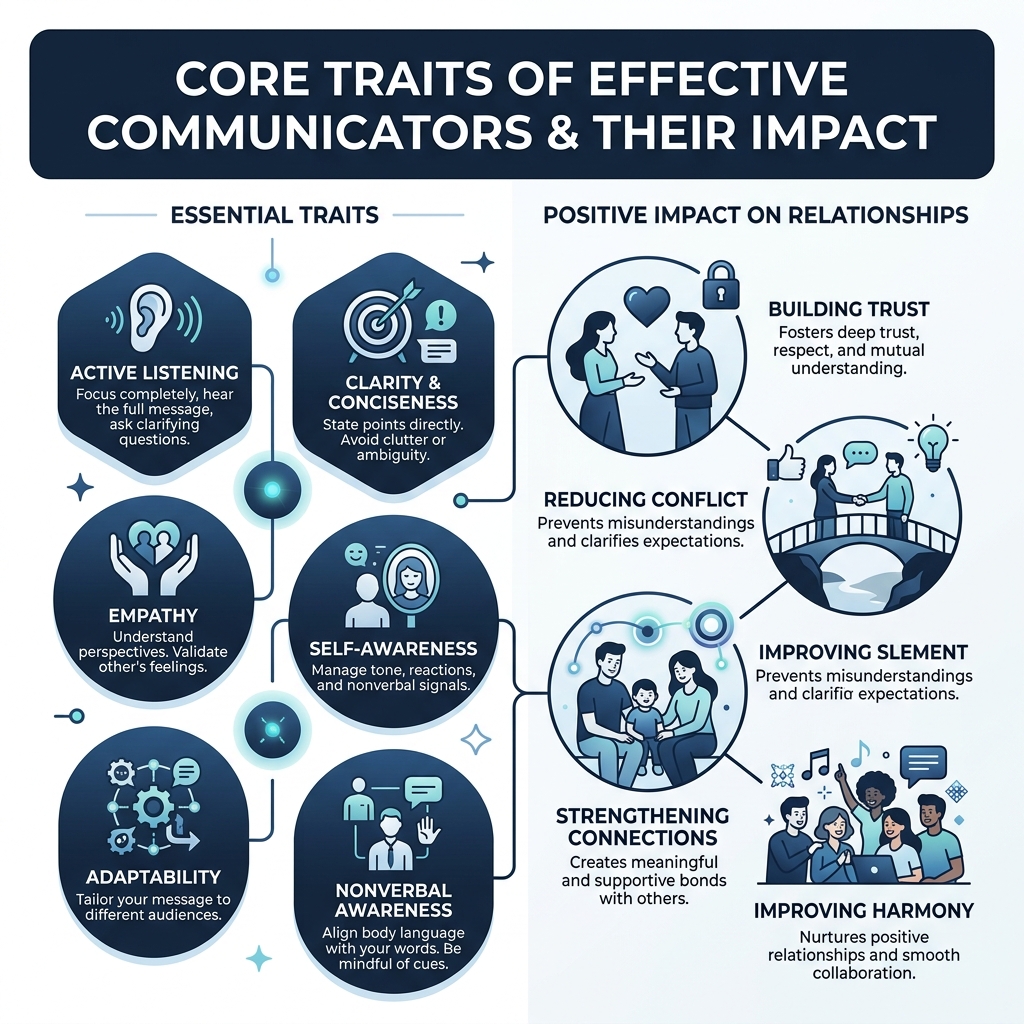
Here is a quick overview of the essential traits every effective communicator shares:
| Trait | Why It Matters |
|---|---|
| Active listening | Ensures you hear the full message, not just part of it |
| Clarity and conciseness | Reduces confusion and saves everyone time |
| Empathy | Helps others feel heard and understood |
| Self-awareness | Lets you manage your tone and reactions |
| Adaptability | Ensures your message fits your audience |
| Nonverbal awareness | Aligns your body language with your words |
I’m Rodman Walsh, a Licensed Marriage and Family Therapist based in Redondo Beach, CA, and in my work with individuals and couples I’ve seen how learning to be an effective communicator it is important to be intentional about both what you say and how you say it. Whether you’re navigating stress at work or tension at home, stronger communication skills can change everything.
The Core Principles of Meaningful Connection
When we look at the foundation of great communication, we often talk about the “5 Cs.” These are the pillars that ensure your message is not just heard, but fully digested. To be an effective communicator it is important to be clear, correct, complete, concise, and compassionate. If you leave one of these out, the bridge between you and the other person might start to wobble.
Clarity is about removing the fog. If you are asking for something, be direct. Conciseness is about respecting the other person’s time. In an era where attention spans are shrinking, getting to the point is a form of kindness. Research from the American Psychological Association suggests that our ability to focus is under siege, so the “fluff” in your emails or conversations might actually be a barrier to being understood.
However, the words you choose are only a small slice of the pie. Scientific research on nonverbal impact reveals that cues like your posture, eye contact, and hand gestures can have between 65 and 93 percent more impact than the spoken word. If you say “I’m fine” while crossing your arms and looking at the floor, nobody believes the words. They believe the body.
In our work here in the South Bay, we often discuss relational therapy benefits because they focus on these exact principles. Learning how to connect isn’t just about professional success. It is about the health of your closest bonds.
Why to be an effective communicator it is important to be self-aware
You cannot steer a ship if you do not know which way the wind is blowing. Self-awareness is the internal compass of communication. It involves emotional intelligence (EQ), which is the ability to recognize your own emotions and those of others. When you are self-aware, you can practice self-regulation. This means instead of snapping back during a heated argument, you take a breath and choose a response that de-escalates the situation.
Improving Emotional Intelligence is a lifelong journey, but it starts with noticing how you feel in the moment. Are you feeling defensive? Are you tired? These internal states leak into your external communication.
Furthermore, understanding attachment styles can explain why you communicate the way you do. Some people withdraw when things get tough, while others become more anxious and talkative. Knowing your “default setting” allows you to adjust it so you can show up more effectively for your partner or colleagues.
To be an effective communicator it is important to be an active listener
Most people do not listen with the intent to understand. They listen with the intent to reply. Active listening is a game-changer. It is the process of being fully present and engaged with the speaker. It involves more than just silence. It requires feedback.
To practice this, try paraphrasing. After someone finishes a thought, say, “So, what I’m hearing is that you’re feeling overwhelmed because of the new project deadline. Is that right?” This does two things. It ensures you actually understood them, and it makes the other person feel deeply validated.
According to effective listening steps, you should also avoid interrupting or imposing your own solutions immediately. Sometimes, people just need to be heard, not “fixed.”
Mastering Nonverbal Cues and Audience Adaptation

Your body is always talking, even when your mouth is shut. To master nonverbal communication, start with the basics:
- Eye Contact: It signals interest and honesty.
- Tone of Voice: A harsh tone can turn a simple request into a perceived attack.
- Facial Expressions: A simple nod or a smile can open doors that words cannot.
- Posture: Standing tall conveys confidence, while leaning in shows engagement.
In our relationships, these cues are vital for setting healthy boundaries. If your body language is inconsistent with your boundaries, people may struggle to respect them. For example, if you say “no” to an extra task at work but do so with a submissive posture and a hesitant voice, the boundary feels weak.
Why to be an effective communicator it is important to be adaptable
One size does not fit all in communication. A strategy that works with your best friend might fail miserably with your CEO. To be an effective communicator it is important to be adaptable to your audience’s needs, the timing of the message, and the pacing of the delivery.
If you are asking for a raise, you wouldn’t do it while your boss is rushing to a high-stakes meeting. You wait for a “receptive mood.” Similarly, you should adjust your language. Avoid jargon when talking to someone outside your field, and be more formal when the situation demands it.
| Context | Communication Style | Key Focus |
|---|---|---|
| Formal (Work/Interviews) | Professional, structured, polite | Clarity, results, respect |
| Informal (Friends/Family) | Relaxed, emotional, slang-friendly | Connection, shared history, humor |
| Conflict Resolution | Calm, neutral, assertive | De-escalation, “I” statements, listening |
Practical Steps to Improve Your Communication Skills
Improving your skills takes deliberate practice. You wouldn’t expect to run a marathon without training, and communication is no different. Here are some exercises we recommend:
- Record Yourself: It sounds cringeworthy, but recording a mock presentation or even a difficult conversation can show you habits you didn’t know you had (like saying “um” too much or fidgeting).
- Seek Feedback: Ask a trusted friend, “How do I come across when we disagree?” Their answer might surprise you.
- The 24-Hour Rule: If you are angry, wait 24 hours before sending that email or text. This allows your emotional brain to cool down and your logical brain to take over.
To be an effective communicator it is important to be clear and concise
Eliminating “fluff” is an art form. We often use filler words because we are afraid of silence, but silence can actually be a powerful tool for emphasis. When you are direct, you reduce the chance of the “telephone game” happening, where your message gets distorted as it passes from person to person.
Our Relational Life Therapy guide emphasizes that being clear about your needs is the kindest thing you can do for your relationships. Vague requests lead to vague results and mounting frustration.
Frequently Asked Questions about Communication
What are the 5 Cs of communication?
The 5 Cs are a framework to ensure your message hits the mark. They stand for:
- Clear: Use simple language and be direct.
- Correct: Check your facts and your grammar.
- Complete: Give the person all the information they need to act.
- Concise: Stick to the point and avoid unnecessary repetition.
- Compassionate: Consider the other person’s feelings and perspective.
How much of communication is nonverbal?
Based on the famous Mehrabian research, up to 93 percent of the emotional impact of a message comes from nonverbal cues (55% body language and 38% vocal tone), while only 7% comes from the actual words. While the exact percentages can vary depending on the context, the takeaway is clear. How you look and sound matters just as much as what you say.
Can communication skills be improved with practice?
Absolutely. Communication is a “soft skill” that functions like a muscle. By engaging in daily exercises, seeking professional feedback, or joining public speaking organizations like Toastmasters, you can significantly enhance your ability to connect with others. Even small changes, like practicing active listening during dinner, can lead to big improvements over time.
Conclusion
At Beyond Therapy, we believe that the way we talk to one another defines the quality of our lives. Whether you are looking for therapy in Redondo Beach or simply want to sharpen your interpersonal tools, we are here to help.
If you are struggling to get your point across or feel like you are constantly being misunderstood, it might be time to take a closer look at your communication habits. We offer a free 15-minute consultation to help you figure out the best path forward. You can find more info about therapy services on our website. To be an effective communicator it is important to be willing to learn, listen, and grow. Let’s start that journey together.
Recent Posts