April 6, 2026
The Secret Sauce of Effective Communication for Work and Life

Key Takeaways
- Effective communication means sharing ideas clearly so people understand your message and intent
- It combines verbal, nonverbal, and written skills
- Poor communication costs U.S. businesses up to $1.2 trillion each year
- 72% of business leaders say it improves productivity
- Simple habits and practical frameworks can help you communicate more effectively
What is Effective Communication and Why Does It Matter?
Effective communication is the process of sharing information so the other person actually understands what you mean, not just what you said.
It sounds simple. It rarely is.
Think about the last time a conversation went sideways at work. A message was misread. A tone was misjudged. A point was made but nothing changed. These moments add up fast, and the cost is real. Miscommunication alone causes up to $1.2 trillion in annual losses across U.S. businesses.
But here is what most people miss. Communication is not mostly about words. Research shows that only 7% of your message comes from the words you use. The rest is tone at 38% and body language at 55%. You can say all the right things and still be completely misunderstood.
The good news? This is a learnable skill. Whether you are navigating a tough conversation at work, struggling to connect with a partner, or just trying to be heard more clearly in everyday life, the right tools make a real difference.
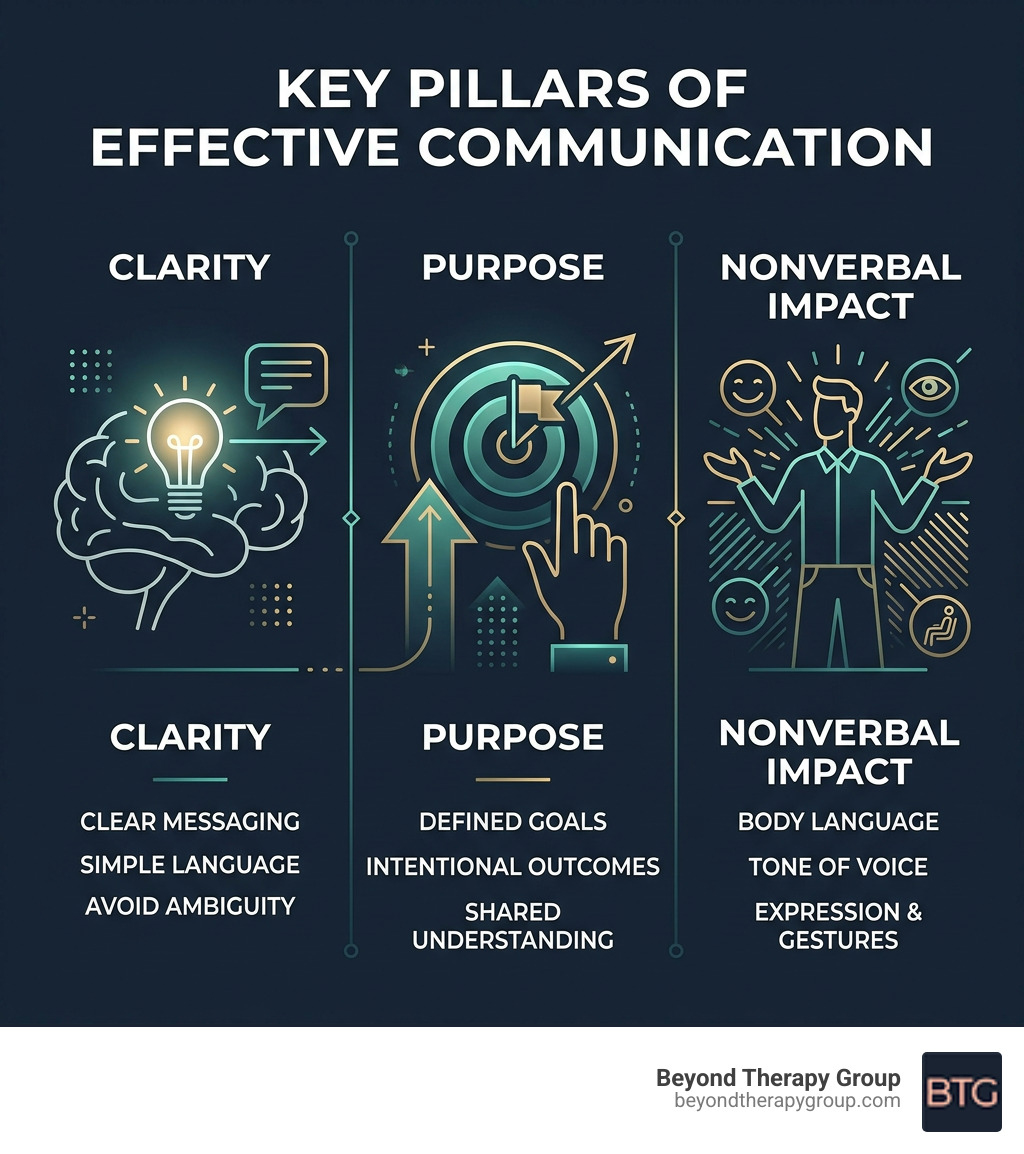
At its heart, Effective Communication is about more than just exchanging information. It is about understanding the emotion and intentions behind that information. When we communicate effectively, we are able to state our needs, set healthy boundaries, and build rapport with almost anyone.
In the workplace, this skill is the backbone of efficiency. When roles are clear and feedback is delivered with empathy, productivity soars. In fact, 72 percent of business leaders report that Effective Communication results in increased productivity, while 60 percent see a significant boost in employee confidence.
In our personal lives, the stakes are even higher. How we interact with family and partners affects our overall well-being. Poor communication often leads to errors, misunderstandings, and unnecessary conflict. This is why we often see people in our Redondo Beach and South Bay offices seeking Relational Therapy: How It Helps to bridge the gap between what they feel and what they express.
The Core Pillars of Effective Communication Skills
To master this “secret sauce,” we need to look at the ingredients. We often talk about the 5 Cs of communication to ensure a message lands correctly. A message should be:
- Clear: Use simple language and avoid jargon.
- Correct: Ensure your facts and grammar are accurate.
- Complete: Give the listener all the information they need to take action.
- Concise: Stick to the point and avoid “information dumping.”
- Compassionate: Consider the other person’s feelings and perspective.
Beyond these 5 Cs, we can look to the ancient wisdom of Aristotle, who identified three pillars of persuasion that still apply to every email, meeting, and dinner table discussion today:
- Logos: The logic and reason behind your message. Does it make sense?
- Pathos: The emotional connection. Why should the listener care?
- Ethos: Your credibility. Do they trust you?

When these three are balanced, your communication becomes much more impactful. However, even the most logical argument can fail if your nonverbal cues are sending a different message. According to the famous 55-38-7 rule, 55 percent of communication is nonverbal, 38 percent is vocal (tone and inflection), and only 7 percent is the actual words spoken.
| Type of Communication | Impact Percentage | Key Elements |
|---|---|---|
| Nonverbal | 55% | Body language, facial expressions, gestures |
| Vocal/Tone | 38% | Pitch, speed, volume, inflection |
| Verbal | 7% | The actual words chosen |
This means that nonverbal cues can have between 65 and 93 percent more impact than the spoken word. If you tell your partner “I’m fine” while crossing your arms and looking at the floor, they are going to believe your body, not your words.
Mastering Nonverbal Cues for Effective Communication
If you want to be a better communicator, you have to become a student of body language. This is not just about what you are doing, but about noticing body language in others to read the room.
- Eye Contact: Maintaining steady (but not aggressive) eye contact signals honesty and interest.
- Posture: Standing or sitting upright suggests confidence, while leaning in slightly shows you are engaged.
- Facial Expressions: A simple nod or a genuine smile can diffuse tension and build trust instantly.
- Tone and Inflection: Your “how” matters as much as your “what.” A sarcastic tone can turn a compliment into an insult.
In our South Bay practice, we often work with individuals who feel like they are “walking on eggshells.” Frequently, this comes down to a mismatch between words and nonverbal signals. Learning to align your body language with your intent is a huge step toward emotional health.
The Power of Active Listening in Effective Communication
We only hear about half of what the other person says during a typical conversation. That is a staggering statistic. Most of us are not actually listening; we are just waiting for our turn to speak.
Active listening is the antidote to this. It involves being fully present and practicing mindful communication by listening without judgment. Here is how to do it:
- Paraphrase: Repeat back what you heard in your own words. “So, what I’m hearing is that you feel overwhelmed by the current project deadline. Is that right?”
- Ask Open-Ended Questions: Instead of asking “Are you mad?”, try “Can you help me understand what’s bothering you?”
- Give Undivided Attention: Put the phone away. Close the laptop. In our digital age, attention is the highest form of respect.
- Favor the Right Ear: Fun fact! The right ear is connected more directly to the left side of the brain, which processes speech and logic. If you are in a noisy environment, tilting your right ear toward the speaker can actually help you understand them better.
Active listening lowers stress for both parties and helps prevent the “he said, she said” cycles that often lead people to seek Relationship and Relational Therapy.
Practical Frameworks for Clearer Interactions
Sometimes, we need a step-by-step guide to get through a difficult interaction. Whether you are in Redondo Beach or anywhere else in the South Bay, these frameworks can help you structure your thoughts before you speak.
One popular method is the 5-step process often taught in executive leadership:
- Clarify: What is the specific goal of this conversation? Are you trying to persuade, explain, or just vent?
- Consider: Who is your audience? What is their current mindset? What do they need from you right now?
- Create: Build your message using the 5 Cs and the pillars of Logos, Pathos, and Ethos.
- Choose: What is the best medium? A quick text might be “lean,” but a face-to-face meeting is “rich” and better for sensitive topics.
- Convey: Deliver the message and then stop to listen for the response.
Another useful tool is the “I Statement” framework, which is vital for understanding Relational Life Therapy. Instead of saying “You always ignore me,” try “I feel neglected when we don’t spend time together, and I would love for us to have a weekly date night.” This reduces defensiveness and keeps the focus on finding a solution rather than assigning blame.
Overcoming Barriers and Navigating Difficult Conversations
Even the best communicators hit walls. Common barriers include high stress, lack of focus, and inconsistent body language. When we are stressed, our “fight or flight” response kicks in, making it nearly impossible to think logically.
This is where Emotional intelligence (EI) comes in. EI is the ability to identify and manage your own emotions while recognizing the emotions of others. People with high EI can regulate their responses even when they are angry.
To navigate difficult conversations, try these strategies:
- Take a Breather: If tempers are flaring, it is okay to say, “I want to have this conversation, but I need fifteen minutes to calm down so I can listen properly.”
- Focus on One Point: Don’t bring up a laundry list of past grievances. Stick to the issue at hand.
- Use Humor: When appropriate, a little lightheartedness can diffuse a tense situation.
- Be Assertive, Not Aggressive: Assertive communication means expressing your needs clearly while still respecting the other person. Avoid passive-aggressive behavior, which often involves “silent treatments” or backhanded compliments.
Setting boundaries is also a form of Effective Communication. Knowing when to say “no” is essential for your mental health. For more on this, check out our guide on Protect Your Relationship: 6 Boundaries Every Couple Needs.
Fostering a Culture of Effective Communication in Leadership
Leadership is not about giving orders; it is about building trust. The most successful organizations foster a culture of “psychological safety,” where team members feel they can speak up without fear of being punished.
Leaders can use Corporate storytelling to make their vision memorable. Instead of just showing a spreadsheet of goals, tell a story about a customer whose life was changed by your product. This uses “Pathos” to create an emotional connection that logic alone cannot achieve.
Another technique is the Delphi method, which allows team members to share their views anonymously before a final decision is made. This ensures that the loudest person in the room doesn’t always “win” and that diverse perspectives are heard.
Leaders should also provide performance feedback that is ongoing and constructive. When feedback is delivered with empathy, it increases employee engagement and motivation. The most dangerous organization is a silent one. If people aren’t talking, it usually means they don’t feel safe enough to be honest.
Frequently Asked Questions about Communication
What are the 5 Cs of communication?
The 5 Cs are a checklist to ensure your message is effective. They stand for Clear (simple language), Correct (accurate facts), Complete (all necessary info), Concise (brief and to the point), and Compassionate (empathetic to the listener). Using these helps prevent Poor communication which often results in errors and duplicate efforts.
How does body language affect my message?
Body language shapes how people interpret your message. If you say “I’m listening” but your body is angled toward the door, the other person may feel dismissed. Congruence means your facial expression, posture, tone, and words all send the same message. When they match, trust grows. In emotional conversations, nonverbal cues often carry more weight than words alone.
How can I improve my listening skills?
Start by practicing active listening. This means minimizing distractions (put the phone away!), making eye contact, and asking open-ended questions. Instead of thinking about your rebuttal, try to truly understand the speaker’s perspective. You can also provide feedback by paraphrasing what they said to ensure you got it right.
Conclusion
Mastering Effective Communication is a lifelong journey, but the rewards are worth the effort. From saving trillions in business losses to deepening the intimacy in your closest relationships, the way we speak and listen defines the quality of our lives.
At Beyond Therapy Group, we believe that everyone deserves to be heard and understood. Whether you are struggling with How Fear Shows Up in Your Relationship Based on Your Attachment Style or you just want to learn How to Know if Relational Therapy is Right for You in Redondo Beach, we are here to help.
We offer a free 15-minute consultation with our therapists to help guide your booking and answer any questions you may have. Let us help you find the “secret sauce” for your own life and work.
Visit us at https://beyondtherapygroup.com/ to take the first step toward clearer, more meaningful connections today.
Recent Posts


