
March 23, 2026
The Ultimate Guide to Drawing Lines in the Sand

Key Takeaways
- Healthy boundaries are the personal limits you set to protect your well-being in relationships and at work
- They define what behavior you will and will not accept from others
- Clear boundaries reduce stress, prevent burnout, and build stronger relationships
- Boundaries must be communicated clearly and enforced consistently to be effective
- Setting limits is an act of self-respect, not selfishness
What Healthy Boundaries Really Mean (And Why Most People Get Them Wrong)
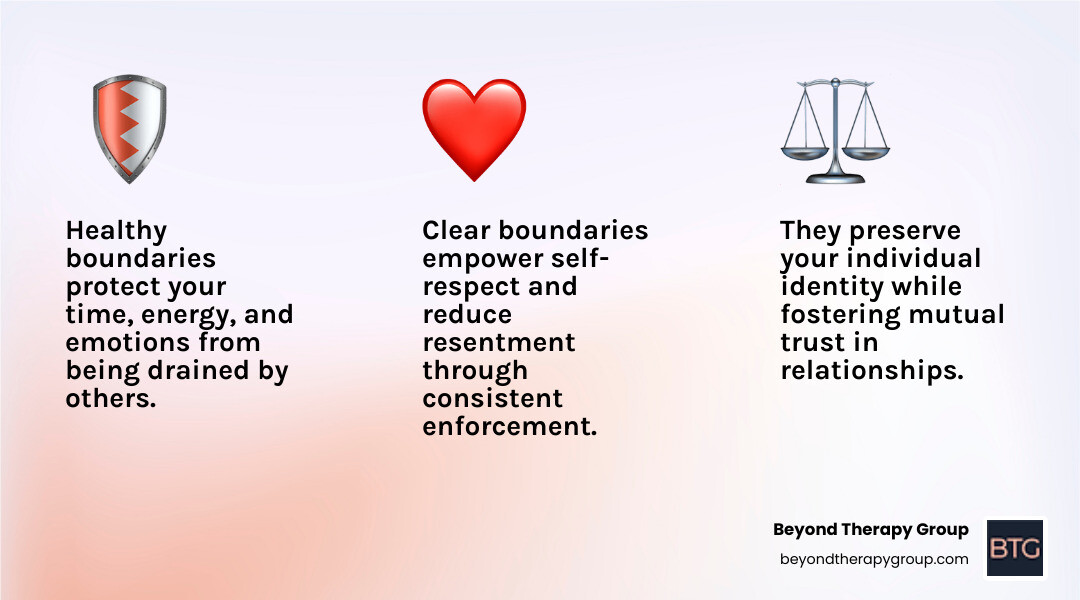
Healthy boundaries are the personal limits you set around your time, energy, emotions, and physical space. They tell others how you expect to be treated. And they guide how you respond when those expectations are not met.
Think of them like a property line. You know where your land ends and your neighbor’s begins. Personal boundaries work the same way. They are not walls meant to keep people out. They are clear markers that protect what matters to you while still allowing real connection.
Yet most people were never taught how to set them. Many of us grew up people-pleasing, avoiding conflict, or simply not knowing that saying “no” was allowed.
The result? Resentment builds. Energy drains. Relationships suffer.
As therapist and author Prentis Hemphill put it: “Boundaries are the distance at which I can love both you and me simultaneously.” That says it all.
Whether you are navigating a difficult relationship at home, feeling overwhelmed at work, or just tired of always putting others first, understanding healthy limits is the first step toward real change.
I’m Rodman Walsh, a Licensed Marriage and Family Therapist with experience helping individuals and couples build healthy boundaries across relationships, trauma recovery, and mental health challenges. In this guide, I will walk you through everything you need to know to start drawing lines that protect your peace.
What Are Healthy Boundaries in Relationships?

In our experience working with clients in Redondo Beach and across the South Bay, we often see a common misconception: that boundaries are about controlling our own actions and responses. They are the framework for mutual trust and safe behavior.
When we have Healthy Boundaries, we preserve our identity. We don’t “merge” with our partner or friend to the point where we lose our own needs. Instead, we create a space where both people can thrive. This involves setting clear expectations about what is okay and what is not. For example, a healthy boundary might be, “I need thirty minutes of quiet time when I get home from work before we discuss evening plans.” This isn’t a rejection of the other person. It is an act of empowerment that ensures you have the energy to be present later.
According to the 7 Tips to Create Healthy Boundaries with Others, one of the most important aspects is consistency. If we set a limit but don’t follow through, we teach people that our words don’t have weight. In a healthy relationship, boundaries foster deeper connections because they remove the guesswork. You don’t have to wonder if you’re upsetting someone because you know they will tell you where their line is.
The Core Types of Personal Limits
Understanding the different “flavors” of boundaries helps us identify where we might be leaking energy. We generally categorize these into several domains. To help you visualize the difference between healthy and unhealthy limits, we’ve put together this comparison based on the Boundaries: What are they and how to create them guide.
| Boundary Type | Porous (Too Loose) | Rigid (Too Strict) | Healthy (Balanced) |
|---|---|---|---|
| Physical | Allowing unwanted touch or letting people into your space when you’re uncomfortable. | Never letting anyone get close and avoiding all physical contact even with loved ones. | Respecting your personal space and asking for permission before touching others. |
| Emotional | Taking on everyone else’s problems or oversharing personal details too soon. | Keeping everyone at a distance and never sharing feelings or being vulnerable. | Sharing personal info gradually and taking responsibility for your own emotions. |
| Time | Saying “yes” to everything or letting people interrupt your work or rest. | Never helping others and being overly protective of time to the point of isolation. | Allocating time for work, self-care, and others based on your current capacity. |
| Financial | Giving money away when you can’t afford it or being easily pressured into spending. | Never sharing resources and being overly controlling or secretive about money. | Setting a budget and sticking to it while deciding when and how much to help others. |
- Physical Space: This is about your body and your personal bubble. It includes who can touch you and how close people can stand to you. In a professional setting, this might look like a coworker not barging into your office without knocking.
- Emotional Energy: This involves how much of your internal world you share and how much of others’ “stuff” you take on. Healthy emotional limits prevent us from becoming “emotional sponges” for everyone else’s drama.
- Time Management: Your time is your most finite resource. Setting boundaries here means knowing when to say “no” to an extra task at work or a social event that would leave you exhausted.
- Financial Limits: This covers your money and possessions. It means deciding who can borrow your car or how much you are willing to spend on a group dinner.
- Intellectual Property: These boundaries protect your thoughts, values, and beliefs. It means standing firm in what you believe even when others disagree, while also respecting their right to their own views.
- Sexual Autonomy: This is the right to decide what you are comfortable with in a sexual context. It requires ongoing consent and clear communication with partners.
Why Protecting Your Space Matters
The Impact of Healthy Boundaries on Mental Health
Setting boundaries isn’t just about being “organized” because it is a vital component of mental health. When our boundaries are blurred, we experience higher levels of stress and anxiety.
Consider the workplace. One study showed that when boundaries are blurred between personal life and work, people experience more emotional exhaustion and less happiness. This “always-on” culture drains our batteries. On the flip side, Hornung (2019) demonstrated that crafting task and cognitive job boundaries enhances self-determination, impact, meaning, and competence at work. When we know exactly where our job ends and our personal life begins, we actually perform better.
By maintaining these limits, we allow ourselves the space to grow. We protect our “yes” by saying “no” to the things that don’t align with our values. This leads to a greater sense of self-respect and prevents the resentment that often poisons long-term relationships.
Identifying Signs of Porous or Rigid Limits
How do you know if your boundaries need a “tune-up”? We look for specific red flags.
Porous boundaries often lead to emotional drain. If you find yourself constantly people-pleasing, feeling responsible for other people’s happiness, or over-sharing personal details with strangers, your boundaries might be too loose. This often results in burnout and a feeling of being “used.”
On the other hand, rigid boundaries can lead to isolation. If you find yourself never asking for help, keeping everyone at an arm’s length, or being highly defensive when someone asks a personal question, your boundaries might be too stiff. While you might feel “safe,” you are also likely feeling lonely.
The goal is to move toward the “Goldilocks” zone: boundaries that are firm enough to protect you but flexible enough to allow for intimacy and growth.
A Practical Framework for Setting and Maintaining Limits
Practical Steps for Setting Healthy Boundaries
Setting a boundary for the first time can feel terrifying. You might worry about being “mean” or facing rejection. However, clear communication is actually an act of kindness. It takes the guesswork out of the relationship.
- Self-Reflection: Before you talk to anyone else, you need to know what you need. What are your core values? What makes you feel safe? What drains your energy?
- Use “I” Statements: Instead of saying, “You always interrupt me,” try, “I feel frustrated when I am interrupted because I lose my train of thought. I would like to finish my point before we move on.” This reduces defensiveness and keeps the focus on your needs.
- Be Direct: Avoid “hinting.” If you need someone to stop calling you after 9:00 PM, say exactly that. “I am turning my phone off at 9:00 PM to get better sleep. If you call after that, I will get back to you in the morning.”
- Start Small: If you are new to this, don’t start with your most difficult family member. Practice on a low-stakes situation, like telling a waiter your order was wrong or declining a minor social invite.
For those in romantic partnerships, we recommend checking out Protect Your Relationship: 6 Boundaries Every Couple Needs for specific advice on maintaining intimacy while protecting your individual selves.
The If-Then Structure and Enforcement
A boundary without a consequence is just a suggestion. To make your Healthy Boundaries effective, they need a clear structure. We often use the “If-Then” model.
The Formula: “If you [Behavior], then I will [Action].”
- “If you continue to yell at me during this argument, then I will leave the room and we can talk when we are both calm.”
- “If you show up at my house without calling first, then I will not answer the door.”
Enforcement is the hardest part, but it is the most crucial. If you say you will leave the room when yelled at, you must actually leave. If you stay and keep arguing, you are teaching the other person that your boundary doesn’t exist.
This is especially important with difficult people, such as those with narcissistic traits or overbearing family members. These individuals may test your boundaries repeatedly. Consistency is your best tool. You don’t need to explain yourself over and over. State the boundary once, and then let your actions do the talking.
Navigating Challenges and Frequently Asked Questions
What should I do when someone violates my boundaries?
First, give grace where it’s due. If it’s a new boundary, the person might simply have forgotten. A calm, firm reminder is often enough: “I’m not taking work calls on the weekend.”
However, if the violation is intentional or repeated, you must move to the “then” part of your if-then structure. This might mean creating more distance, limiting the topics you discuss with that person, or in extreme cases, going “no-contact” for a period of time. Your primary responsibility is your own safety and well-being. If you are struggling with a particularly difficult situation, seeking professional support from a therapist can help you create a safety plan and stay firm in your resolve.
How do I identify my own personal boundaries?
Your body often knows your boundaries before your mind does. Pay attention to your “anger cues.” If you feel a flash of resentment, annoyance, or a “tight” feeling in your chest after an interaction, that is a signal that a boundary has been crossed.
We recommend doing an “energy audit.” Look at your schedule and your relationships. Which ones leave you feeling energized? Which ones leave you feeling like a wrung-out towel? Tracking these feelings over a week can help you see where you need to draw a line.
How can I respect other people’s boundaries?
Respect is a two-way street. To be a person who others feel safe with, you must practice active listening. When someone tells you “no” or asks for space, accept it without becoming defensive.
- Ask Permission: “Is now a good time to talk about something heavy?”
- Accept the “No”: If a friend declines an invite, don’t press them for a reason. Simply say, “No problem, maybe next time!”
- Take Responsibility: If you accidentally cross a line, offer a sincere apology and change your behavior moving forward.
Conclusion
Building Healthy Boundaries is not a one-time event. It is a lifelong practice of self-care and self-respect. It is about realizing that you are the gatekeeper of your own life. By drawing these lines in the sand, you aren’t pushing people away. You are creating the conditions for your most authentic, healthy relationships to flourish.
At Beyond Therapy, we understand that this process can be daunting, especially if you have spent years prioritizing others over yourself. We are here to support our neighbors in Redondo Beach and the South Bay as they navigate these changes.
We offer tailored guidance to help you identify your needs, communicate them effectively, and find the peace you deserve. If you’re ready to start your journey, we invite you to take advantage of our free 15-minute consultation. This is a chance for you to meet a therapist, ask questions, and see how we can help you build the life you want.
Start your journey with professional support today and take the first step toward a more empowered you.
Recent Posts