
May 14, 2026
How ACT Therapy Helps You Quit Drinking for Good

How Acceptance Commitment Therapy for Alcohol Use Can Help You Quit Drinking
Acceptance commitment therapy alcohol use is a proven, mindfulness-based approach that helps people quit drinking by changing their relationship with cravings and difficult emotions, rather than fighting them.
Here is what you need to know quickly:
- What it is: ACT is a type of behavioral therapy that builds psychological flexibility so you can act on your values instead of your urges
- How it works: You learn to accept uncomfortable feelings without letting them drive your drinking
- Does it work? Yes. Research shows ACT increases the odds of abstinence at the end of treatment and at short-term follow-up compared to other active therapies
- vs. CBT: ACT outperformed CBT for abstinence at end of treatment (p = 0.002) in meta-analysis findings
- Who it helps: People with alcohol use disorder (AUD), including those with co-occurring depression, anxiety, or PTSD
Most people who struggle with alcohol are not weak. They are trying to cope with stress, painful memories, or emotions that feel too big to handle. As the saying goes, “Embrace your demons and follow your heart” (Russ Harris, 2007). That is the heart of what ACT offers.
Globally, over 20 million Americans meet the criteria for a substance use disorder. Yet many standard treatments still focus on willpower and thought control, which often makes cravings stronger, not weaker. ACT takes a different path. It teaches you to stop fighting your inner experiences and start living by what truly matters to you.
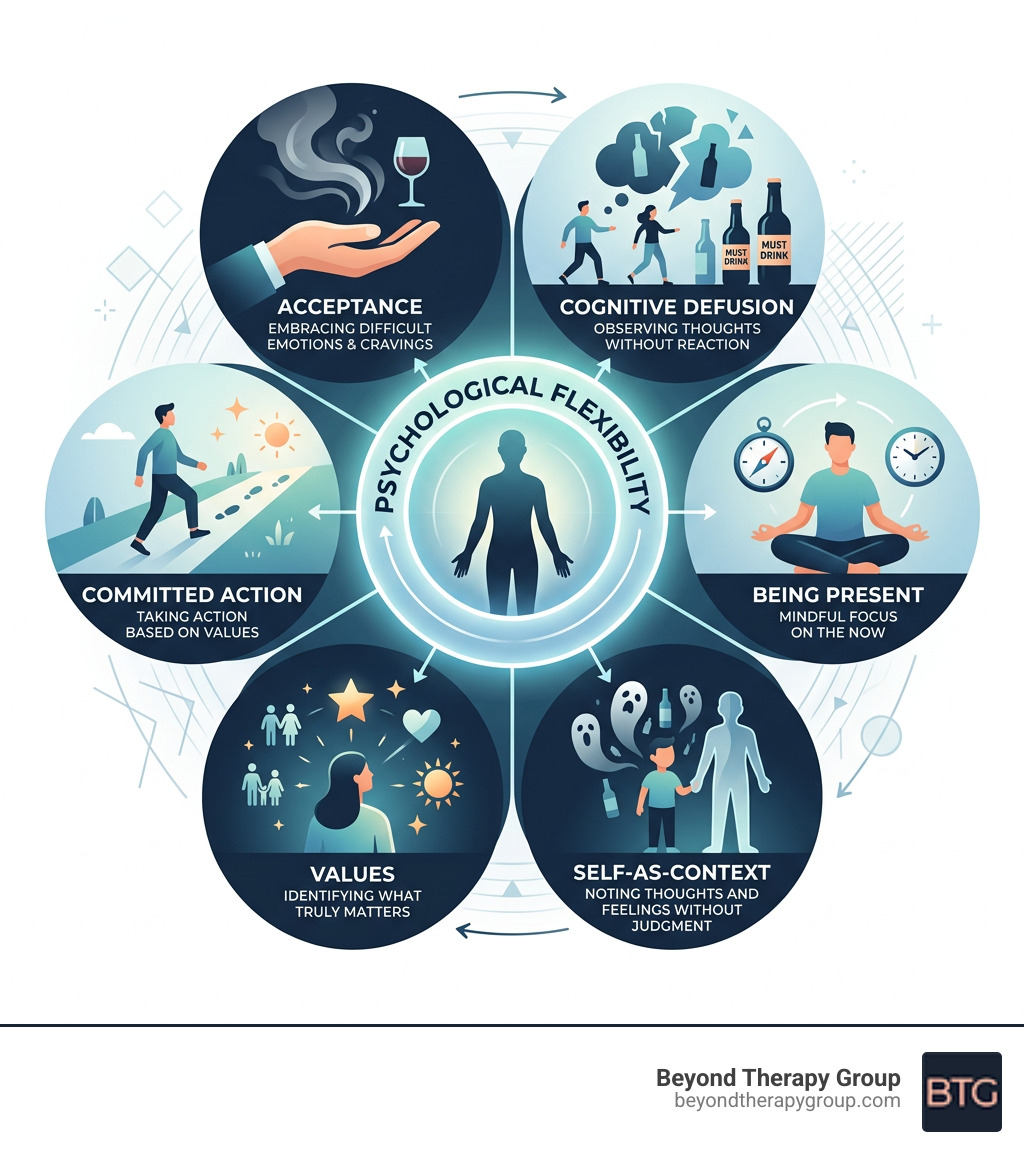
Understanding Acceptance Commitment Therapy Alcohol Use
At its core, acceptance commitment therapy alcohol use is a behavioral approach that comes from the “third wave” of therapy. While older therapies focused on changing the content of your thoughts, ACT focuses on changing how you relate to them. This is based on something called Relational Frame Theory.
The goal of ACT is to increase your psychological flexibility. This means being able to stay in the present moment even when things are hard and making choices that align with your long-term goals rather than your short-term urges. In the context of alcohol use, psychological flexibility is the “secret sauce” that helps you choose a healthy life even when a craving is screaming at you.
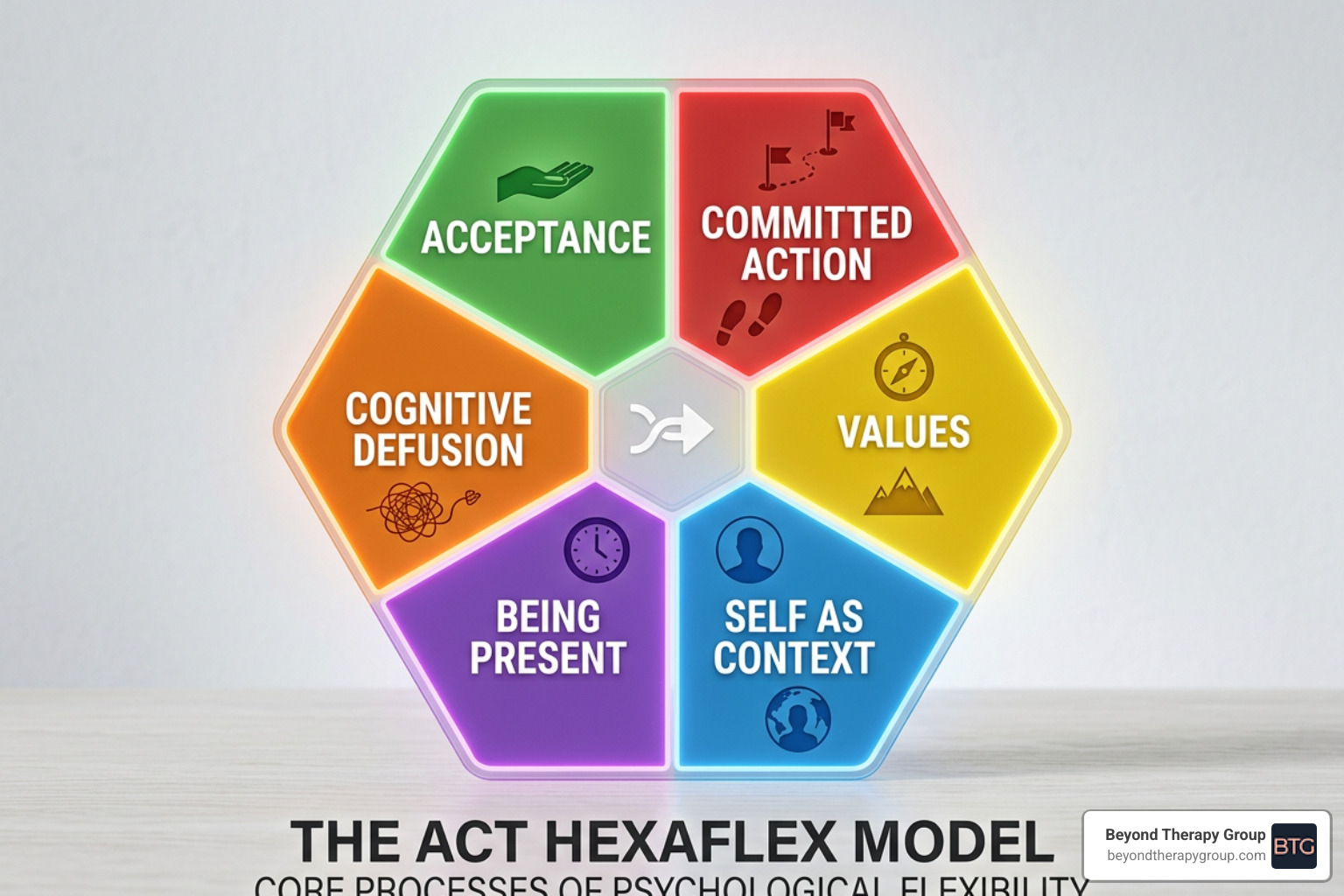
Core Processes of Acceptance Commitment Therapy Alcohol Use
To help you find freedom from alcohol, we use six core processes. Think of these as six tools in your recovery toolkit.
- Cognitive Defusion: This is the art of unhooking yourself from your thoughts. Instead of thinking “I need a drink,” you learn to say “I am having the thought that I need a drink.” This small shift creates space so the thought does not have to control your hands.
- Acceptance: This is not about liking the pain. It is about making room for it. Instead of drinking to numb anxiety, you learn to let the anxiety be there without reacting to it.
- Being Present: Alcohol often takes us out of the moment. We drink because we are worried about the future or regretful about the past. ACT teaches you to stay right here, right now.
- Self-as-Context: You are more than your addiction. You are the “observer” of your life. This process helps you see that while you have cravings, you are not your cravings.
- Values: What actually matters to you? Is it being a present parent? A reliable friend? A healthy athlete? We help you clarify what you want your life to stand for.
- Committed Action: Once you know your values, you take steps to live them. This is the “act” part of ACT. It is about setting goals and taking small, concrete steps toward the life you want.
ACT vs Traditional CBT for Alcohol Use Disorder
Many people ask us how ACT differs from traditional Cognitive Behavioral Therapy (CBT). While both are effective, they take very different approaches to your internal world.
In traditional CBT, the focus is often on “cognitive restructuring.” This means identifying “irrational” thoughts and trying to replace them with more positive ones. If you think “I can’t handle this stress without a beer,” a CBT therapist might help you challenge that thought with evidence.
In acceptance commitment therapy alcohol use, we do not care if the thought is “true” or “false.” We only care if the thought is helpful. We do not try to change the thought. We just change how much power you give it.
Comparing the Two Approaches
| Feature | Traditional CBT | ACT (Acceptance and Commitment Therapy) |
|---|---|---|
| Goal | Reduce symptoms by changing thoughts | Increase flexibility by accepting thoughts |
| View of Urges | Something to be avoided or replaced | Something to be observed and accepted |
| Main Tool | Cognitive restructuring | Mindfulness and Defusion |
| Focus | Symptom reduction | Values-based living |
Research shows that ACT can be especially powerful for people who have tried traditional methods and felt like they were “failing” because they could not stop their negative thoughts. ACT says you do not have to stop them. You just have to stop letting them drive the car.
Practical ACT Techniques to Manage Cravings
One of the most famous metaphors in ACT is the Bus Metaphor. Imagine you are the driver of a bus. Your thoughts, cravings, and memories are the passengers. Some of them are mean. Some of them shout directions like “Turn left and go to the liquor store!” or “You are a failure, just give up!”
In the past, you might have stopped the bus to argue with the passengers or tried to kick them off. But while you were arguing, you were not driving toward your destination. ACT teaches you that you can keep the bus moving toward your values (your destination) even while the passengers are shouting in the back. You do not have to like them, but you do not have to do what they say either.
Mindfulness and Urge Surfing
Another practical tool we use is Urge Surfing. Instead of fighting a craving, you imagine it as an ocean wave. Every wave has a starting point, a peak where it feels most intense, and a natural “wash out” where it disappears.
When you feel a craving, we help you:
- Notice where you feel it in your body (tight chest, dry mouth)
- Acknowledge it without judgment (“There is a craving”)
- Breathe through it without trying to make it go away
- Watch as it naturally loses strength
Defusion Exercises
We also use humor to take the power out of scary thoughts. A therapist might have you sing your most distressing thought to the tune of “Twinkle Twinkle Little Star” or say it in a silly cartoon voice. It is hard to be terrified of a thought like “I am a total loser” when it is being sung by a duck. This helps you realize that thoughts are just sounds and words, not absolute truths.
Evidence and Success Rates for Long-Term Recovery
We know you want to know if this actually works. The data is very encouraging. For example, a meta-analysis showed that ACT increased the odds of abstinence at the end of treatment with a Log RR of 0.264. Even more importantly, it showed that a higher number of ACT sessions significantly increased long-term abstinence rates (p < 0.001).
Success in Diverse Populations
ACT has shown incredible results across different groups of people:
- Veterans: In studies of veterans with PTSD and AUD, ACT helped reduce total drinks and heavy drinking days.
- Incarcerated Women: One study found that ACT led to a 43.8% abstinence rate compared to 26.7% for CBT after six months.
- Technology-Based ACT: Even digital versions show promise. The Smartquit app achieved a 13% quit rate compared to 8% for standard guides.
Success Rates of Acceptance Commitment Therapy Alcohol Use
While ACT is excellent at promoting short-term abstinence, its real strength is often found in the “slow and steady” approach. By targeting deep-seated emotions like shame, ACT helps people build a life they do not want to escape from.
In a pilot matched control trial, patients receiving ACT plus treatment as usual (TAU) had significantly higher cumulative abstinence duration at 3 and 6 months compared to those only receiving TAU. They also reported lower levels of depression and anxiety. This suggests that acceptance commitment therapy alcohol use is particularly effective for those dealing with “dual diagnosis” or comorbid conditions.
How to Start Acceptance Commitment Therapy Alcohol Use
Starting therapy can feel overwhelming, but it is the most important step you can take. Here in the South Bay and Redondo Beach areas, we offer specialized support to help you navigate this journey.
One common concern is accessibility. The good news is that many insurance plans now cover ACT as an essential health benefit.
When looking for a therapist, ensure they are specifically trained in ACT. It is a specialized modality that requires a deep understanding of Relational Frame Theory and the six core processes.
Frequently Asked Questions about ACT for AUD
Can ACT help with comorbid anxiety or depression?
Yes. In fact, this is one of ACT’s greatest strengths. Because ACT is “transdiagnostic,” it targets the underlying psychological inflexibility that fuels both addiction and mood disorders. By learning to accept uncomfortable emotions rather than drinking them away, you naturally improve your mental health across the board.
How many sessions are typically required for AUD?
While every person is different, research suggests that a higher number of sessions leads to better long-term outcomes. Many programs range from 10 to 12 sessions for initial stabilization, though many people find that ongoing work helps them maintain their values-based lifestyle.
Is ACT effective when delivered via smartphone apps?
While in-person therapy provides the highest level of support and accountability, digital ACT interventions have shown success in pilot trials. Apps like Smartquit have demonstrated higher quit rates than traditional guides, making them a great adjunct to regular therapy sessions.
Conclusion
Recovery is not about becoming a “perfect” person who never has a bad thought or a craving. It is about becoming a person who can have those thoughts and still choose to be the person they want to be.
At Beyond Therapy Group, we understand the unique challenges of overcoming alcohol use in the South Bay and Redondo Beach communities. We are here to help you stop fighting the “passengers” on your bus and start driving toward the life you deserve.
We offer a free 15-minute consultation with our therapists to help guide your booking and answer any questions you might have about how we use acceptance commitment therapy alcohol use in our practice.
Take the first step today. You do not have to do this alone.
Recent Posts


