
July 20, 2026
A–Z Guide to Emotional Boundaries in a Relationship

What Emotional Boundaries in a Relationship Actually Mean (And Why Most People Struggle)
Key Takeaways
- Emotional boundaries in a relationship define where your feelings end and another person’s feelings begin
- Clear limits protect your mental health and help prevent burnout and resentment
- Healthy boundaries create deeper trust and more genuine connection
- Boundaries can be learned and strengthened at any stage of a relationship
- Nearly 60% of adults report struggling to set or maintain healthy emotional limits
Emotional boundaries in a relationship are the internal limits that help you tell the difference between your own feelings and someone else’s. They define what you are responsible for emotionally and what you are not.
Think of it this way: when your partner has a terrible day and comes home in a bad mood, you can care about how they feel without absorbing that mood as your own. That distinction is an emotional boundary in action.
It sounds simple. But for most people, it is anything but.
Nearly 60% of adults report struggling to set or maintain healthy emotional limits in their relationships. And over 70% of people who seek therapy name boundary-related issues as a primary reason for going.
If you have ever felt:
- Drained after spending time with someone you care about
- Responsible for fixing other people’s feelings
- Afraid to say no in case it damages the relationship
- Resentful without being able to explain exactly why
…then this guide is for you.
Emotional boundaries are not about pushing people away. They are about showing up more fully, more honestly, and more sustainably in every relationship you have. Done well, they do not reduce closeness. They make real closeness possible.
Basic emotional boundaries in a relationship vocab:
What Are Emotional Boundaries in a Relationship?
To understand emotional boundaries in a relationship, we must first look at what it means to own our internal world. An emotional boundary is a healthy dividing line between your emotional experience and that of another person. It is the understanding that you are the sole owner of your feelings, your thoughts, your values, and your choices. You are not responsible for managing, fixing, or carrying the emotional weight of anyone else.
Nearly 60% of adults struggle with limits because we are rarely taught how to build them. Instead, we are often encouraged to accommodate others at our own expense.
Physical boundaries are easy to see because they involve your body and your physical space. If someone stands too close or touches you without permission, you immediately feel the violation. Emotional limits are invisible, which makes them much harder to define.
While physical limits protect your body, emotional limits protect your energy and your sense of self. They allow you to practice self-definition, which is the ability to know who you are and what you stand for, even when someone you love disagrees with you.
Why Emotional Boundaries in a Relationship Matter
When we set clear limits, we protect our mental health and create a safe environment for both partners to grow. Research from 2026 shows that couples who practice clear emotional limits enjoy 40% higher relationship satisfaction and report much lower rates of burnout.
Without these limits, relationships become exhausting. You find yourself constantly trying to manage your partner’s moods, walking on eggshells to avoid conflict, or losing your own interests to keep the peace.
By establishing healthy limits, you build emotional safety. You and your partner can express your true feelings without fear of being swallowed up by the other person’s reaction. This is the foundation of a sustainable connection.
Diffuse, Rigid, and Flexible Boundaries
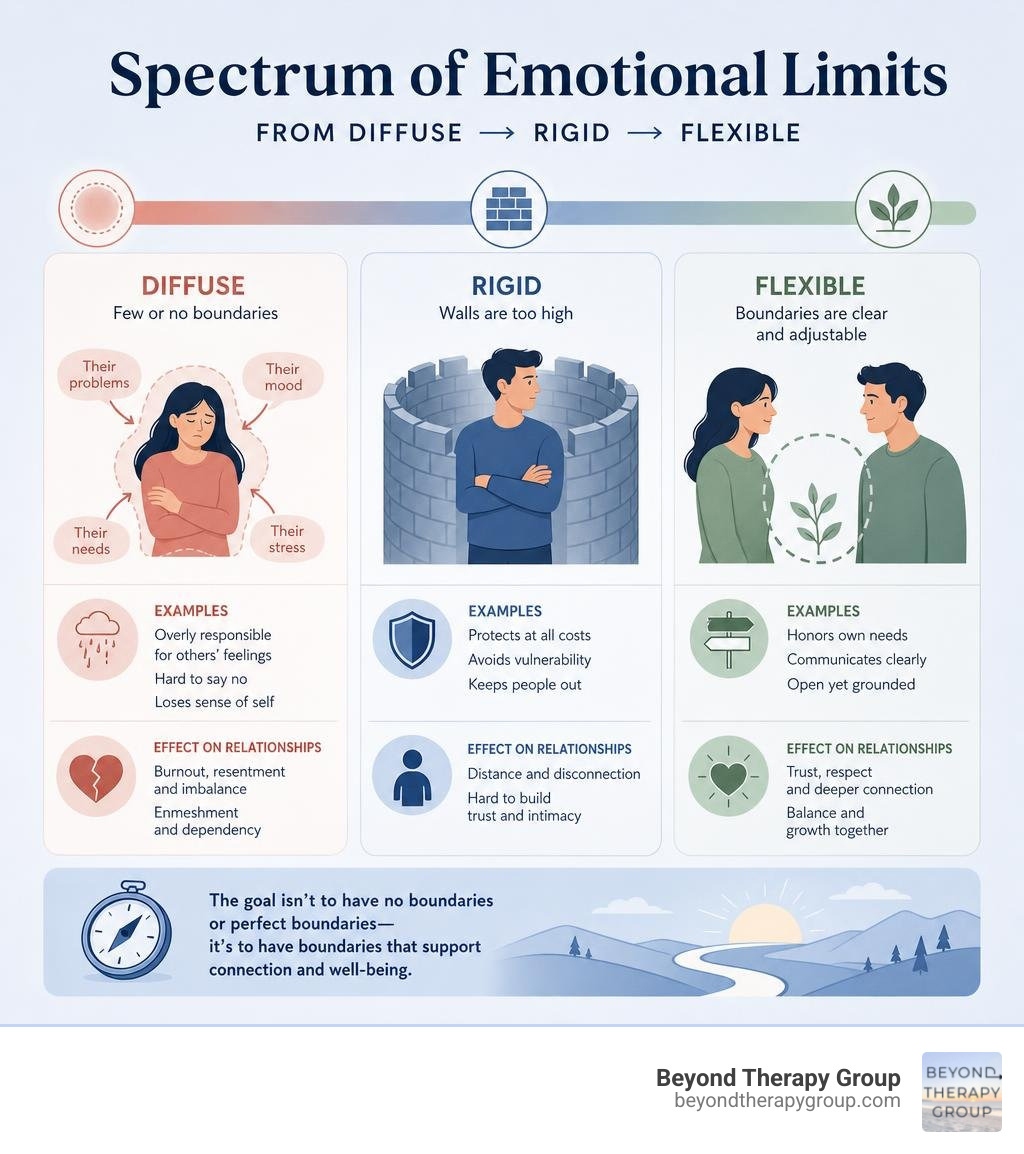
Psychologists often categorize personal boundaries into three distinct types: diffuse, rigid, and flexible. Understanding where you fall on this spectrum is the first step toward building healthier relationships.
If you grew up in an enmeshed family where individual feelings were discouraged, you might find yourself struggling with diffuse limits. In fact, adults who grew up in enmeshed families are three times more likely to struggle if enmeshed in their adult lives.
Here is a breakdown of how these three types of boundaries affect your relationships:
| Boundary Type | Characteristics | Impact on Relationships |
|---|---|---|
| Diffuse (Porous) | Blurred limits, taking on others’ emotions, saying yes to avoid rejection, fear of conflict | Leads to enmeshment, codependency, chronic exhaustion, and a loss of personal identity |
| Rigid | High walls, emotional distance, keeping others at a distance, refusing to share feelings | Prevents true intimacy, leads to isolation, and makes partners feel rejected or shut out |
| Flexible (Healthy) | Clear but adaptable, based on trust, able to say no, owning your own feelings | Fosters mutual respect, deepens emotional intimacy, and supports individual autonomy |
Healthy Emotional Boundaries in a Relationship vs. Emotional Walls
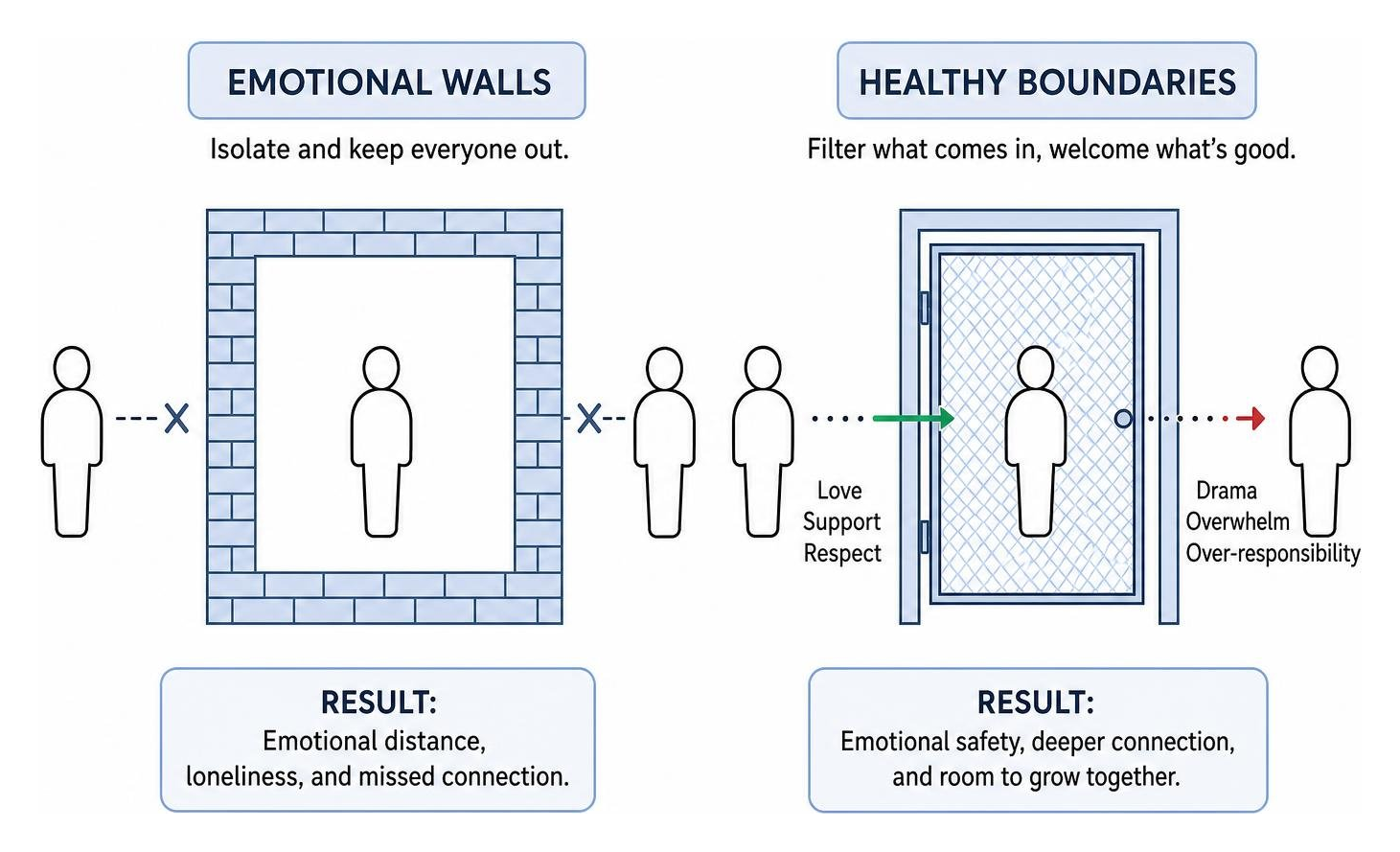
It is common to confuse healthy boundaries with emotional walls, but they are actually opposites.
An emotional wall is built out of fear and pain. It is a non-permeable barrier designed to keep everyone out so you do not get hurt. While walls keep you safe from conflict, they also keep you safe from love. They create emotional distance and leave both partners feeling lonely.
A healthy emotional boundary is semi-permeable. It acts like a screen door, letting the fresh air of love and connection in while keeping the bugs of emotional over-responsibility out. Boundaries allow you to remain vulnerable and present because you know you are safe. You do not need to build walls when you know how to set healthy limits.
How to Identify Where Your Limits Are Lacking
Recognizing where your boundaries are weak requires honest self-reflection. The most common warning sign that you lack boundaries is resentment.
Resentment is the anger we feel when we say yes to something we actually want to say no to. It is the quiet frustration that builds when we feel taken advantage of, even though we never spoke up about our limits.
Other signs include constant anxiety before interacting with certain people, a habit of people-pleasing, and feeling like you must constantly fix everyone else’s problems. If you want to explore your personal limits further, you can read A Comprehensive Guide to Defining Personal Boundaries to help you map out your needs.
The Cost of Poor Limits: Burnout and Codependency
When we live without emotional boundaries, the personal cost is high. Over time, taking on everyone else’s emotional baggage leads to chronic exhaustion and relationship burnout.
It also opens the door to codependency. In a codependent dynamic, your self-worth becomes entirely tied to how well you can rescue or please your partner. You stop living your own life and start living theirs.
This emotional over-responsibility is unsustainable. If you feel trapped in a relationship where you are constantly walking on eggshells, you might find our guide on Drawing the Line with Toxic and Controlling Partners helpful for reclaiming your autonomy.
Real-World Examples Across Different Settings
To see what boundaries look like in daily life, let us explore a few common scenarios across different types of relationships. You can also view our complete Relationship Boundaries List: Complete Guide for more ideas.
- Romantic Partners: Your partner comes home angry after a stressful day at work. A healthy boundary means acknowledging their stress and offering support, but not letting their bad mood ruin your entire evening. It also means not immediately trying to solve their work problems for them unless they ask.
- Family Dynamics: A parent uses guilt tactics to pressure you into visiting more often. Setting a boundary means saying, “I love you and want to see you, but I can only visit for two days this holiday.” You hold firm to your decision even if they respond with passive-aggressive comments.
- Workplace Expectations: Your boss sends you non-urgent emails late at night. A healthy boundary means turning off your work notifications after hours and responding during regular business hours, protecting your personal rest time.
How to Establish and Communicate Your Limits Effectively
Communicating your boundaries does not have to be a dramatic or hostile event. In fact, the most effective boundaries are communicated calmly, clearly, and with very few words.

When you are ready to set a boundary, follow these simple guidelines:
- Pick the right time: Do not try to set a major boundary in the middle of a heated argument. Wait until both you and your partner are calm, rested, and receptive.
- Use “I” statements: Focus on your own feelings and needs rather than blaming the other person. Instead of saying, “You are always demanding my attention,” try saying, “I need some quiet time to unwind when I first get home from work.”
- Be direct and firm: Do not over-explain or apologize for your needs. Clarity is kindness. You do not need to give a long list of reasons why you cannot do something. A simple, “I cannot take that project on right now,” is enough.
If you are worried about looking cold or uncaring, you can learn more about How to Set Boundaries in Your Relationship Without Being a Jerk to find the right balance of warmth and firmness.
Handling Pushback and Staying Grounded
When you start changing the rules of a relationship, the other person will likely push back. This is normal. People who benefit from your lack of boundaries will often protest when you finally set them.
You might hear accusations of being selfish, cold, or uncaring. In these moments, it is crucial to stay grounded and manage your own feelings of guilt.
Guilt is simply a sign that you are unlearning old habits of people-pleasing. It does not mean you have done something wrong. To help you navigate these difficult conversations, look at Protect Your Relationship: 6 Boundaries Every Couple Needs for practical communication strategies.
Balancing Compassion with Personal Limits
Many people worry that setting boundaries means they are turning their backs on the people they love. But there is a massive difference between empathy and caretaking.
Empathy is holding space for someone else’s pain and letting them know they are not alone. Caretaking is stepping in to solve their problems, manage their moods, and protect them from the consequences of their own choices.
Think of the classic airplane oxygen mask rule. You must put your own mask on first before you can help anyone else. If you exhaust all your emotional energy trying to keep everyone else happy, you will eventually have nothing left to give. Setting boundaries is actually an act of care that preserves your capacity to love others over the long term.
Practical Strategies and Tools to Strengthen Your Limits
Building healthy boundaries is a skill that takes time and practice. Here are a few practical tools you can start using today:
- Mindfulness: Check in with your body throughout the day. When someone asks you for a favor, do you feel a tightening in your chest or stomach? Your body often knows your limits before your mind does.
- The 24-Hour Rule: If you are a chronic people-pleaser, avoid agreeing to requests immediately. Practice saying, “Let me check my schedule and get back to you tomorrow.” This gives you time to reflect on whether you actually have the emotional capacity to say yes.
- Journaling: Use writing to clarify your values and identify where you feel resentful. If you want a structured way to practice this, you can download our Boundaries Worksheet PDF for Adults: Download Guide to help you get started.
Supporting Autonomy and Genuine Presence
Healthy boundaries do more than just protect you. They also support autonomy, which is a core human need.
When you stop trying to fix your partner’s emotions, you communicate that you trust them to handle their own inner life. This allows both of you to show up as independent, self-determined individuals.
Instead of monitoring each other’s reactions, you can finally enjoy each other’s company. True presence is only possible when you know you are free to say no.
When to Seek Professional Support
If you find yourself stuck in the same painful relational patterns, you are not alone. Over 70% of individuals in therapy cite boundary issues as a major reason for reaching out.
Working with a relational therapist can provide you with a safe space to explore your childhood patterns, practice assertive communication, and build the confidence you need to hold your limits. If you are ready to take that step, our team at Beyond Therapy is here to help.
Frequently Asked Questions about Emotional Limits
How do I know if my emotional limits are realistic?
A realistic boundary is based on your actual emotional capacity, not on what you think you should be able to handle. If a limit protects your mental health while still allowing you to show up honestly in the relationship, it is realistic. Unreasonable boundaries are those designed to punish, control, or completely shut out your partner.
Why do I feel so guilty when setting limits?
Most of us were socialized to prioritize keeping the peace over being honest. When you start setting limits, your brain interprets this change as a threat to your connection, triggering feelings of guilt. Unlearning these old equations takes time. With practice, you will learn to tolerate the temporary discomfort of guilt in exchange for the long-term peace of healthy boundaries.
What should I do if my partner repeatedly ignores my limits?
If your partner continues to cross your boundaries after clear communication, it is time to stop talking and start acting. A boundary is not a rule for the other person to follow. Instead, it is a declaration of what you will do if a limit is crossed. You may need to take space, end the conversation, or re-evaluate the future of the relationship.
Conclusion
Building emotional boundaries in a relationship is not about creating distance. It is about building a bridge of mutual respect that allows both partners to feel safe, seen, and appreciated.
If you are ready to start your boundary journey, we invite you to reach out to us at Beyond Therapy. We serve clients in Redondo Beach and the wider South Bay area, offering personalized support to help you navigate your relationship dynamics.
We offer a free 15-minute consultation with our therapists to help guide your booking and answer any questions you might have. Schedule a Relational Therapy Consultation with our team today, and let us help you build the healthy, sustainable connections you deserve.
Recent Posts


