
May 30, 2026
10 Surprising Relationship Boundaries Everyone Needs

Why a Relationship Boundaries List is Essential for Healthy Love
Key Takeaways
- A relationship boundaries list helps both partners feel safe, respected, and understood
- Healthy limits prevent resentment, burnout, and emotional exhaustion
- Boundaries apply to emotional, physical, digital, financial, and time-related areas
- Clear communication using I statements makes setting limits easier
- Limits can and should evolve as relationships grow and change
A relationship boundaries list is one of the most practical tools you can bring into any relationship. Whether you are navigating a romantic partnership, a friendship, or a family dynamic, knowing where your limits are, and sharing them clearly, makes everything run smoother.
Here is a quick overview of the core types of healthy relationship boundaries:
| Type | What It Covers |
|---|---|
| Emotional | How feelings are shared and respected |
| Physical | Personal space and touch preferences |
| Digital | Passwords, screen time, and online privacy |
| Financial | Spending, saving, and financial independence |
| Time | Alone time, work hours, and shared schedules |
| Sexual | Consent, pace, and comfort levels |
| Intellectual | Respecting different opinions and beliefs |
| Social | Time with friends, family, and outside relationships |
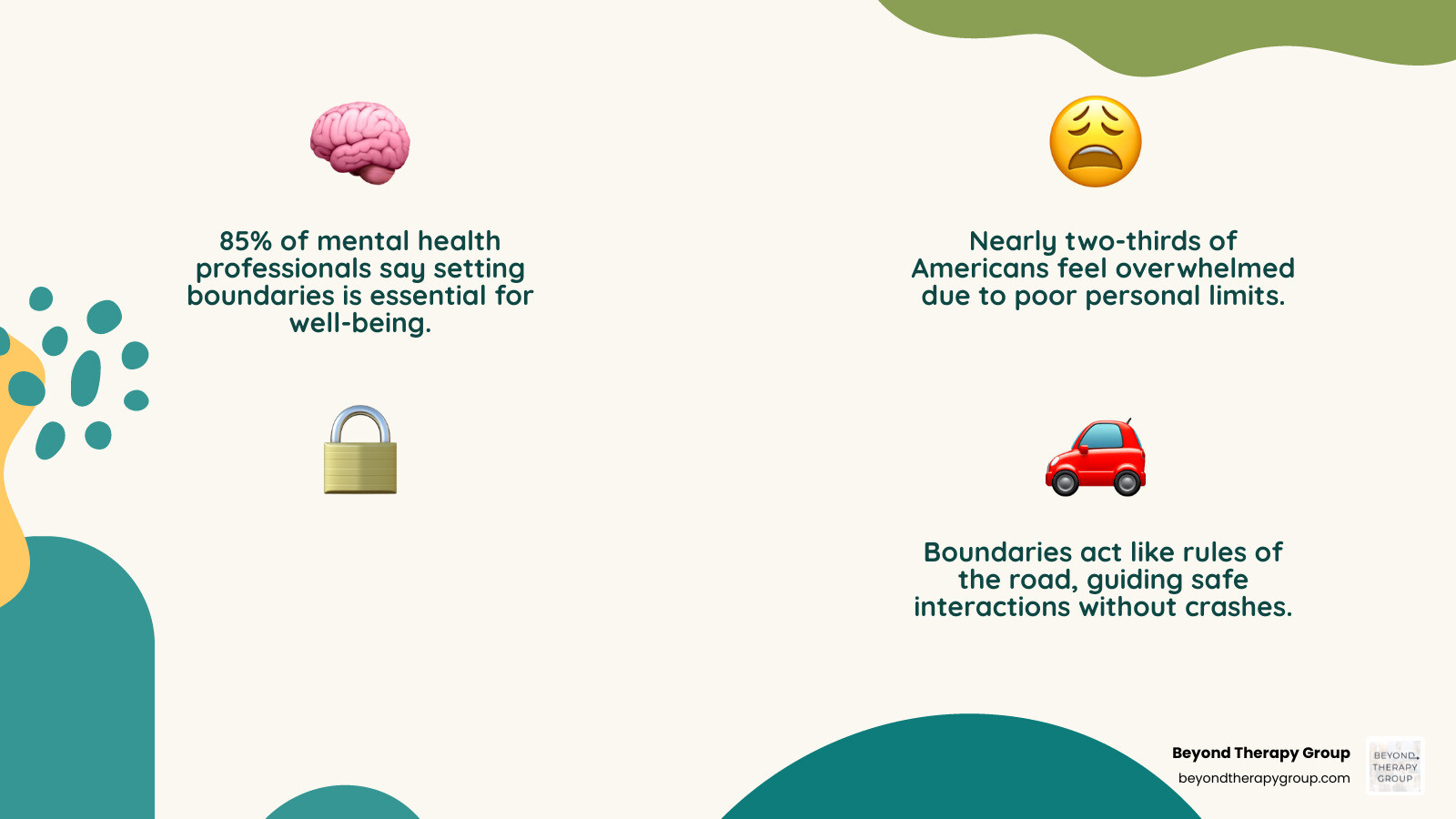
And yet, despite how important these limits are, most people struggle to set them. Nearly two-thirds of Americans say they feel overwhelmed because they find it hard to establish personal boundaries. Over a quarter of young people even confuse controlling behaviors with healthy ones.
That gap between knowing boundaries matter and actually setting them is exactly where things break down.
Think of boundaries less like walls and more like the rules of the road. They do not stop you from going where you want. They just help everyone get there safely, without crashing into each other.
The good news is that setting clear limits is a skill. And like any skill, it gets easier with practice.
Key relationship boundaries list vocabulary:
As we navigate the complexities of modern life in April 2026, the need for a clear relationship boundaries list has never been more apparent. Boundaries are not about keeping people out. They are about keeping you safe and whole so you can show up fully for the people you love. When we lack these “invisible fences,” we often find ourselves drifting into enmeshment, where it becomes hard to tell where one person ends and the other begins.

Research shows that 85% of mental health professionals consider boundary-setting essential for well-being. Without them, we risk emotional burnout and deep-seated resentment. We might feel like we are constantly “walking on eggshells” or that our needs are secondary to everyone else’s. By using an Ultimate Checklist For Healthy Boundaries, you create a roadmap for mutual respect.
Setting boundaries fosters trust because it removes the guesswork. When your partner knows exactly what makes you feel respected and what makes you feel overwhelmed, they can love you more effectively. It preserves your individuality, ensuring that even in a close partnership, you remain a unique person with your own interests, values, and energy levels.
10 Surprising Examples of Healthy Boundaries
When we think of a relationship boundaries list, we often think of the big things like infidelity or physical space. However, in our current digital and age, some of the most important boundaries are the ones we might not expect.
1. Digital Privacy and Password Protection
In 2026, our phones are extensions of our brains. A healthy boundary is agreeing that passwords remain private. Trust is built by not snooping, rather than by having total access. You might say, “I value our trust, and I also value my digital privacy. I prefer that we keep our phone passwords to ourselves.”
2. The Right to Decompress
Coming home from a long day in Redondo Beach or South Bay often requires a transition period. A decompression boundary might look like 20 minutes of silence when you first walk through the door. This prevents you from snapping at your partner due to work stress.
3. Emotional Labor and “Venting” Limits
We all need to vent, but sometimes our partners do not have the emotional bandwidth to listen. A surprising but healthy boundary is asking, “Do you have the space for me to vent about work right now?” This respects their mental energy.
4. Financial Independence
Even in committed relationships, maintaining some level of financial autonomy is vital. This might mean having a “no-questions-asked” spending limit or keeping separate accounts for personal hobbies. It prevents the feeling of being controlled or having to ask for “permission” to treat yourself.
5. Intellectual Autonomy
You do not have to agree on everything to have a great relationship. An intellectual boundary is the right to hold your own opinions and change your mind without being ridiculed or pressured to convert to your partner’s viewpoint.
6. Social Energy and “Opting Out”
Just because your partner wants to go to a party doesn’t mean you have to. A social boundary allows one person to stay home and recharge while the other goes out. It acknowledges that your social batteries might drain at different rates.
7. Conflict Timeouts
During a heated argument, our brains often go into “fight or flight” mode. A healthy limit is the “20-minute timeout.” You agree that if things get too intense, either person can call a break to cool down before continuing the talk calmly.
8. Growth Boundaries
As we evolve, our needs change. A growth boundary is an agreement that both partners will support each other’s personal development, even if it means spending less time together temporarily while one person pursues a new certification or hobby.
9. Parenting Alignment
For those with children, a critical boundary is “no undermining in front of the kids.” If you disagree with a partner’s discipline, you discuss it behind closed doors. This protects the emotional stability of the household.
10. Protecting Your Relationship from Outside Influence
This involves setting limits on how much information you share with your parents or friends about your relationship. It ensures that the “inner circle” of your partnership remains private and sacred. For more on this, check out how to Protect Your Relationship 6 Boundaries Every Couple Needs.

How to Communicate and Enforce Your Limits
Setting the boundary is only half the battle. Communicating it effectively is where the magic happens. Many people fear that setting a limit will make them seem distant or controlling, but when done correctly, it actually brings you closer.
The gold standard for communication is the “I” statement. Instead of saying, “You always crowd me when I get home,” try, “I feel overwhelmed when I don’t have a few minutes to myself after work. I need 15 minutes of quiet time to be a better partner for you.”
Consistency is key. If you set a boundary and then let it slide without a word, you are teaching people that your limits are optional. If a boundary is crossed, bring it up gently and immediately. “I noticed you shared that story about my sister after I asked to keep it private. It makes it hard for me to feel safe sharing things with you. Can we stick to our agreement?”
Flexibility is also important. Boundaries are not meant to be rigid cages. As life transitions happen, such as a new job or moving to a new home in the South Bay, you may need to sit down and adjust your relationship boundaries list.
| Communication Style | Healthy (Boundaried) | Unhealthy (Controlling/Passive) |
|---|---|---|
| Tone | Calm and firm | Yelling or “giving the silent treatment” |
| Language | “I need…” or “I feel…” | “You always…” or “You make me…” |
| Goal | Mutual respect and safety | Winning the argument or compliance |
| Timing | Chosen calm moment | During the heat of a fight |
Learning Mastering The Art Of Speaking Up For Yourself is a journey. It is okay if it feels clunky at first.
Identifying When Your Boundaries Are Being Violated
How do you know if you need to revisit your relationship boundaries list? Your body usually tells you before your mind does. If you find yourself feeling a flash of resentment, a knot in your stomach, or a sense of dread when a certain topic comes up, those are “boundary signals.”
Common signs of boundary violations include:
- Guilt-tripping: Being made to feel bad for saying “no” or for needing space.
- Walking on eggshells: Feeling like you have to monitor your every move to avoid upsetting your partner.
- Enmeshment: Feeling responsible for your partner’s emotions or happiness to the point where you lose your own.
- Gaslighting: Having your feelings dismissed or being told you are “too sensitive” when you express a limit.
Statistics show that 64% of Americans feel overwhelmed because they struggle to set these limits. If you find that every time you try to Speak Your Truth And Save Your Relationship, you are met with anger or dismissal, it may be a sign of a deeper issue. Healthy boundaries should be met with curiosity and respect, not punishment.
Frequently Asked Questions about Boundaries
Is it selfish to have a relationship boundaries list?
Absolutely not. In fact, it is one of the most unselfish things you can do. By being clear about what you need to stay healthy and happy, you are ensuring that you don’t burn out and become resentful toward your partner. Self-respect is the foundation of a healthy love. When you respect yourself enough to set a limit, you give your partner permission to do the same.
Can boundaries change over time?
Yes, and they should! A boundary you needed when you first started dating might not be necessary five years later. Or, you might find that as you grow, you need new protections for your time and energy. Life transitions like moving, changing careers, or health changes often require a “boundary reset.” Regular check-ins, perhaps once a month, can help keep your relationship boundaries list current.
What if my partner reacts poorly to my relationship boundaries list?
It is common for people to react with surprise or even defensiveness when you first start setting limits, especially if they are used to you always saying “yes.” Stay calm. Explain that the boundary is about your needs, not a judgment of their character. You might say, “This isn’t about pushing you away. It’s about making sure I have the energy to be present with you.” If the reaction remains hostile or controlling, it may be time to seek professional guidance.
Final Thoughts
Creating and maintaining a relationship boundaries list is a lifelong practice that pays dividends in the form of deeper trust and less stress. Whether you are working on your romantic life, your family ties, or your professional connections in the South Bay, you have the right to be respected and the responsibility to speak up for your needs.
If you are finding it difficult to draw these lines or if you feel like your “no” isn’t being heard, we are here to help. At Beyond Therapy, we specialize in helping individuals and couples navigate the complexities of relational life. We offer a free 15-minute consultation to help you find the right therapist who can guide you through the process of setting healthy limits.
Ready to start your journey toward more respectful and fulfilling connections? Explore our services in Relationship And Relational Therapy today.
Recent Posts


