
June 23, 2026
A–Z Guide to Active Listening Training

Why Active Listening Training Transforms How We Communicate
Active listening training teaches you a structured set of skills to fully understand what someone is saying before you respond.
Quick answer: What is active listening training?
- It is a structured program that builds your ability to hear, understand, and respond to others with full attention and intention
- It covers techniques like paraphrasing, asking open-ended questions, reading nonverbal cues, and validating emotions
- It applies to workplace leadership, team communication, conflict resolution, and personal relationships
- It is a learnable skill, not an innate trait, and improves with deliberate practice
Most people vastly overrate their own listening abilities. You might nod, maintain eye contact, and say “mm-hmm” at the right moments. But real listening is something quite different.
Think about this: how often have you finished speaking with someone and walked away feeling like they truly got it? That feeling is rare. And it is not an accident when it happens.
Research shows that employees feel twice as heard when a leader not only listens but also takes action on what they heard. That gap between hearing words and making people feel understood is exactly what active listening training is designed to close.
Whether you are a manager trying to build a stronger team, a professional navigating difficult conversations, or someone who simply wants to connect more meaningfully with the people around you, this guide walks you through everything you need to know.
Key takeaways from this guide:
- Active listening is a structured communication skill that requires full presence and conscious effort to understand the speaker
- Organizations that invest in structured communication programs experience improved employee engagement and stronger workplace relationships
- Combining verbal validation with concrete follow-up actions is twice as effective at making team members feel heard
Handy active listening training terms:
The Core Principles of Active Listening Training
To appreciate why structured training is so valuable, we first have to look at how we normally listen. For most of us, “listening” is just the quiet period we endure while waiting for our turn to speak. We are busy drafting our brilliant rebuttal or thinking about what we want for dinner, completely missing the nuances of what is being shared.
This is the fundamental difference between hearing and listening:
- Hearing is a passive physical process. Your ears pick up sound waves, and your brain registers that someone is making noise.
- Listening is an active cognitive process. It requires mental energy, focus, and a conscious decision to understand the message behind the noise.
In professional and relational settings, listening usually falls into a few distinct categories. Passive listening is when we hear the words but offer minimal engagement, perhaps nodding along while keeping our minds elsewhere. While this might get you through a routine status meeting, it lacks the depth required to build trust.
Empathic listening, on the other hand, goes much deeper. It is about understanding the speaker’s emotional state and perspective. This is where cognitive empathy comes into play. Cognitive empathy is the intellectual capacity to understand another person’s frame of reference or mental state without necessarily taking on their emotional distress. It allows you to say, “I understand why this situation is frustrating to you,” even if you do not feel frustrated yourself.
When you participate in structured training, you learn to transition from passive habits to highly engaged, empathic communication.
| Feature | Passive Listening | Active Listening |
|---|---|---|
| Primary Focus | Waiting for your turn to speak, thinking of a response | Understanding the speaker’s message and intent |
| Body Language | Slouched, distracted, sporadic eye contact | Open posture, nodding, consistent and natural eye contact |
| Mental State | Multi-tasking, judging, or assuming outcomes | Curious, non-judgmental, fully present |
| Verbal Response | Giving unsolicited advice, changing the subject | Paraphrasing, asking open-ended questions, validating |
| Outcome | Misunderstandings, missed details, surface-level connection | Stronger relationships, clear action steps, mutual trust |
Key Techniques and the Five-Step Active Listening Cycle
Effective communication is not a one-way street. It is a dynamic process of sending, receiving, decoding, and responding to messages. When we practice structured listening, we are not just absorbing information; we are actively building a bridge toward mutual understanding and stronger relationships.
To make this practical, we can break the communication process down into specific leadership applications, common barriers, a repeatable cycle, and essential verbal cues.
How Active Listening Training Enhances Leadership
In the business landscape of 2026, the caricature of the talking-head boss who only barks orders is thoroughly outdated. Modern leadership is about influence, and you cannot influence people you do not understand.
When leaders undergo soft-skills training, they learn to pay close attention to nonverbal cues. A direct report might say, “I can take on that extra project,” but their slumped shoulders, lack of eye contact, and quiet tone of voice tell a completely different story. A trained leader picks up on these subtle discrepancies.
By focusing on open body language and maintaining relaxed, supportive eye contact, leaders signal that they are fully present. This presence is the cornerstone of building psychological safety. When team members know they can speak honestly without fear of immediate judgment or professional retaliation, innovation flourishes, and mistakes are caught before they turn into disasters. If you want to dive deeper into what makes a leader truly resonant, explore the essential traits of great communicators.
Overcoming Common Barriers to Listening
Even with the best intentions, we all run into roadblocks that get in the way of deep communication. Training helps us identify and dismantle these barriers:
- Internal Distractions: Your mental to-do list, worries about an upcoming deadline, or physical fatigue can easily pull your attention away from the speaker.
- Emotional Filters: If you have historical tension with a colleague, you might hear their neutral suggestion as a personal attack. Emotional filters distort the speaker’s true intent.
- Premature Judgment: We often start formulating our response or deciding whether we agree before the other person has finished their sentence.
- Multitasking: Checking your phone, replying to emails, or glance-reading a notification during a conversation instantly tells the speaker they are not your priority.
To learn more about moving past these common pitfalls, check out The Art of Active Listening, which highlights how leaders can train themselves to stay anchored in the present moment.
Step-by-Step Process for Meaningful Conversations
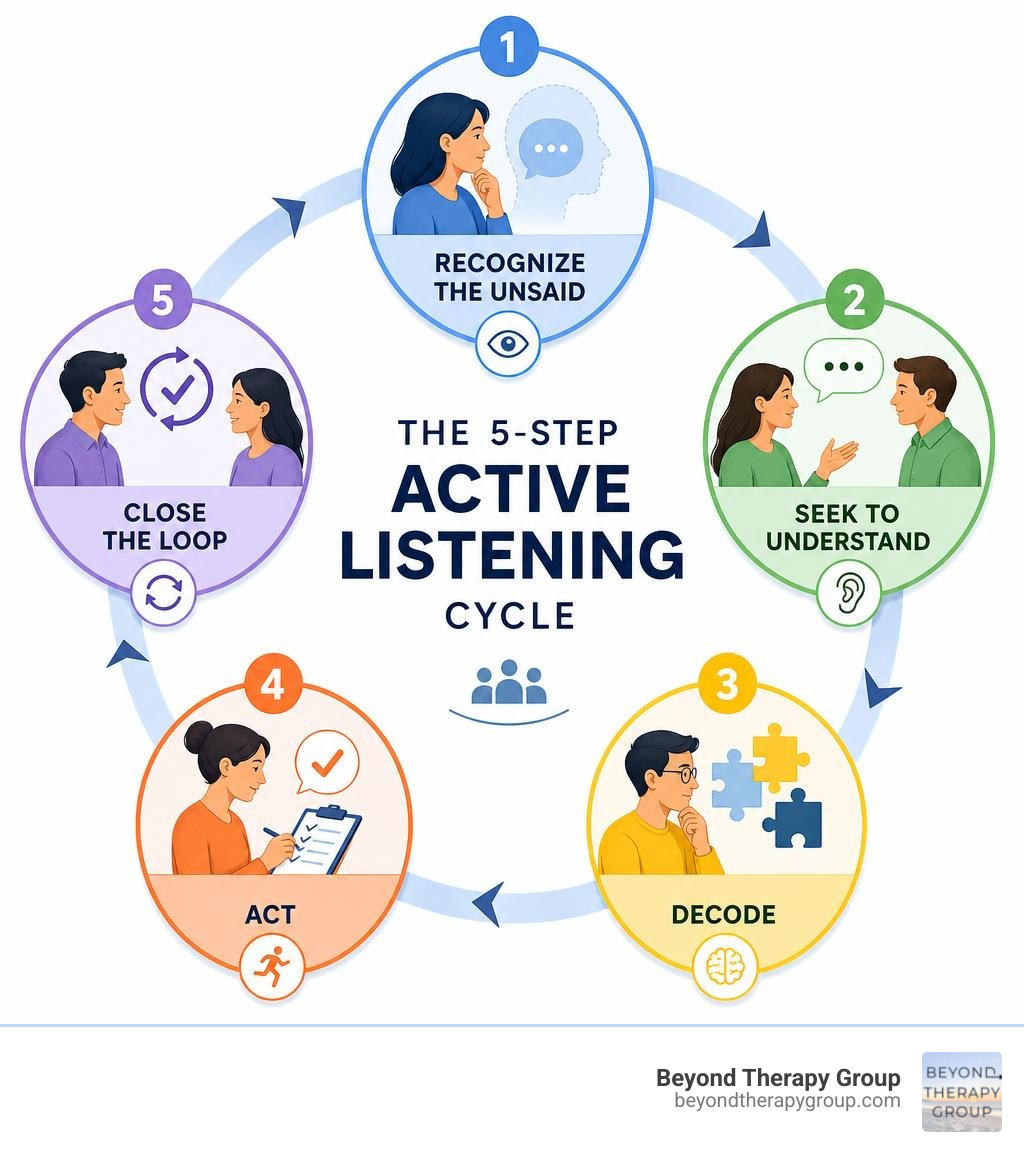
To keep your communication structured and effective, you can follow a repeatable five-step cycle during your conversations. This cycle helps ensure that no details are lost and that the speaker feels genuinely valued:
- Recognize the Unsaid: Pay attention to nonverbal signals, shifts in tone, and what the speaker might be hesitant to say directly.
- Seek to Understand: Lead with curiosity rather than a desire to prove a point. Put aside your assumptions and focus on their perspective.
- Decode: Translate the verbal and nonverbal messages into a clear understanding of the speaker’s core needs and emotions.
- Act: Respond thoughtfully. This might mean offering verbal validation, asking a clarifying question, or agreeing on next steps.
- Close the Loop: Follow up on the conversation. If you promised to look into a resource or adjust a deadline, make sure you do it and let them know. Listening without action is only half the battle.
Mastering this cycle is the secret sauce of effective communication in both your professional career and your personal relationships.
Using Verbal Cues and Clarifying Questions
Once you are mentally present, you need the right verbal tools to show the speaker you are engaged. These tools help clarify the message and keep the conversation moving forward productively:
- Paraphrasing: Restating what you heard in your own words. For example: “It sounds like you are feeling overwhelmed because the project scope expanded, but the deadline stayed the same. Is that right?”
- Open-Ended Questions: Instead of asking questions that only require a “yes” or “no” response, ask questions that invite deeper reflection. Try phrases like, “What do you think is the biggest bottleneck here?” or “How can we best support you with this transition?”
- Summarizing: Periodically wrapping up the main points of the conversation to ensure you are both on the same page. “To make sure I have this right: we are going to pause the design phase, check in with the client on Tuesday, and meet back here on Wednesday morning.”
- Validation: Acknowledging the speaker’s feelings, even if you do not agree with their perspective on the situation. “I can see how frustrating it must have been to find out about that change at the last minute.”

Implementing Active Listening Training in Your Organization
Bringing communication training into a corporate setting is one of the most effective ways to boost performance, reduce costly misunderstandings, and retain top talent. When employees feel heard, they are far more likely to stay engaged and committed to their roles.
Designing an Effective Active Listening Training Program
An exceptional training program goes far beyond lectures and slide decks. To build lasting habits, training must be interactive, practical, and tailored to modern work environments:
- Role-Playing Exercises: Participants practice real-world scenarios, such as managing a difficult performance review or handling an unhappy client, in a safe, constructive environment.
- Mindfulness Practices: Short, practical exercises help employees clear their minds and focus their attention before entering important meetings or conversations.
- Virtual Listening Skills: In our hybrid and remote world, we must learn to manage digital distractions, read nonverbal cues through a webcam, and show engagement in virtual spaces.
- Cross-Cultural Communication: Training should address how different cultures express agreement, disagreement, and respect, helping global teams collaborate smoothly.
If you are looking for structured options to bring to your team, programs like the Active Listening Training Course offer excellent frameworks for corporate workshops and professional development.
Measurable Benefits and Outcomes of Listening Skills
Investing in communication training is not just a “nice-to-have” initiative; it delivers clear, measurable outcomes for organizations:
- Rapid Conflict Resolution: Most workplace conflicts stem from simple misunderstandings. When team members know how to listen to understand rather than to defend themselves, conflicts de-escalate quickly.
- Higher Employee Engagement: Employees who feel their ideas and concerns are genuinely heard are significantly more motivated and productive.
- Seamless Team Collaboration: Projects run smoother when team members clearly understand instructions, respect diverse viewpoints, and align on shared goals.
- Better Decision-Making: When leaders gather input from all levels of the organization and listen to different perspectives, they make more informed, low-risk decisions.
Developing these skills also gives individuals the confidence to speak up and contribute to discussions. To see how listening and speaking work hand-in-hand, you can explore practical techniques to speak with greater clarity.
Frequently Asked Questions About Active Listening
Here are some of the most common questions people ask when exploring communication training.
What is the difference between active and passive listening?
Passive listening is simply hearing the words without fully engaging your mind. You might nod or say “mm-hmm,” but you are likely distracted or planning your response. Active listening requires full mental focus, curiosity, and a conscious effort to understand both the words and the emotions behind them. It involves paraphrasing, validating, and asking clarifying questions to ensure mutual understanding.
How does active listening improve workplace relationships?
It builds a foundation of trust and psychological safety. When people feel heard, they feel valued and respected. This reduces defensive behavior, makes conflict resolution much easier, and encourages open, honest collaboration across teams.
Can active listening skills be learned online?
Yes! Modern e-learning platforms, virtual workshops, and interactive webinars make it highly convenient to build these skills. Many online programs incorporate video examples, self-reflection prompts, and virtual role-playing exercises to help you practice and refine your communication habits from anywhere.
Conclusion
At our practice, we believe that communication is the foundation of both professional success and personal well-being. Whether you are leading a corporate team, navigating a career transition, or trying to strengthen your closest relationships, learning to listen with intention is one of the most transformative steps you can take.
Our team provides personalized support to help you build the self-awareness, emotional intelligence, and communication skills you need to thrive. If you are located in Redondo Beach or the wider South Bay area, we invite you to take the next step in your personal growth journey.

We offer a free 15-minute consultation to help guide your booking, answer any questions you might have, and match you with the right therapist for your needs. Let us help you build stronger connections and communicate with confidence. Reach out to explore our therapy services today.
Recent Posts


