
May 21, 2026
Stop Mumbling and Start Speaking with These Assertive Drills

Why Assertive Speaking Practice Exercises Are Worth Your Time
Key Takeaways
- Assertive speaking practice exercises help you communicate clearly and respectfully without aggression or passivity.
- Core techniques include “I” statements, the DESC script, the broken record method, and fogging.
- Body language like posture, eye contact, and tone are just as important as the words you use.
- Common barriers include anxiety, people-pleasing, and self-defeating beliefs, all of which can be worked through with practice.
- Starting small in low-stakes situations builds confidence for harder conversations over time.

Assertive speaking practice exercises are structured drills that help you express your needs clearly, calmly, and respectfully, without steamrolling others or shrinking into silence.
Here are the most effective ones to start with:
- “I” statements – Say “I feel frustrated when meetings run over” instead of “You always waste my time.”
- DESC script – Describe the situation, Express your feelings, Specify what you want, and state the Consequences.
- Broken record – Calmly repeat your position without getting drawn into arguments.
- Fogging – Acknowledge the other person’s point, then hold your ground.
- Mirror practice – Rehearse assertive responses out loud while watching your body language.
- Saying no drills – Practice declining requests firmly but without over-explaining.
- Role-play scenarios – Act out real-life situations like asking for a raise or pushing back on a deadline.
Most of us were never taught how to speak up for ourselves. We either go quiet and let things slide, or we push too hard and damage relationships. Neither feels good, and over time, both take a real toll on your confidence, your stress levels, and your sense of self.
The American Psychological Association defines assertiveness as expressing your feelings and needs in a direct, honest, and respectful way. It is the middle ground between being passive and being aggressive. And here is the part that matters most: it is a learned skill, not a personality trait.
That means you can get better at it with the right practice.
Handy assertive speaking practice exercises terms:
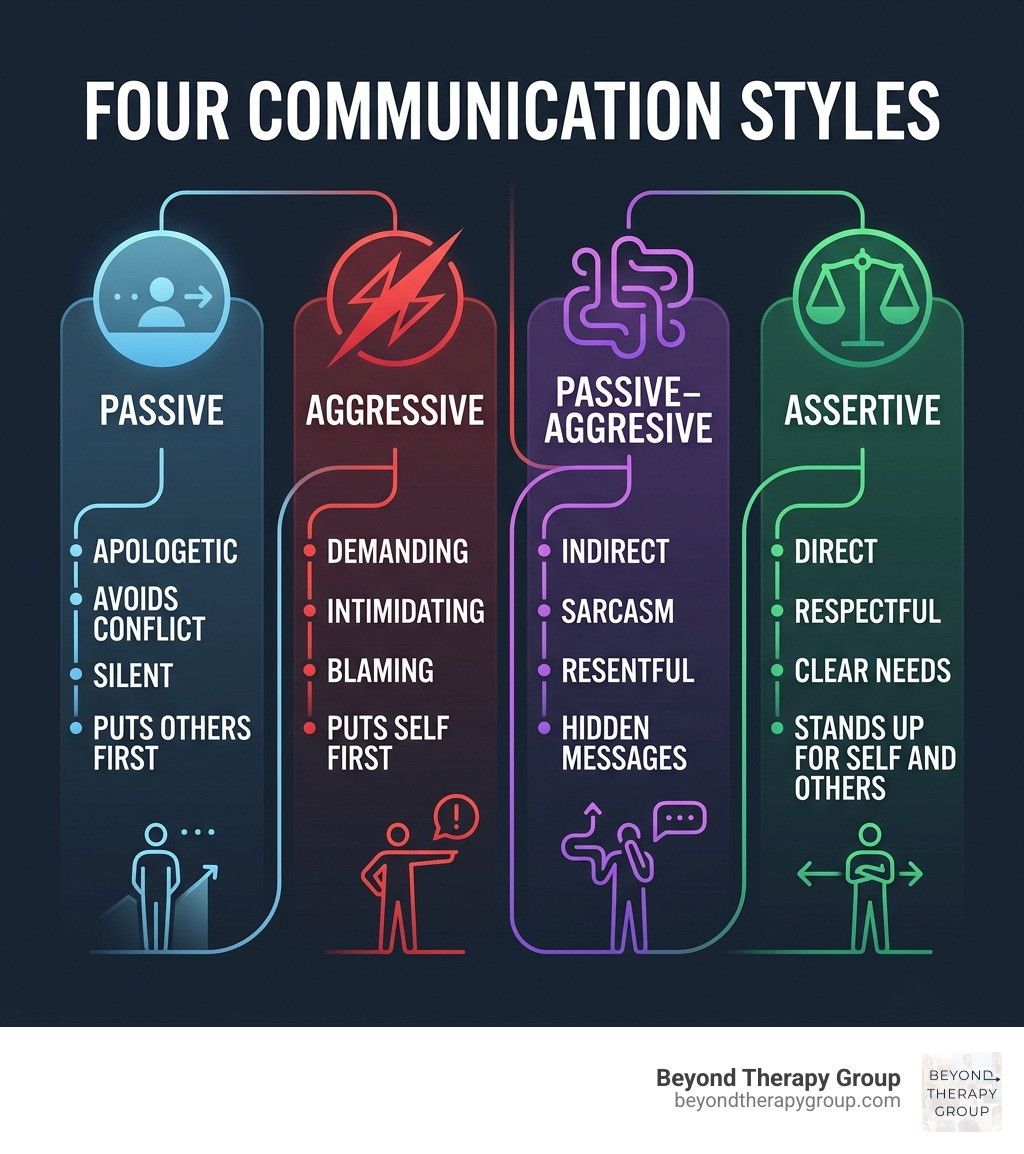
Defining Assertive Communication Styles
To master assertive speaking practice exercises, we first need to recognize what assertiveness actually looks like compared to other styles. In our practice in Redondo Beach, we often see people confuse being “nice” with being passive, or being “strong” with being aggressive.
Passive Communication
This is the “doormat” style. You avoid conflict at all costs, often at the expense of your own needs. You might mumble, look at the floor, or say “it doesn’t matter” when it actually does. The internal result? Resentment and a sense that your voice doesn’t count.
Aggressive Communication
This style is about winning. It involves blaming, shouting, or using “you” statements to put others down. While it might get you what you want in the short term, it destroys trust and alienates the people around you.
Passive-Aggressive Communication
This is a hybrid style where you seem to agree on the surface but sabotage things behind the scenes. Think of it as “sarcasm with a sting” or the “silent treatment.” It is a defensive mechanism that avoids directness while still expressing anger.
Assertive Communication
This is the “sweet spot.” It is built on mutual respect and diplomacy. You stand up for your rights while acknowledging the rights of others. It is direct, honest, and clear.
| Trait | Passive | Aggressive | Assertive |
|---|---|---|---|
| Goal | Avoid conflict | To win | Mutual respect |
| Eye Contact | Avoids it | Staring/Glaring | Steady and direct |
| Voice | Quiet/Hesitant | Loud/Shouting | Calm and firm |
| Posture | Slumped | Leaning in/Tense | Upright and relaxed |
| Language | “I guess,” “Maybe” | “You always,” “You never” | “I feel,” “I need” |
Research from What Is Assertive Communication? How to Speak Up with Confidence highlights that assertive people are more likely to manage conflict effectively because they accept others’ opinions while remaining open about their own needs.
Core Components of Assertive Speaking Practice Exercises
Speaking assertively is a full-body experience. It isn’t just about the words you choose. It involves three core pillars: verbal, nonverbal, and emotional.
The Verbal Component
This is what you say. Assertive language is factual and evidence-based rather than opinionated or judgmental. We recommend saying less. Be direct and specific. Avoid “fluff” words like “I’m sorry, but…” or “If you don’t mind…” which can weaken your message.
The Nonverbal Component
Did you know that a huge portion of your message is sent through your body? If you say “I am confident” while staring at your shoes, no one will believe you.
- Eye Contact: Maintain steady, soft eye contact. Don’t stare like a predator, but don’t look away like you’re hiding.
- Posture: Stand or sit upright. Keep your shoulders back and your chest open.
- Tone: Aim for a medium pace. Project your voice so you are easily heard, but keep the volume controlled.
- Facial Expressions: Keep your face neutral or aligned with your message. If you are delivering a serious boundary, don’t smile nervously.
The Emotional Component
This is about staying centered. Before starting one of your assertive speaking practice exercises, take a deep breath. Managing your internal anxiety allows you to respond thoughtfully rather than reacting emotionally.

Learn more about these elements in our guide on Mastering the Art of Speaking Up for Yourself.
Practical Drills for Daily Confidence
Now, let’s get into the actual “gym work” of communication. These assertive speaking practice exercises are designed to be practiced alone or with a trusted partner.
Essential Assertive Speaking Practice Exercises for Daily Life
1. The DESC Script
Developed by Sharon and Gordon Bower, this is the gold standard for assertive requests.
- D (Describe): State the facts of the situation objectively. “The report was due at 3:00 PM, and I haven’t received it yet.”
- E (Express): Use “I” statements to share your feelings. “I feel stressed because I can’t finish my part without it.”
- S (Specify): Clearly state what you want to happen. “I need you to send me the draft by 5:00 PM today.”
- C (Consequences): State the positive outcome of following through. “If I get it by then, we can submit the project on time and avoid a late penalty.”
2. “I” Statements
This exercise involves rewriting accusatory “you” statements.
- Instead of: “You never listen to me!”
- Try: “I feel unheard when I’m speaking and you are looking at your phone.” This reduces defensiveness and keeps the focus on your experience.
3. The Broken Record
This is perfect for dealing with pushy salespeople or people who won’t take “no” for an answer. You simply repeat your firm, calm statement over and over without getting angry or changing your mind.
- “I understand, but I’m not interested in buying this today.”
- “I hear you, but the answer is still no.”
4. Fogging
Fogging is a technique for handling criticism. You find a small grain of truth in what the other person is saying (the “fog”) to acknowledge their point without agreeing with the insult or becoming defensive.
- Criticism: “You’re always late with your work!”
- Fogging response: “You’re right, I was late with this specific report. I’m working on a better schedule for the next one.”
5. Mirror Practice
Stand in front of a mirror and deliver a 30-second assertive pitch. Watch your facial expressions and posture. Are you fidgeting? Is your voice steady? This helps align your nonverbal cues with your words. You can find more structured scripts in this Assertive Communication handout from the VA.
Advanced Techniques for Setting Boundaries
Saying No Without the Guilt
Many people in the South Bay area struggle with people-pleasing. A great exercise is the “No Sandwich.”
- Start with a brief acknowledgement: “Thank you for thinking of me.”
- Deliver the clear “No”: “I’m not able to take on any more projects right now.”
- End with a polite closing: “I hope the event goes well!” Do not over-explain. “No” is a complete sentence.
Handling Criticism and Giving Feedback
When giving feedback, focus on the behavior, not the person. Use the “Problem-Feeling-Ask” formula.
- Problem: “I noticed you’ve been late to our meetings this week.”
- Feeling: “I’m concerned that we’re missing important information.”
- Ask: “Can we agree to start exactly at 9:00 AM from now on?”
Three Ways to Enter a Circle
This is a visualization or physical drill. Imagine entering a circle of people at a party or meeting.
- Passive: Imagine shuffling in, head down, waiting for someone to notice you.
- Aggressive: Imagine pushing through, interrupting the conversation, and demanding attention.
- Assertive: Imagine walking up with an upright posture, waiting for a natural pause, making eye contact, and saying, “Do you mind if I join you?”
For more on these traits, check out Talk the Talk: Essential Traits of Great Communicators.
Overcoming Internal Resistance
Even with the best assertive speaking practice exercises, you might feel a “block” when it’s time to use them. This is normal.
Overcoming Barriers to Assertive Speaking Practice Exercises
Anxiety and Physical Tension
When we feel threatened, our bodies go into fight-or-flight mode. This makes assertive speaking difficult. Practice “Box Breathing” (inhale for 4, hold for 4, exhale for 4, hold for 4) before a tough conversation to calm your nervous system.
Self-Defeating Beliefs
We often carry “scripts” in our heads that stop us from being assertive.
- Belief: “If I say no, they won’t like me.”
- Reality: “It is impossible to please everyone, and setting boundaries actually earns respect.”
- Belief: “My needs aren’t as important as theirs.”
- Reality: “I have a right to express my needs and feelings respectfully.”
Cultural Influences
Depending on your upbringing, you may have been taught that being assertive is “rude” or “disrespectful,” especially toward authority figures. It is important to remember that assertiveness is a tool for healthy relationships, not a sign of disrespect.
Skills Deficit
Sometimes we aren’t assertive simply because we don’t know the words. This is why role-playing and DESC scripts are so vital. They give you a “template” to use when your brain freezes up.

A great resource for shifting your mindset is this guide on How to think assertively from CBT SoCal.
Frequently Asked Questions about Assertiveness
What is the difference between assertive and aggressive?
Assertiveness is about standing up for yourself while respecting others. Aggression is about standing up for yourself by putting others down. Assertiveness uses “I” statements and a calm tone; aggression uses “you” statements and often involves shouting or intimidation.
How do I practice assertiveness without feeling guilty?
Guilt is a common side effect of breaking a people-pleasing habit. Remind yourself that setting boundaries is a form of self-care, not a form of selfishness. The more you do it, the less guilt you will feel. Start with low-stakes situations, like telling a waiter your order was wrong, before moving to big conversations with family or bosses.
Can assertiveness training help with workplace anxiety?
Absolutely. Research shows that assertiveness training significantly lowers stress, anxiety, and depression. In the workplace, being assertive helps you manage your workload, set clear expectations, and avoid the burnout that comes from over-committing.
Conclusion
Mastering assertive speaking practice exercises is one of the most powerful things you can do for your personal and professional development. It improves your emotional balance, strengthens your relationships, and builds a level of confidence that carries into every part of your life.
You don’t have to become an expert overnight. Start small. Practice in the mirror. Try one “I” statement today. If you find that internal barriers like deep-seated anxiety or past experiences are making it hard to speak up, we are here to help.
At Beyond Therapy, we offer tailored consultations to help you navigate these challenges. We provide a free 15-minute consultation with our therapists in Redondo Beach and the South Bay area to help guide your journey and answer any questions you may have.
Ready to find your voice? Learn more about our therapy services and take the first step toward speaking your truth with confidence.
Recent Posts


