
May 12, 2026
Drawing the Line with Toxic and Controlling Partners

Key Takeaways
- Healthy boundaries focus on personal autonomy rather than changing a partner’s behavior.
- Controlling tactics often include isolation, financial restriction, and emotional manipulation.
- Consistency and clear communication are essential when facing resistance from a partner.
- Professional support is necessary if safety is at risk or if control escalates to abuse.
Why Setting Boundaries with a Controlling Partner Can Change Everything
If you feel watched, managed, or guilty for simply living your life, you are not alone.
Here is a quick overview of how to protect yourself:
- Name what is happening. Recognize controlling behavior for what it is: isolation, monitoring, criticism, or financial restriction.
- Know your limits. Identify what you will and will not accept in the relationship.
- Communicate clearly. Use “I” statements to express your needs without blame.
- Stay consistent. Follow through every time a limit is crossed.
- Build outside support. Reconnect with friends, family, or a therapist to reduce dependency.
- Get help if safety is at risk. If control escalates to threats or abuse, seek professional support immediately.
Controlling relationships rarely start with obvious red flags. More often, the pattern builds slowly. A partner questions where you are going. Then who you are seeing. Then what you are wearing. Before long, you feel like you need permission to live your own life.
Research shows that approximately 41% of women and 26% of men have experienced coercive control tactics from an intimate partner at some point in their lives. This can include being cut off from friends and family, having finances monitored or restricted, or being watched constantly.
The impact is real. Many people in these dynamics report anxiety, low self-esteem, and a creeping sense that their feelings and needs simply do not matter.
The good news? Setting firm, clear limits can shift the dynamic. Controllers only hold power when you comply. When you stop complying, consistently and calmly, the dynamic starts to change.
This guide walks you through exactly how to do that.
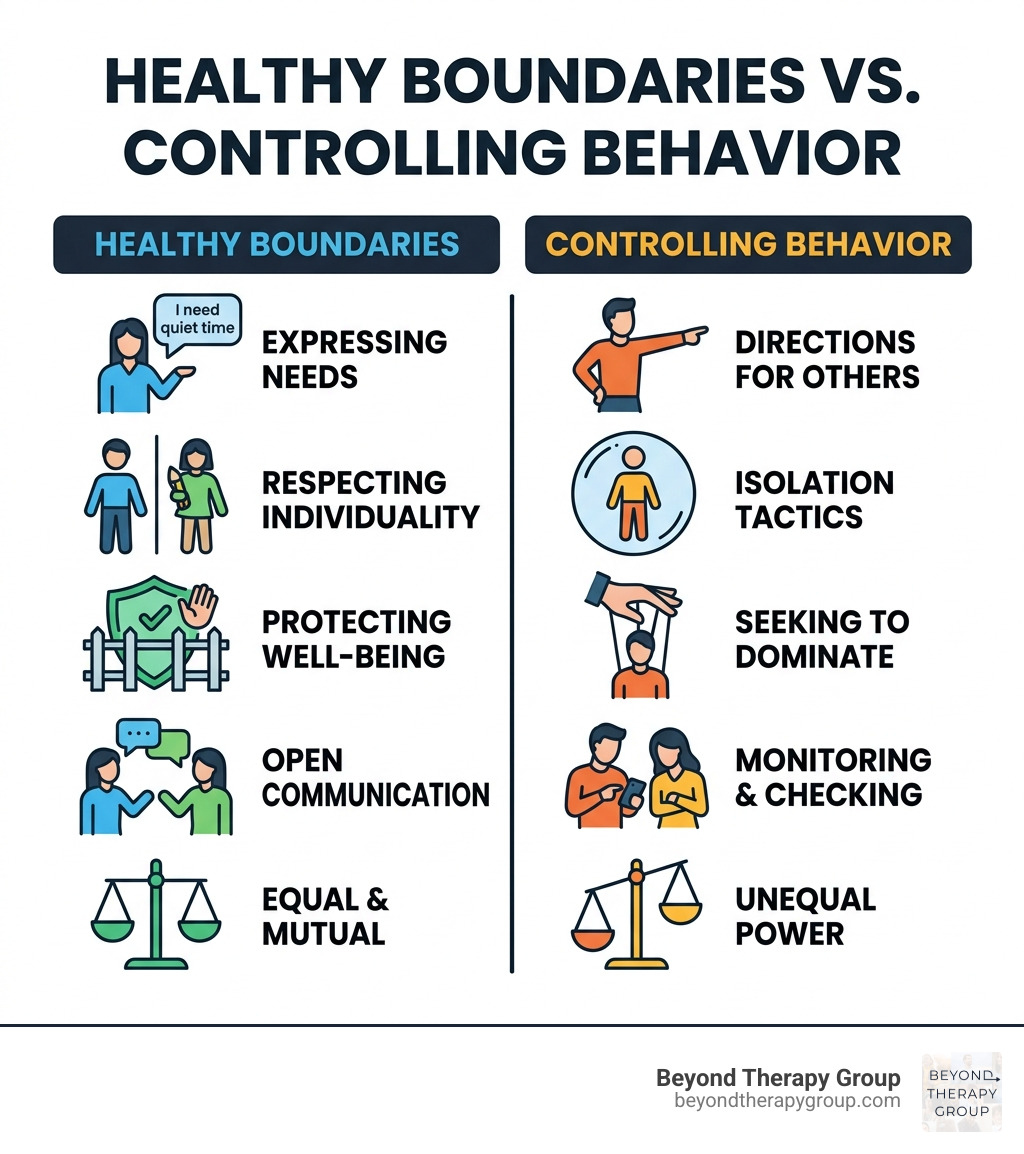
Boundaries vs. Control: Knowing the Difference
In our work at Beyond Therapy, we often see a confusing trend in modern dating. People sometimes use “therapy speak” to justify a need for power. You might hear a partner say, “It is my boundary that you don’t talk to other men,” or “I have a boundary that you cannot post pictures in a swimsuit.”
We need to be very clear: those are not boundaries. Those are rules for someone else’s behavior.
True boundaries are about your rules of engagement. They are about what you will do, what you find acceptable, and how you protect your own peace. They are “on your side of the street.” When we set boundaries with a controlling partner, we are not trying to change who they are. We are stating what we will no longer tolerate in our own lives.

Setting a boundary is an act of self-respect. It says, “I value myself enough to protect my time, my body, and my emotional energy.” Control, on the other hand, is born from a lack of trust and an attempt to dictate another person’s actions. While a boundary fosters autonomy and respect, control erodes it.
To help you get started, we recommend checking out our Ultimate Checklist for Healthy Boundaries to see where your relationship currently stands.
Defining Personal Limits
Personal limits are the specific lines you draw regarding your preferences, desires, and dealbreakers. They are the “no-go” zones of your life. For example:
- Preferences: “I prefer to have at least one night a week to see my friends without checking in constantly.”
- Desires: “I want a relationship where we both have access to our own separate bank accounts.”
- Dealbreakers: “I will not stay in a relationship where my phone is searched or my location is tracked without my consent.”
If you find it difficult to identify where your lines are, you might find The Ultimate Guide to Drawing Lines in the Sand helpful for clarifying your non-negotiables.
Identifying Controlling Behavior
Controlling behavior often masks itself as “concern” or “protection.” A partner might say they want your passwords “for safety” or discourage you from seeing a certain friend because that friend is “unstable.”
The core of control is coercion and dominance. It involves a pattern of oppression where one person uses fear, guilt, or anger to keep the other person in line. Unlike a healthy request for compromise, a controlling demand does not leave room for your choice. If you say “no” and the result is a “punishment” (like the silent treatment, raging, or threats), you are dealing with control, not a boundary.
Recognizing the Signs of a Controlling Partner
It can be startling to realize that 1 in 4 women and 1 in 9 men experience severe intimate partner violence, according to data from the National Domestic Violence Hotline. Often, this violence begins with subtle, non-physical control. Recognizing these signs early is vital for your safety.

One of the most common signs is constant criticism. A controlling partner might nitpick your appearance, your career choices, or even how you load the dishwasher. This is designed to chip away at your confidence until you feel you cannot make decisions without their input.
Another red flag is conditional love. This is the “I will only be nice to you if you do exactly what I want” dynamic. It creates an environment where you are constantly walking on eggshells, trying to avoid the next blow-up. For a deeper look at protecting your relationship from these dynamics, read about the 6 Boundaries Every Couple Needs.
Emotional and Digital Monitoring
In 2026, control has moved into the digital space. Surveillance is a major component of modern coercive control. This might look like:
- Demanding to see your text messages or social media DMs.
- Insisting on knowing your phone password.
- Using “Find My” or other location-tracking apps to monitor your every move.
- Installing cameras in the home under the guise of “security” but using them to watch you.
This type of monitoring is often fueled by the partner’s own internal struggles. To understand why your partner might feel this intense need for surveillance, it helps to explore How Fear Shows Up in Your Relationship Based on Your Attachment Style. Often, an insecure attachment style leads a person to believe that “closeness” equals “total access,” which is a dangerous misconception.
Financial and Social Isolation
Isolation is a classic tactic used to make you more dependent on the controller. It usually starts small. They might make snide comments about your family or create a scene every time you try to go out with friends. Eventually, you stop going out just to avoid the conflict.
Financial abuse is perhaps the most hidden form of control, yet it appears in approximately 99% of domestic violence cases. This can include:
- Restricting your access to bank accounts.
- Monitoring every cent you spend.
- Preventing you from working or pursuing an education.
- Opening credit cards in your name without your knowledge.
To help you distinguish between a partner who is simply opinionated and one who is being coercive, we have put together this comparison:
| Feature | Healthy Influence | Coercive Control |
|---|---|---|
| Decision Making | Decisions are made together through compromise. | One partner makes all major decisions unilaterally. |
| Social Life | You are encouraged to have your own friends and hobbies. | You are discouraged or prevented from seeing loved ones. |
| Privacy | Your phone, journals, and conversations are private. | Your digital and physical life is constantly monitored. |
| Finances | Both partners have transparency and access to funds. | Money is used as a tool for punishment or restriction. |
| Communication | You can express disagreement without fear of retaliation. | Disagreement leads to anger, guilt-trips, or threats. |
Practical Strategies for Setting Boundaries with a Controlling Partner
Setting boundaries with a controlling partner requires a shift in mindset. You are not asking for permission. You are informing them of your reality.
The most powerful tool you have is the word “no.” Many people in controlling relationships are “people pleasers” who fear conflict. However, saying “no” is like a muscle; the more you use it, the stronger it gets. When you refuse to comply with a controlling demand, the partner loses their primary source of power. They may become annoyed or frustrated, but you remain free.
If you struggle with the “how” of this, we recommend our guide on Mastering the Art of Speaking Up for Yourself.
Communicating Boundaries with a Controlling Partner Effectively
When you speak, be direct and use “I” statements. Avoid getting defensive or over-explaining your reasons. Over-explaining gives a controlling person “hooks” to argue with.
Try using “Policy Statements.” These are incredibly effective because they frame the boundary as a personal rule rather than a personal attack.
- Instead of: “I hate it when you check my phone, please stop.”
- Try: “I have a policy of keeping my digital communications private. I won’t be sharing my password anymore.”
- Instead of: “You always get mad when I go to my mom’s house.”
- Try: “I value my relationship with my family. I will be visiting my mother on Sunday afternoons.”
By stating your boundary as a policy, you make it non-negotiable. For more tips on how to frame these conversations, see our article on how to Speak Your Truth and Save Your Relationship.
Maintaining Boundaries with a Controlling Partner During Conflict
Expect resistance. A person who is used to having control will not give it up easily. They may use guilt (“If you loved me, you’d do this”), anger, or pouting.
When this happens, do not engage in the argument. If you set a limit and they start to rage, you can say: “I can see you are upset, but my decision stands. I am going to the other room now.”
Disengaging is not “losing.” It is refusing to play the game. If you stay in the room and argue, you are giving them the attention and power they are seeking. By leaving the room or ending the conversation, you are enforcing your boundary in real-time.
Reclaiming Independence and Managing Resistance
Reclaiming your life is a process that takes time, patience, and self-compassion. It starts with rediscovering who you were before the relationship became about the other person’s needs.
One of the best things you can do is reconnect with your support system. Controllers thrive in the dark. By bringing your friends and family back into your life, you create a safety net that makes you less vulnerable to manipulation.
Handling Negative Reactions
When you first start setting boundaries with a controlling partner, you might experience what psychologists call an “extinction burst.” This is a temporary increase in the bad behavior as the partner tries even harder to get you to comply.
They might:
- Pout or use the silent treatment.
- Accuse you of being selfish or “changed.”
- Threaten to leave the relationship.
Consistency is the only way through this. If you give in during an extinction burst, you teach the partner that they just need to be more aggressive or more manipulative to get what they want. If you stay firm, they will eventually realize the old tactics no longer work.
Building a Support Network
You do not have to do this alone. In fact, doing it alone is much harder. We encourage our clients in Redondo Beach and across the South Bay to build a “team” for their recovery.
- Friends and Family: People who knew you before the control started can help remind you of your worth.
- Mentors: A trusted supervisor or teacher can provide a perspective outside the relationship.
- Professional Guidance: A therapist can provide you with the tools to manage the anxiety that comes with setting boundaries.
At Beyond Therapy, we specialize in helping people find their voice. If you feel stuck, we offer a free 15-minute consultation with our therapists to help you figure out the best way forward.
Frequently Asked Questions about Boundaries with a Controlling Partner
What is the difference between a boundary and a demand?
A boundary is about your behavior and what you will accept (“I will leave the room if I am being yelled at”). It focuses on your autonomy and self-respect. A demand is about the other person’s behavior and aims to restrict their freedom (“You are not allowed to go to that party”). Boundaries invite respect; demands invite resentment.
Why does my partner react with anger when I set a limit?
Anger is often a defense mechanism against a perceived loss of power. When you set a limit, you are taking back the power that they have grown accustomed to. For some, this triggers deep-seated insecurities or fears of abandonment. However, their anger is their responsibility to manage, not yours to “fix” by giving in.
When is it time to leave a controlling relationship?
While some controlling behaviors can be addressed through therapy and firm boundaries, there are times when leaving is the only healthy option. You should consider leaving if:
- Your safety or the safety of your children is at risk.
- Your partner refuses to acknowledge their behavior or seek help.
- Your boundaries are consistently and intentionally violated despite your best efforts.
- You feel a persistent sense of fear or “walking on eggshells.”
If you are unsure, exploring Relationship and Relational Therapy can help you gain the clarity you need to make a safe decision.
Conclusion
Reclaiming your autonomy from a controlling partner is one of the most difficult, yet rewarding, things you will ever do. It is about more than just “fixing” a relationship; it is about saving yourself. By understanding the difference between healthy limits and coercive control, and by standing firm in your own worth, you can begin to reshape your life.
You have a right to your feelings, your friends, your finances, and your freedom. If you are struggling to draw those lines in the sand, we are here to support you.
Beyond Therapy provides tailored consultations and therapy services designed to help you navigate these complex dynamics. We offer a free 15-minute consultation to answer your questions and help you find the right path forward in your journey toward emotional health.
More info about relational therapy services
You deserve a relationship built on mutual respect, trust, and the freedom to be exactly who you are. Don’t wait to start drawing the line.
Recent Posts