
July 4, 2026
The Best Family Boundaries Counseling Services for Beginners

Why Family Boundaries Counseling Services Matter for Your Mental Health
Key Takeaways
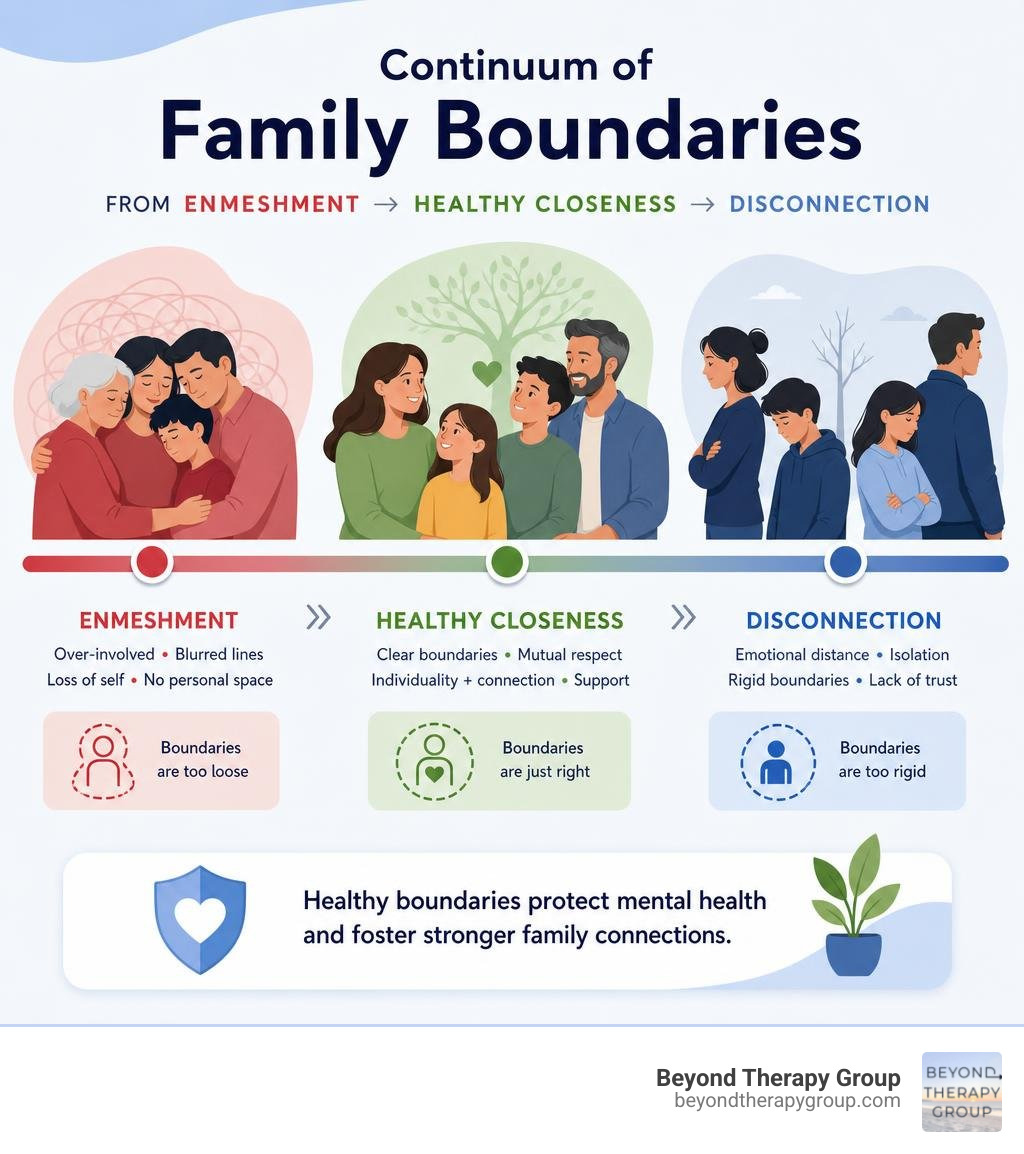
- Healthy boundaries protect mental health and foster stronger family connections.
- Enmeshment blurs personal identity while healthy closeness respects individual autonomy.
- Guilt and cultural expectations often make setting limits with relatives challenging.
- Assertive communication and consistent enforcement help manage family pushback.
- Professional counseling provides the tools needed to navigate complex relational dynamics.
Family boundaries counseling services help individuals and families build healthier limits, improve communication, and reduce the stress that comes from unclear or broken relational patterns. If you’re looking for the right support, here’s a quick overview:
What to look for in family boundaries counseling services:
- Therapists trained in family systems who understand how patterns develop across generations
- Culturally sensitive approaches that honor your background while supporting your individual needs
- Practical skill-building including assertive communication and role-playing difficult conversations
- Trauma-informed care for families with deeper relational wounds
- Flexible formats that work for busy schedules, including individual sessions focused on family dynamics
Family relationships are some of the most meaningful connections in our lives. They can also be the most complicated.
You might feel drained after every phone call with a parent. You might say yes to things you deeply want to say no to. You might carry guilt just for having needs of your own.
You’re not alone in that.
Research shows that 68% of adults feel obligated to stay close to family members even when it harms their mental health. And unresolved family boundary issues are directly linked to higher rates of anxiety, depression, and burnout.
The good news? Healthier patterns are possible. With the right guidance, you can protect your wellbeing and stay connected to the people you love.
Family boundaries counseling services terms to remember:
Understanding Family Boundaries: Closeness vs. Enmeshment
To understand how to build healthier relationships, we first need to look at what boundaries actually are. Many people think a boundary is a giant concrete wall designed to keep people out. In reality, a healthy boundary is much more like a fence with a secure gate. It allows you to let the good things in while keeping the harmful things out.
When we talk about family dynamics, boundaries are the invisible lines that define where you end and your relative begins. These limits are essential for emotional regulation and maintaining a strong sense of autonomy. Without them, family members can easily step on each other’s toes, leading to anxiety and exhaustion.
If you want to dive deeper into how these limits function, you can read The Ultimate Guide to Counseling for Healthy Boundaries.
To help make sense of how your family interacts, it is helpful to look at the difference between a healthy, close-knit dynamic and an enmeshed dynamic.
| Boundary Type | Enmeshment | Healthy Closeness |
|---|---|---|
| Personal Identity | Your identity is completely defined by your family role. | Your identity is defined by your own personal values and interests. |
| Privacy | Personal privacy is viewed as keeping secrets or betraying the family. | Privacy is respected as a normal, healthy part of being an individual. |
| Conflict Resolution | Disagreement feels like an existential threat or a deep betrayal. | Conflict is handled through open communication and mutual respect. |
| Support Style | Smothering support that often leads to codependency. | Empowering support that encourages individual growth and decision-making. |
Defining Healthy Limits in the Household
Establishing healthy limits in your household is not about punishing your relatives. It is a vital form of self-care that protects your mental health. When everyone in a household understands what is okay and what is not okay, relational stress drops significantly.
Think of household boundaries as guidelines for mutual respect. This includes physical limits, like knocking before entering a room, and emotional limits, like not venting raw frustrations onto a sibling who is already overwhelmed. When we do not define these limits, we invite resentment into our homes. If you are ready to evaluate the limits in your own life, you can use our Ultimate Checklist for Healthy Boundaries to see where you stand.
Enmeshment vs. Healthy Closeness
It can be difficult to spot the difference between a family that is wonderfully close and one that is enmeshed. Close-knit families offer a safety net. They love and support you, but they also celebrate your unique path, even if it looks different from theirs.
In an enmeshed family, that safety net is replaced by a leash. If you try to make a decision that does not align with the family consensus, you might be met with intense pushback or guilt. In these systems, personal privacy is often treated as a threat. Knowing the difference is the first step toward reclaiming your peace.
Recognizing the Signs You Need Better Boundaries
Sometimes, the need for better boundaries does not show up as a loud argument. Instead, it shows up as a quiet, heavy exhaustion. You might find yourself sighing deeply every time a family member’s name pops up on your phone screen.

When we ignore our own limits to maintain family loyalty, we pay a steep emotional price. Over time, constant boundary crossings lead to deep resentment, burnout, and anxiety. This is especially true when cultural expectations and guilt trips make you feel like you must choose between your own mental health and being a good family member.
Common Warning Signs with Parents and Siblings
How do you know if your family relationships have crossed the line from close to unhealthy? Here are a few common scenarios that our clients in Redondo Beach and the South Bay often share with us:
- The Overbearing Parent: A parent who calls you multiple times a day and gets upset if you do not answer immediately. They might also offer unsolicited advice on your career, parenting, or relationships, expecting you to follow their advice without question.
- The Intrusive Sibling: A brother or sister who asks highly personal questions about your finances or personal life, then uses that information to judge your choices.
- The Obligation Trap: Feeling like you must attend every single family gathering, even when you are physically exhausted or mentally drained, simply to avoid a guilt trip.
If these situations sound familiar, you can explore our Relationship Boundaries List: Complete Guide to identify other areas where your limits might be getting crossed. You might also find it helpful to learn about Protect Your Relationship: 6 Boundaries Every Couple Needs to keep your partnership strong when family drama starts to spill over.
The Cultural and Emotional Barriers to Saying No
Setting boundaries is rarely easy, but it can feel nearly impossible when collective values and cultural obligations are involved. Many cultures place a beautiful emphasis on family loyalty, respecting elders, and community support. However, these values can sometimes be weaponized to keep you from saying no.
A major study highlighted that 70% of participants reported improved well-being when balancing cultural obligations with personal boundaries. This proves that you do not have to reject your culture or stop loving your family to protect your peace. It is entirely possible to honor your heritage while also practicing healthy emotional regulation and honoring your personal limits.
How to Set and Maintain Boundaries Without the Guilt
One of the biggest hurdles to setting boundaries is the wave of guilt that often follows. We worry that saying no makes us selfish, cold, or a bad relative.

To move past this, we have to reframe how we view boundaries. Assertive communication is not a weapon to push people away. It is a tool that allows you to show up authentically in your relationships. When you set a clear limit, you are actually teaching people how to love and respect you over the long term.
If you want to learn how to communicate your needs clearly and kindly, check out our guide on How to Set Boundaries in Your Relationship Without Being a Jerk.
Practical Scripts for Setting Family Boundaries
When you are ready to set a boundary, using clear, compassionate, and direct language is key. You do not need to apologize, over-explain, or make excuses. Here are a few simple scripts you can adapt for your own life:
- To an overbearing parent: “I love talking to you, but I cannot answer the phone while I am at work. I will call you back on Tuesday evening when I am free.”
- To an intrusive relative: “I know you are asking because you care, but I am not comfortable discussing my finances. Let’s talk about how your garden is doing instead.”
- To a sibling asking for a favor you cannot do: “I would love to help you move, but I have a lot on my plate this weekend and need to rest. I hope you find someone else to assist!”
For more practice on speaking up for yourself, you can explore our resources on Mastering Assertiveness and Boundary Training for Better Relationships.
Handling Pushback and Resistance
When you start enforcing new boundaries, expect some pushback. Your family has spent years, sometimes decades, interacting with you in a specific way. When you change the rules of the game, they might react with confusion, anger, or guilt trips.
This resistance is not a sign that your boundary is wrong. In fact, it is often proof that the boundary was desperately needed. The key to navigating this pushback is consistency. If you set a limit but give in the moment someone gets upset, you teach them that your boundaries are negotiable. Stay firm, stay kind, and remember that you are not responsible for managing their emotional reactions. If you are dealing with a partner or relative who struggles to respect your limits, you might find our guide on Drawing the Line with Toxic and Controlling Partners helpful.
Choosing the Right Family Boundaries Counseling Services
If you have tried setting boundaries on your own and keep running into a wall, it might be time to seek professional support. Navigating deep-seated family dynamics is hard work, and you do not have to do it alone.
At Beyond Therapy, we offer specialized, systemic family therapy designed to help you understand your relational patterns and build healthier habits. Whether you want to work on these dynamics individually or bring family members into the room, our team of compassionate therapists is here to help. We proudly serve clients throughout Redondo Beach and the wider South Bay community.
How Family Boundaries Counseling Services Facilitate Healing
Working with a professional therapist offers a safe, neutral space to unpack years of family conditioning. Here is how specialized counseling can help you make real progress:
- Identifying Unspoken Rules: Every family has unspoken rules, like “never disagree with dad” or “we don’t talk about difficult things.” A therapist helps you bring these hidden expectations to light.
- Role-Playing Conversations: Practicing what you want to say in a safe environment builds your confidence before you have the real conversation with your relatives.
- Processing Grief: Sometimes, setting boundaries means accepting that a family member may never change. Therapy helps you process the grief of letting go of the relationship you wished you had, allowing you to appreciate the one you actually have.
To get a better idea of how this process works, read our article on A Deep Dive into Boundaries in a Counselling Relationship and see our A Practical Guide to Boundary Work in Psychotherapy.
When to Seek Professional Family Boundaries Counseling Services
It can be hard to know when a relationship issue is just a minor bump in the road or a sign that you need professional help. We recommend reaching out for support if you experience any of the following:
- You feel persistent anxiety or dread before interacting with family members.
- You are considering cutting ties completely because the relationship feels too painful to maintain.
- You find yourself using substances or other unhealthy coping mechanisms to deal with family stress.
- Past family-of-origin trauma is actively interfering with your current relationships, career, or self-esteem.
Frequently Asked Questions About Family Boundaries
Is setting boundaries with my family selfish?
No, setting boundaries is not selfish. It is a necessary act of self-care. When you do not set boundaries, you eventually run out of emotional energy, which leads to resentment and burnout. Setting clear limits allows you to preserve your mental health so you can show up with genuine love and mutual respect.
How long does it take to see improvements with family boundaries?
Most clients begin to feel more confident and experience clearer communication within four to six weeks of consistent therapy and practice. However, mastering these skills in highly stressful situations can take several months. Relational patterns that took decades to build do not disappear overnight, but steady, consistent practice leads to lasting behavioral shifts.
Can I set boundaries if my family refuses to participate in therapy?
Absolutely. While it is wonderful when a whole family wants to heal together, you do not need their cooperation to change your own life. When you work with a therapist individually, the focus shifts to personal empowerment. By changing how you react and interact within the system, you naturally disrupt the old, unhealthy patterns and protect your own peace.
Conclusion
Building healthy family relationships is a journey that requires time, patience, and plenty of self-compassion. You can love your family deeply while still protecting your own mental health. You do not have to choose between being a good relative and being a healthy individual.
If you are ready to take the first step toward stronger, more respectful relationships, we are here to support you. Beyond Therapy offers a free 15-minute consultation with our therapists to help guide your booking and answer any questions you might have about our services in Redondo Beach and the South Bay.
Schedule a consultation for relational therapy with us today, and let’s start building a healthier foundation together.
Recent Posts