
June 10, 2026
Counseling for Healthy Boundaries: Beginner’s Guide

- Healthy boundaries protect your mental health and help you build stronger and more respectful relationships
- Common obstacles like guilt and people-pleasing can be worked through with professional support
- Boundary setting is a learnable skill that improves with practice and the right guidance
- Counseling gives you a safe space to identify your limits and communicate them with confidence
- Setting limits is an act of self-care and not selfishness
Why Healthy Boundaries Matter for Your Mental Health
What is counseling for healthy boundaries?
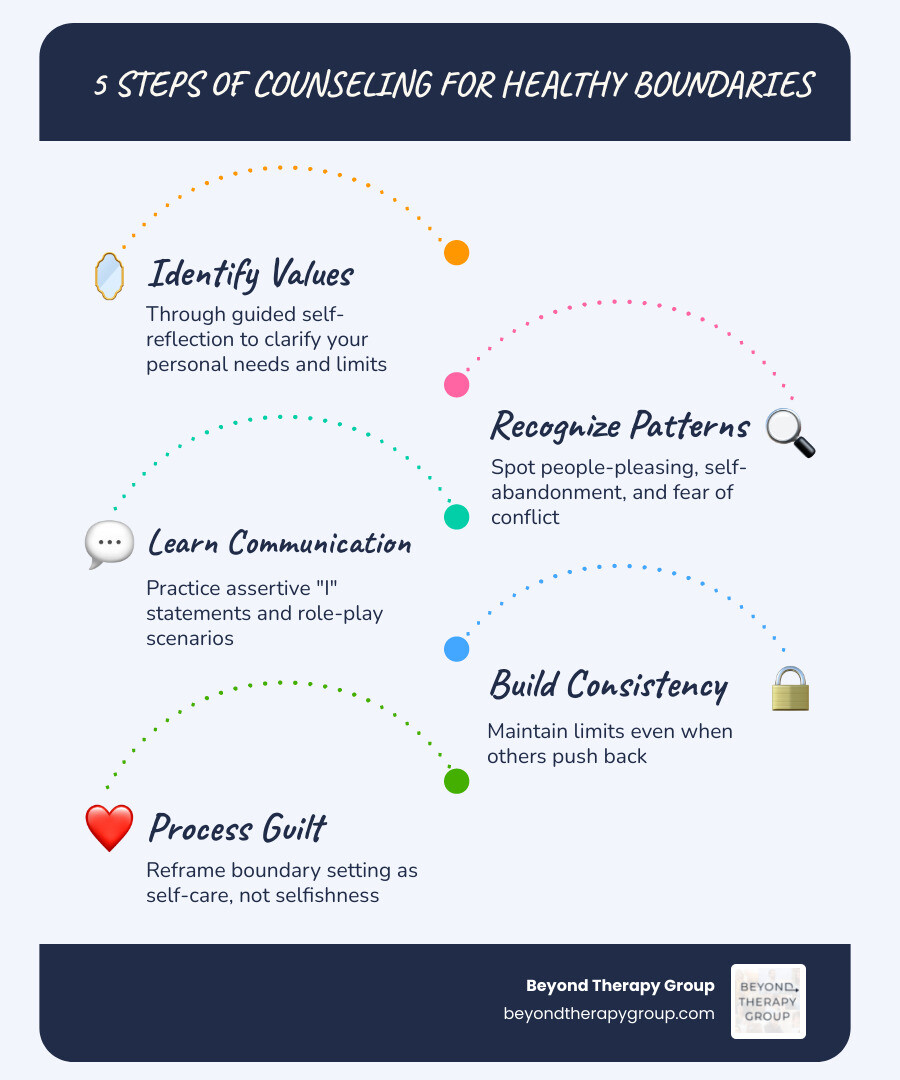
Counseling for healthy boundaries is a form of professional therapy that helps you identify your personal limits, communicate them clearly, and maintain them consistently across relationships. Here is what it typically involves:
- Identifying your values and needs through guided self-reflection
- Recognizing patterns like people-pleasing, self-abandonment, or fear of conflict
- Learning assertive communication using tools like “I” statements and role-play practice
- Building consistency so limits hold up even when others push back
- Processing guilt and reframing boundary setting as self-care rather than selfishness
Do you say yes when you mean no? Do you feel drained after helping everyone around you? Do you dread conflict so much that your own needs go unmet?
If that sounds familiar, you are not alone.
Setting limits in relationships is one of the most common struggles people bring to therapy. And it makes sense. Most of us were never taught how to do it well.
Research shows that setting and maintaining boundaries helps regulate stress hormones, improves emotion regulation, and strengthens relationships over time. Yet for many people, the idea of drawing a line with a partner, parent, or coworker feels almost impossible.
The good news is that boundary setting is a skill, not a personality trait. It can be learned, practiced, and improved. And with the right support, it does not have to damage the relationships you care about most.
That is exactly where counseling comes in.
Counseling for healthy boundaries vocab to learn:
Understanding Healthy Boundaries in Relationships
At its heart, a boundary is simply a guideline for how you want to be treated and how you will treat others. Think of it as an invisible line that defines where you end and another person begins. Without this line, we often fall into enmeshment, where we take on other people’s emotions or let their needs override our own.
Healthy boundaries are not walls meant to shut people out. Instead, they are more like a drawbridge. You can lower the bridge to let people in for closeness and intimacy, but you also have the power to raise it when you need protection, rest, or space. This dynamic approach allows for connection without the risk of losing yourself in the process.
In our work at Beyond Therapy, we often see that boundaries fall into several categories:
- Physical boundaries: Protecting your personal space and your right to choose when and how you are touched.
- Emotional boundaries: Separating your feelings from someone else’s and choosing what personal information you share.
- Time boundaries: Valuing your schedule and saying no to requests that overextend you.
- Mental boundaries: Protecting your thoughts, values, and opinions from being dismissed or belittled.
When these limits are clear, relationships actually become safer. Both people know what to expect, which reduces anxiety and builds a foundation of mutual respect. To explore how this looks in a partnership, you might find our guide on Protect Your Relationship: 6 Boundaries Every Couple Needs helpful.

Common Challenges and the Role of Counseling for Healthy Boundaries
If setting boundaries was easy, everyone would do it. The reality is that many of us face internal and external pushback the moment we try to stand up for ourselves. This is where counseling for healthy boundaries becomes an essential tool.
Many people struggle with a deep-seated fear of conflict. They worry that saying “no” will lead to an argument or, worse, the end of a relationship. Others deal with intense guilt, feeling like they are being “mean” or “selfish” for having needs at all. This is often rooted in childhood experiences or cultural expectations where being “helpful” was the only way to earn love and approval.
Burnout is a major red flag that your boundaries need work. When you are constantly managing everyone else’s expectations, your own “battery” runs dry. This is even common among professionals; for instance, research shows that over 50% of early-career psychologists experience burnout, often because they are still learning how to manage the emotional labor of their work.
In a therapeutic setting, we help you look at the “why” behind these challenges. We explore the A Deep Dive into Boundaries in a Counselling Relationship to show you how a healthy, professional connection can serve as a blueprint for your personal life.
Overcoming People-Pleasing Through Counseling for Healthy Boundaries
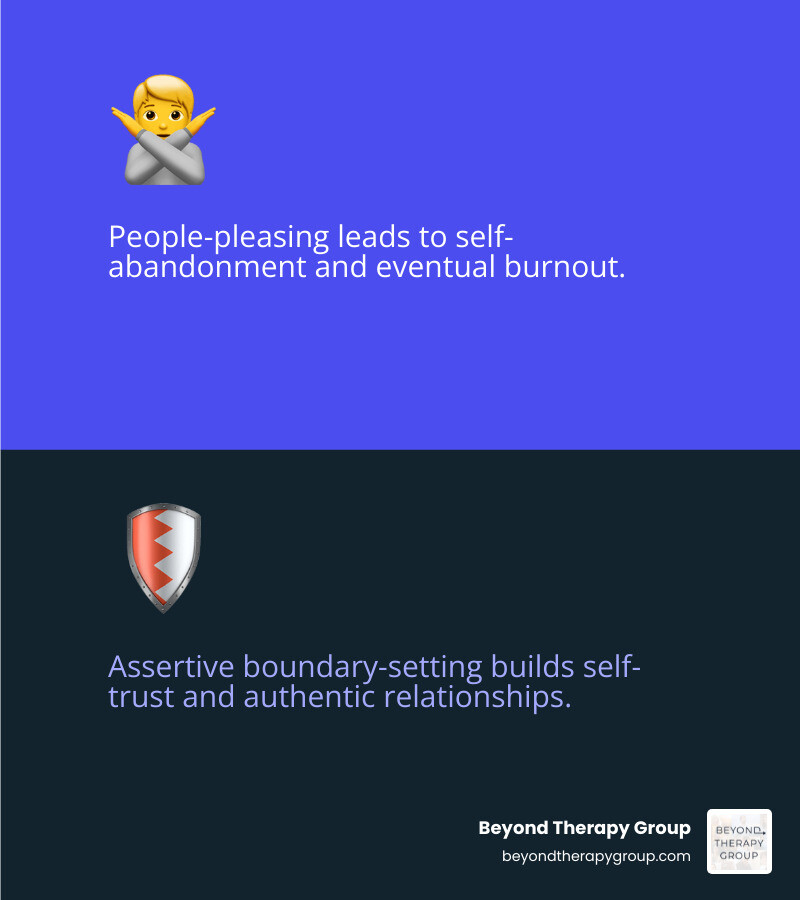
People-pleasing is often a survival strategy. It is a way to stay safe by keeping everyone else happy. However, the cost of people-pleasing is self-abandonment. Every time you say “yes” to someone else to avoid discomfort, you might be saying “no” to your own peace of mind.
Through our Relational Therapy Services, we help you shift from people-pleasing to assertiveness. Assertiveness is not about being rude or aggressive. It is about being honest and direct while still respecting the other person.
Counseling helps you build self-trust. You learn to listen to your body’s signals—like that tight feeling in your chest when someone asks for a “favor” you don’t have time for. By honoring those signals, you stop abandoning yourself and start building a life that feels authentic to you.
Practical Strategies for Setting and Maintaining Limits
Once you understand why boundaries matter, the next step is learning how to set them in the real world. This requires a mix of self-awareness and clear communication.
We recommend starting with a bit of “detective work.” Spend a week noticing when you feel resentful, annoyed, or exhausted. These feelings are often “boundary markers” telling you that a limit has been crossed. Once you identify the need, you can use these strategies:
- Use “I” Statements: Instead of saying “You always interrupt me,” try “I feel unheard when I’m interrupted, and I’d like to finish my thought.” This reduces defensiveness in the other person.
- Be Clear and Direct: Avoid over-explaining. You don’t need a three-paragraph excuse to decline an invitation. “I can’t make it this time, but thanks for thinking of me” is a complete sentence.
- Consistency is Key: If you set a rule but don’t follow through, people learn that your boundaries are negotiable. Consistency teaches people how to treat you.
- The 75/25 Rule: During a tough conversation, try to keep 75% of your awareness on your own body and feelings, and 25% on the other person. This helps you stay grounded in your truth rather than getting swept up in their reaction.
For a more detailed breakdown, check out The Ultimate Guide to Drawing Lines in the Sand or use our Ultimate Checklist for Healthy Boundaries to track your progress.

How to Communicate Needs Without Damaging Connections
A common myth is that boundaries create distance. In reality, they create safety. When you are honest about your needs, you stop building up the “unspoken resentment” that eventually causes relationships to explode.
Think of your boundary as an act of sovereignty. You are the ruler of your own emotional state. By communicating your limits, you are inviting the other person to connect with the real you, not the version of you that is pretending to be okay.
Active listening also plays a huge role. When you set a boundary, give the other person a moment to process it. You can be firm in your limit while still being warm in your delivery. For more tips on this balance, read How to Set Boundaries in Your Relationship Without Being a Jerk.
Navigating Boundary Violations and Enforcement
What happens when you say “no” and the other person ignores you? This is the hardest part of boundary work. It is important to remember that you cannot control how others react, but you can control your response.
When a boundary is violated, you have a few options depending on the situation:
| Situation | Healthy Response | Unhealthy Response |
|---|---|---|
| A friend pushes for personal info | “I’m not comfortable sharing that right now.” | Sharing anyway and feeling resentful later. |
| A partner ignores a request for space | “I need 20 minutes of alone time. I’ll come find you then.” | Getting into a shouting match about space. |
| A coworker emails late at night | Waiting until work hours to reply. | Replying immediately while feeling angry. |
| A family member makes a rude comment | “If that happens again, I’m going to end this call.” | Silently fuming or “testing” them to see if they do it again. |
Enforcement is not about punishing the other person. It is about protecting yourself. If someone repeatedly ignores your limits, especially in the case of toxic or controlling partners, you may need to reconsider the level of access that person has to your life. You can find more specific guidance on this in our article on Drawing the Line with Toxic and Controlling Partners.
Enforcing Limits with Counseling for Healthy Boundaries
Enforcing boundaries is often a “nervous system” job. If your body believes that saying “no” is dangerous, you will likely freeze or cave in the moment.
In counseling for healthy boundaries, we use somatic awareness to help you stay calm when you’re being tested. We might practice grounding techniques so that when your heart starts racing during a confrontation, you can stay present and hold your line. We also work on reframing the “guilt” that follows enforcement. Instead of seeing it as a sign you did something wrong, we help you see it as a sign that you are breaking an old, unhealthy pattern.
Our Relational Therapy Insights page offers more resources on how to navigate these complex emotional waters.
Frequently Asked Questions about Boundary Setting
Are boundaries selfish or do they create distance?
This is the most common misconception. Boundaries are actually an act of self-respect that protects the relationship. Think of it this way: if you never set boundaries, you will eventually burn out or become so resentful that you pull away entirely. Boundaries allow you to stay connected for the long haul because they ensure the relationship is sustainable for you.
How do boundaries differ between family and coworkers?
The “stakes” and the “scripts” change. With family, boundaries often involve untangling years of enmeshed patterns, which can feel very emotional. With coworkers, boundaries are usually more functional, focusing on time, capacity, and professional roles. In South Bay and Redondo Beach, many of our clients struggle with work-life balance, and we help them develop specific scripts to “clock out” mentally and physically.
What are the long-term benefits for self-esteem?
When you consistently honor your own needs, you send a message to your subconscious that you are worth protecting. Over time, this builds a deep sense of self-trust and confidence. You stop looking for external validation because you know how to validate yourself. You’ll likely find that your anxiety decreases, your energy levels rise, and your relationships become much more mutual and fulfilling.
Conclusion
Learning to set healthy boundaries is a journey, not a destination. It takes time to unlearn the habits of people-pleasing and to find the courage to speak your truth. But the reward—a life where you feel respected, energized, and authentically connected—is well worth the effort.
At Beyond Therapy, we are here to support you every step of the way. Whether you are navigating a difficult family dynamic, a stressful workplace, or a romantic relationship that feels off-balance, our team in Redondo Beach and the South Bay is ready to help.
We offer a free consultation with our therapists to help guide your booking and answer any questions you might have about counseling for healthy boundaries. You don’t have to figure this out alone. Start your journey with relationship and relational therapy today and take the first step toward the emotional health and freedom you deserve.
Recent Posts