
June 16, 2026
How to Master Assertive Boundary Setting in 5 Easy Steps

Key Takeaways
- Assertive communication sits between passive and aggressive and protects both your needs and others’ dignity.
- Your body often signals a boundary violation before your mind catches up. Tuning in early prevents resentment.
- The DESC method and “I” statements give you a clear, repeatable structure for expressing your limits.
- Consistency is the hardest part of boundary setting and also the most important.
- Setting boundaries is an act of care, not cruelty. It builds trust and deeper connection over time.
Why Assertive Boundary Setting Tips Actually Change Your Life
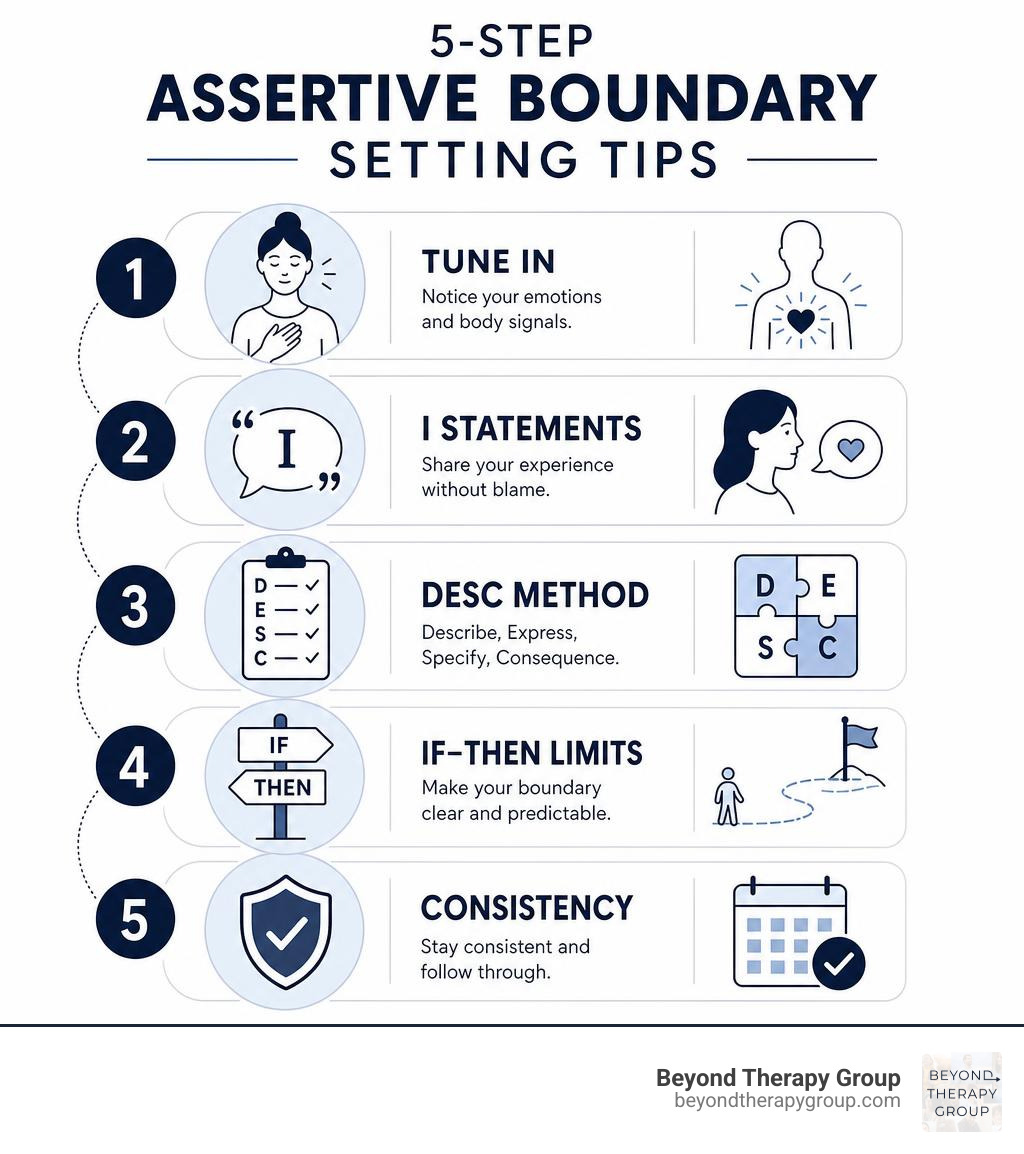
Assertive boundary setting tips are practical tools for expressing your needs clearly and calmly, without aggression or guilt. Here is a quick overview of how to do it:
- Tune in to your emotions and body signals to recognize when a limit has been crossed.
- Use “I” statements to name your experience without blaming the other person.
- Apply the DESC method (Describe, Express, Specify, Consequence) to structure your message.
- Set an IF-THEN limit so both parties understand what happens if the boundary is not respected.
- Stay consistent and follow through, even when it feels uncomfortable.
Most people think they only have two options when a conversation gets hard: go quiet or blow up. But there is a third path, and it is far more effective.
Assertive communication sits right in the middle. It is honest, direct, and respectful. And the results are measurable. Research shows that people who set clear boundaries report 40% lower stress levels and 35% higher relationship satisfaction.
Yet for many busy professionals, setting limits still feels selfish, scary, or just plain awkward. You may know you need boundaries. But when the moment comes, your chest tightens, the words disappear, and you end up saying yes when you mean no.
That is not a character flaw. It is a skill gap. And skills can be learned.
This guide breaks the process down into five practical steps you can start using today.
Assertive boundary setting tips vocabulary:
- Effective Communication
- broken record assertive method
- to be an effective communicator it is important to be
Understanding the Communication Styles of Boundary Setting
To successfully apply assertive boundary setting tips, we must first look at the four primary communication styles. Think of these styles as different ways of managing personal space.
When we communicate, we are constantly balancing our own rights with the rights of the other person. The quadrant model below shows how each style handles this balance.
| Communication Style | How You Treat Your Own Needs | How You Treat Others’ Needs | Typical Outcome |
|---|---|---|---|
| Passive | Discounted (You do not speak up) | Valued (You put them first) | Resentment and burnout |
| Aggressive | Valued (You demand your way) | Discounted (You ignore their feelings) | Conflict and broken trust |
| Passive-Aggressive | Discounted directly, expressed indirectly | Discounted | Confusion and eroded safety |
| Assertive | Valued (You speak honestly) | Valued (You listen with respect) | Mutual respect and clarity |
Let us look closer at how these styles play out in real life.
- The Passive Style: If you are a passive communicator, you tend to avoid conflict at all costs. You might tell yourself that you are just being nice. In reality, you are hiding your true feelings. This often leads to overcommitting, feeling taken advantage of, and building deep-seated resentment.
- The Aggressive Style: Aggressive communicators state their boundaries like ultimatums. They use blame, loud tones, or physical intimidation. While they might get what they want in the short term, they leave a trail of damaged relationships behind them.
- The Passive-Aggressive Style: This style is a mix of the first two. You do not state your needs directly, but you let your frustration leak out through sarcasm, silent treatment, or deliberate mistakes. It discounts both your own sovereignty and the other person’s dignity.
- The Assertive Style: This is the sweet spot. Assertiveness is the ability to express your feelings, thoughts, and needs openly while fully respecting the rights of others. It is based on the philosophy of nonviolent communication, which assumes that we all have universal human needs that can be met without hurting one another.
When you practice assertiveness, you realize that protecting your boundaries is actually a form of honesty. If you want to dive deeper into how to find your voice, check out our guide on Mastering the Art of Speaking Up for Yourself.
Building these skills is not about changing your personality. It is about building a repeatable habit. In fact, structured training works. A 2020 meta-analysis showed that structured programs improve self-reported assertiveness by 0.74 standard deviations. To learn more about structured skill-building, read about Assertiveness Training: Build the Skill from Scratch | Boundary Playbook.
Overcoming the Mental Roadblocks to Drawing the Line
If boundaries are so good for us, why do we struggle so much to set them?
The answer lies in our belief systems. Many of us grew up in family systems where boundaries were viewed as rejection. We carry deep-seated faulty beliefs that act as mental roadblocks.

Here are the three most common faulty beliefs that keep people stuck:
Faulty Belief 1: “My job is to make sure everyone else is happy.”
This is the classic people-pleaser trap. You believe that if someone else is upset, you have failed. But here is the truth. You are responsible for your actions and your tone, but you are not responsible for other people’s emotional reactions. When you avoid setting a boundary to keep someone else comfortable, you are actually choosing temporary peace over long-term relationship health.
Faulty Belief 2: “Setting boundaries is mean and selfish.”
We often confuse being nice with being kind. Being nice means walking on eggshells and never upsetting anyone. Being kind means being honest, clear, and direct. Letting someone cross your limits until you resent them is not kind. Setting a boundary is actually a generous act because it tells the other person exactly how to stay in a healthy relationship with you.
Faulty Belief 3: “I have to wait until I feel completely ready and calm.”
If you wait until the anxiety disappears, you will wait forever. For anxious individuals, boundary setting presents a double bind. Setting the boundary makes you anxious, but not setting it also makes you anxious. The key is to accept the discomfort. Guilt and anxiety are normal side effects of doing something new. They are not signs that you are doing something wrong.
To overcome these blocks, we must embrace the concept of individual sovereignty. This is the understanding that you are the ultimate authority over your own body, time, and emotional energy. You do not need anyone else’s permission to protect your resources.
If you are ready to start dismantling these mental barriers, read our deep dive on The Ultimate Guide to Drawing Lines in the Sand. For more support on shifting your mindset, you can also explore these 6 Tips for Setting Better Boundaries – Psychology Today.
How to Master Assertive Boundary Setting Tips in 5 Steps
Now that we have cleared the mental hurdles, let us look at the practical framework. Think of this five-step process as your personal roadmap for clear communication.

By practicing these steps, you can transition from passive compliance to confident, assertive living. For a handy tool to keep you on track, refer to our Ultimate Checklist for Healthy Boundaries. For a comprehensive overview of the mechanics of limits, check out How to Set Boundaries: A Complete, Practical Guide | Boundary Playbook.
Step 1: Tune Into Your Somatic Signals and Emotional Needs
Your body is your boundary barometer. Long before your mind registers a boundary violation, your body knows.
You might feel a sudden tightness in your chest, a knot in your stomach, or a flush of heat in your face. These physical sensations are emotional signals. They are trying to tell you that something valuable is being compromised.
We recommend practicing the 75/25 somatic rule during difficult conversations. Keep 75% of your awareness anchored inside your own body, tracking your physical sensations. Leave only 25% of your attention on the other person. This prevents you from getting swept up in their emotions and helps you stay connected to your own needs.
Step 2: Use Clear ‘I’ Statements and the DESC Method
Once you identify your need, you must communicate it. The best way to do this without triggering defensiveness is by using “I” statements and the DESC method.
The DESC method is a highly structured communication tool:
- D – Describe: State the situation objectively without drama or blame.
- E – Express: Share how you feel or what you experience using an “I” statement.
- S – Specify: Clearly state what you need or what action you want the other person to take.
- C – Consequence: Outline what you will do to protect your peace if the behavior continues.
Instead of saying, “You always ruin our dinners by checking your work phone,” try using the DESC method:
“We are sitting at dinner, and your phone is on the table (Describe). I feel disconnected when you answer emails during our quality time (Express). I would like us to keep our phones put away during dinner (Specify). If you need to take an urgent work call, I will step away and finish my dinner in the kitchen (Consequence).”
Step 3: Establish the IF-THEN Limit
A boundary is not about controlling the other person. It is about controlling your own actions. This is where the IF-THEN limit comes in.
An IF-THEN statement clearly links the other person’s choice to your response. It gives them a clear map of the consequences. For example, “If you continue to raise your voice at me, then I am going to end this phone call.”
Notice that you are not demanding that they stop yelling. You are simply stating what you will do if they choose to keep yelling. This keeps the focus entirely on what you can control. For more practical advice on using this formula to manage anxiety, check out Boundaries for Anxious Folks in 3 Steps – Therapy in a Nutshell.
Step 4: Maintain Connection and Compassion
You do not have to build a permanent brick wall to protect yourself. Think of a healthy boundary as a drawbridge. You control when it goes up for protection and when it comes down for connection.
You can set firm limits while still staying warm and compassionate. The secret is to validate the relationship while holding the line.
You might say, “I love spending time with you, but I cannot host visitors this weekend.” This approach shows that you value the connection, even if you do not have the capacity for the specific request. To learn more about balancing empathy with limits, read How To Set Boundaries in Healthy Ways.
Step 5: Enforce the Boundary with Absolute Consistency
Consistency is the hardest part of boundary setting, and it is also the most important.
If you set a boundary but fail to follow through on the consequence, you teach the other person that your words do not have weight. They will continue to push, hoping you will fold again.
Holding the line is uncomfortable. You will feel the urge to apologize, over-explain, or compromise. When this happens, take a deep breath, drop into your body, and remember that consistency is the ultimate act of self-respect.
Practical Scripts and Assertive Boundary Setting Tips for Daily Life
Having the right words ready can make all the difference when your chest gets tight. Let us look at some practical, therapist-approved scripts for different areas of your life.
Assertive Boundary Setting Tips for the Workplace
Workplace boundaries are essential for preventing burnout and maintaining professional respect. When setting these limits, focus on your capacity rather than your personal feelings.
- When asked to take on extra work: “I would love to help with this project, but I do not have the capacity to deliver it to a high standard right now. If this is a priority, what current tasks should we deprioritize to make room for it?”
- When receiving late-night messages: “To make sure I perform my best during work hours, I do not check my professional messages after 6:00 PM. I will respond to this first thing tomorrow morning.”
- When a coworker vents constantly: “I want to support you, but I do not have the emotional bandwidth to process this right now. Let us focus our energy on finishing this task.”
For more tips on navigating office dynamics, read our guide on Mastering Assertiveness and Boundary Training for Better Relationships.
Assertive Boundary Setting Tips for Family and Romantic Relationships
Setting boundaries with loved ones can feel especially risky because the emotional stakes are so high. However, clear limits actually foster deeper intimacy.
- With a parent who gives unsolicited advice: “I know you love me and want the best for me, but I need to make this decision on my own. I would value your emotional support rather than advice right now.”
- With a partner during a heated argument: “I want to hear what you have to say, but I cannot engage when you speak to me in that tone. Let us take a twenty-minute break to cool down and try again.”
- With a friend who cancels plans repeatedly: “I value our friendship, but I feel frustrated when plans change at the last minute. I need us to stick to our scheduled times, or I will need to take a break from planning events.”
To learn how to protect your romantic partnership without creating distance, check out How to Set Boundaries in Your Relationship Without Being a Jerk.
Handling Pushback, Anger, and Guilt-Tripping
When you start setting boundaries, some people will not be happy. The people who benefit from your lack of boundaries are often the ones who will fight hardest against them.
When pushback comes, you do not need to argue. Instead, use these three proven assertiveness techniques:
- The Broken Record Technique: This involves repeating your boundary calmly, using the exact same words, without adding new arguments or justifications. If a family member keeps pushing you to attend an event, you simply say, “I understand you want me there, but I do not have the capacity to attend.” When they push back again, you repeat, “I understand, but I do not have the capacity to attend.” This removes any conversational hooks they can use to negotiate.
- Fogging: This technique is highly effective when dealing with critical or manipulative behavior. You agree with the grain of truth in their criticism while completely holding your ground. For example, if someone says, “You are being incredibly selfish by not helping me move,” you can respond, “You are right, I am prioritizing my own rest this weekend, so I will not be able to help.”
- Negative Assertion: If you make a genuine mistake, own it directly and move on. This prevents the other person from using your mistake as leverage to cross your boundaries. You might say, “You are right, I forgot to send that email. I will send it now.” By owning the mistake calmly, you take away their ammunition.
If you want to master the art of deflecting manipulation, read our full guide on How to Use the Broken Record Technique to Deflect Manipulators.
Frequently Asked Questions About Assertive Boundaries
What is the difference between a boundary and an ultimatum?
A boundary is about controlling your own actions, while an ultimatum is an attempt to control someone else. A boundary states what you will do to protect your peace (“If you yell, I will leave the room”). An ultimatum demands what they must do under threat (“You must stop yelling right now, or you are a terrible partner”). Boundaries preserve individual sovereignty; ultimatums attempt to force compliance.
How do I handle someone who gets angry when I set a boundary?
Their anger is information about their internal state, not proof that you did something wrong. Stay calm, keep your tone even, and do not get dragged into a shouting match. Restate your limit once. If their anger escalates and compromises your emotional safety, remove yourself from the situation immediately. You do not owe anyone an audience for their rage.
Can you set boundaries while remaining a kind person?
Yes, absolutely. In fact, setting boundaries is one of the kindest things you can do. When you do not set boundaries, you accumulate quiet resentment that eventually poisons your relationships. By being clear about your limits, you show respect for yourself and offer the other person a roadmap for a sustainable, healthy relationship.
Conclusion
Mastering assertive boundary setting tips is a lifelong practice, not a one-time event. It requires self-awareness, patience, and a willingness to tolerate temporary discomfort for long-term peace of mind.
If you find yourself struggling with persistent guilt, anxiety, or people-pleasing patterns, you do not have to walk this path alone. Professional support can make a world of difference.
At Beyond Therapy, we help clients in Redondo Beach, the South Bay, and surrounding areas build self-advocacy skills, reduce anxiety, and cultivate healthier relationships. We invite you to explore our professional therapy services and take advantage of our free 15-minute consultation with our therapists to help guide your booking and answer any questions you may have.
Your peace of mind is worth protecting. Start small, stay consistent, and remember that you have the right to speak up for yourself.
Recent Posts


