
May 26, 2026
How to Use the Broken Record Technique to Deflect Manipulators

Key Takeaways
- The broken record assertive method is a communication technique where you calmly repeat a clear, simple statement until the other person stops pushing back.
- It works by removing the “fuel” that manipulators need to keep an argument going.
- It is especially useful for people-pleasers who struggle with guilt when saying no.
- The key is calm, consistent repetition without over-explaining or apologizing.
- It can be used in personal relationships, professional settings, and everyday boundary situations.
What the Broken Record Assertive Method Can Do for You
The broken record assertive method is one of the most practical tools you can use to hold a boundary without losing your cool.
Have you ever walked away from a conversation feeling like you caved in again? Someone pushed back, you started explaining yourself, and before you knew it you had agreed to something you never wanted to do.
That pattern is exhausting. And it is incredibly common, especially for people who feel a wave of guilt every time they say no.
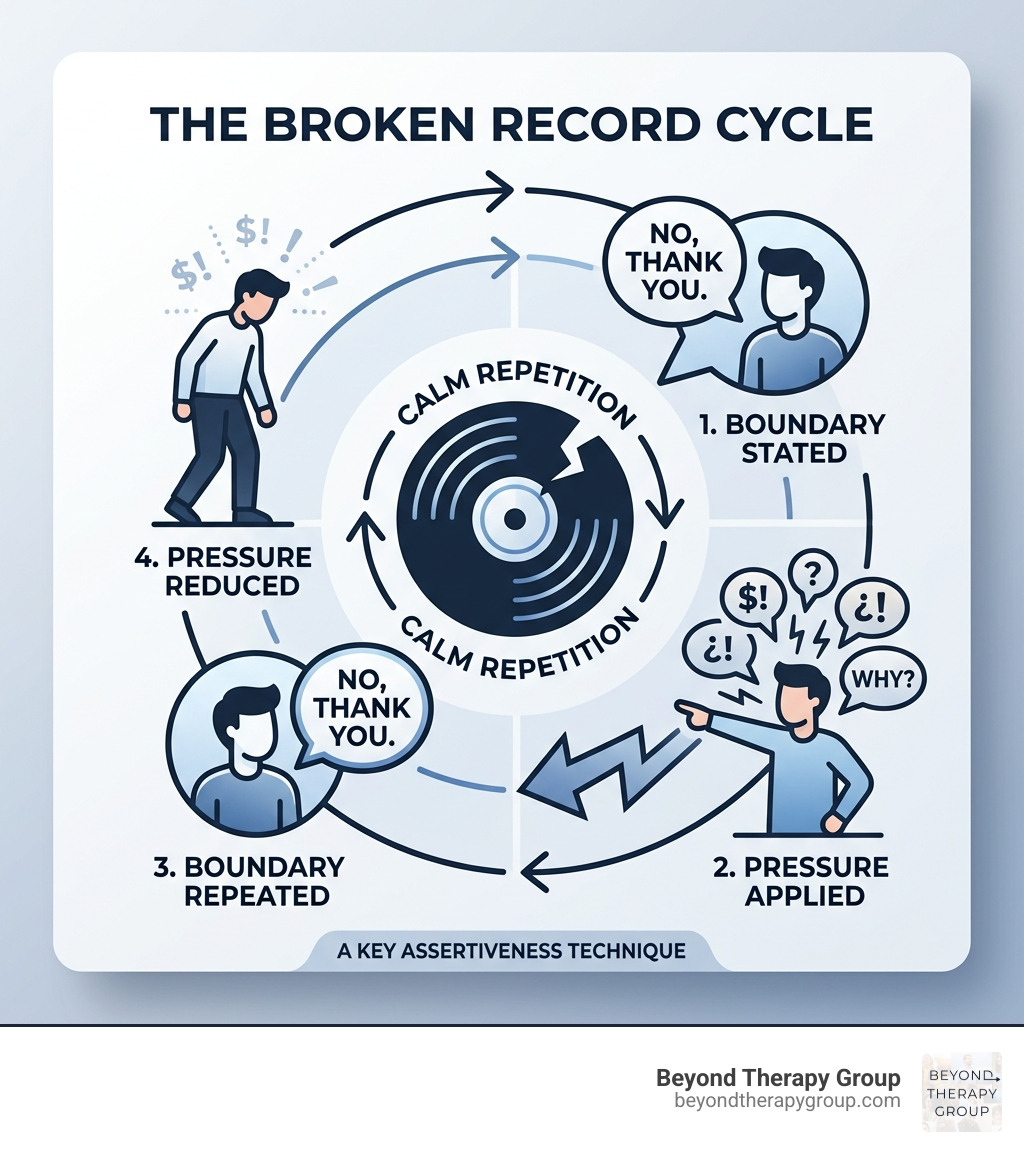
The broken record method gives you a way out of that cycle. Instead of defending, justifying, or debating, you simply repeat your position. Calmly. Clearly. As many times as it takes.
Here is a quick look at how it works:
- Choose one short, clear statement that describes your position or boundary.
- Repeat it consistently every time the other person pushes back.
- Do not add new explanations or engage with side arguments.
- Keep your tone steady and your delivery calm.
- Stay with it until the pressure stops.
It sounds simple. But for anyone who has been conditioned to over-explain or apologize their way through conflict, it can feel like a radical shift.
Broken record assertive method glossary:
- Effective Communication
- Effective communication in schools
- To be an effective communicator it is important to be
What is the Broken Record Assertive Method?
The broken record assertive method is a cornerstone of assertiveness training that involves the calm, persistent repetition of a specific phrase or boundary. The name comes from the era of vinyl records. When a record was scratched, the needle would get stuck in a groove, repeating the same few seconds of a song over and over again.
In communication, we use this “scratch” to our advantage. Instead of allowing a conversation to wander into justifications or emotional traps, we stay in the groove of our original statement.
The Origins of the Technique
This method was popularized by psychologist Manuel J. Smith in his 1975 bestseller, When I Say No, I Feel Guilty. Smith identified that many of us are taught to believe that we must provide a “good” reason for our choices. Manipulators exploit this belief by attacking our reasons until we feel we have no choice but to give in.
By using The broken-record technique , we exercise our assertive right to be the final judge of our own behavior, feelings, and emotions. We do not need to provide a list of excuses to justify our “no.” The “no” is enough.
Persistence Without Aggression
The beauty of this method is that it is not aggressive. You aren’t raising your voice, calling names, or making threats. You are simply being persistent. While children are often natural masters of this—think of a toddler asking for a cookie ten times in a row—adults often lose this skill because we are worried about being “annoying” or “rude.” Reclaiming this technique allows us to navigate power imbalances with grace and firmness.
Why the Broken Record Assertive Method Works for People-Pleasers
For those of us in Redondo Beach or the South Bay who identify as “recovering people-pleasers,” setting a boundary can feel like walking through a minefield of guilt. We worry that if we don’t explain why we are saying no, the other person will think we are mean or selfish.
Guilt Reduction
The broken record assertive method is particularly effective for people-pleasers because it limits the amount of “data” you give a manipulator. When you provide a reason—such as “I can’t come to the party because I’m too tired”—a manipulator will try to solve your problem for you: “Oh, just come for an hour! You can nap beforehand!”
When you stop providing reasons, you stop providing hooks. This drastically reduces the back-and-forth “ping-pong” match that usually leads to a wave of guilt. You can learn more about this in our guide on Mastering the Art of Speaking Up for Yourself.
Non-Negotiable Positioning
Most people-pleasers operate from a place of negotiation. We hope that if we explain ourselves well enough, the other person will give us “permission” to say no. The broken record method shifts you into a non-negotiable position. You aren’t asking for permission; you are stating a fact. This shift is empowering and helps build the internal muscle needed for long-term boundary setting.
Starving the Emotional Fuel
Manipulators, whether they are demanding bosses or guilt-tripping relatives, thrive on emotional reactivity. They want you to get defensive, angry, or flustered. When you use the broken record method, you remain a “gray rock”—boring and unreactive. By repeating the same calm phrase, you deprive the manipulator of the emotional fuel they need to keep the fire of the argument burning.
Step-by-Step Guide to the Broken Record Assertive Method
Using this technique effectively requires more than just repetition; it requires strategy. If you do it with a snarky tone, it becomes aggressive. If you do it with a shaky voice, it becomes passive. Here is how to get it right.
1. Phrase Selection
Choose a short, clear, and neutral statement. Avoid using the word “but,” as it often signals the start of an excuse. Instead, use a pause or a simple acknowledgment.
- “I understand, and I’m not able to take on more work right now.”
- “I’ve decided I won’t be attending the event.”
- “I’m not interested in buying anything today.”
2. Calm Delivery
Your voice should be steady and your volume moderate. Avoid sounding frustrated or angry. The goal is to sound like a recorded message—reliable, consistent, and unchangeable. Check out The Broken Record Assertiveness Technique: How to Say “No” Without Feeling Guilty | Positive Affirmations Center for more tips on maintaining your composure.
3. Acknowledge and Repeat
You don’t have to ignore what the other person is saying. In fact, acknowledging them can make the technique feel less robotic. You can use a formula like: Acknowledgment + “and” + Your Broken Record Statement.
- Them: “But we really need you there!”
- You: “I hear that it’s important to you, and I’ve decided I won’t be attending.”
4. Verbatim Repetition
Try to keep the wording as close to the original as possible. Changing the wording can suggest that you are starting to negotiate. If you say “I can’t come” the first time and “I’m busy” the second time, the manipulator sees a “hole” they can poke through. Stick to the script.
The Psychology of Persistent Boundaries
Why does repeating ourselves actually work? It isn’t just about being stubborn; there are deep psychological principles at play that help both you and the person you are talking to.

Reciprocal Inhibition
One of the founders of behavioral therapy, Joseph Wolpe, introduced the concept of “reciprocal inhibition.” This is the idea that two opposing emotional states cannot exist at the same time. Specifically, you cannot feel assertive and anxious simultaneously. By forcing yourself to use an assertive script like the broken record assertive method, you actually inhibit your own anxiety. The more you practice, the more your brain associates these situations with calm resolve rather than fear.
Extinction of Manipulation
In behavioral psychology, “extinction” occurs when a behavior that was previously reinforced no longer gets a response. If a manipulator is used to getting their way by badgering you until you cave, your “caving” is the reinforcement. When you switch to the broken record method, their badgering no longer works. Eventually, their brain realizes that this tactic is a waste of energy, and the manipulative behavior begins to fade. For more on this, read The Ultimate Guide to Drawing Lines in the Sand.
Self-Efficacy and Confidence
Every time you successfully use this method, you build what psychologists call “self-efficacy”—the belief in your ability to handle a situation. You aren’t just winning an argument; you are proving to yourself that you can protect your peace. Over time, this builds a deep-seated confidence that makes it easier to set boundaries in all areas of your life.
Real-World Applications and Examples
It is one thing to read about a technique and another to use it when your heart is racing. Let’s look at how this plays out in common scenarios we see in our South Bay community.
Dealing with Demanding Salespeople
Salespeople are trained to overcome objections. If you say it’s too expensive, they offer a discount. If you say you don’t have time, they offer a shorter demo.
- Salesperson: “This is a limited-time offer for South Bay residents!”
- You: “I understand, and I’m not interested in buying anything today.”
- Salesperson: “But you could save 50% if you sign up now!”
- You: “I hear you, and I’m not interested in buying anything today.”
Handling Guilt-Tripping Parents
This is often the hardest place to use the method because the emotional stakes are so high.
- Parent: “You never come home for the holidays anymore. Don’t you love us?”
- You: “I love you very much, and I won’t be coming home for the holidays this year.”
- Parent: “Your cousin is coming! It’ll be so lonely without you.”
- You: “I’m sure it will be a nice visit with my cousin, and I won’t be coming home for the holidays this year.”
Responding to Passive-Aggressive Colleagues
Passive-aggressive people often use “harangues” or excessive critiques to put you on the defensive. The broken record stops the cycle.
- Colleague: “Must be nice to leave right at 5:00 while the rest of us stay late.”
- You: “Yes, I’m leaving now to keep my evening commitments.”
- Colleague: “I guess some people just don’t care about the team goals as much.”
- You: “I hear your frustration, and I’m leaving now to keep my evening commitments.”
For more relational advice, see How to Set Boundaries in Your Relationship Without Being a Jerk.
Common Pitfalls and How to Avoid Them
Even with the best intentions, it’s easy to slip back into old habits. Here are the most common mistakes people make when trying the broken record assertive method.

Over-Explaining
This is the number one mistake. We feel a “gap” in the conversation and we want to fill it with reasons. Remember: Reasons are just targets for a manipulator to hit. If you find yourself saying “because…” stop right there. Your decision is the reason.
Excessive Apologizing
Apologizing once can be a polite social lubricant: “I’m sorry, I can’t do that.” But repeating “I’m so sorry” five times makes you look weak and unsure. It signals to the other person that if they push a little harder, your guilt will eventually make you crack. Limit yourself to one apology, or better yet, none at all. You are allowed to have boundaries without being sorry for them. Our Ultimate Checklist for Healthy Boundaries covers this in detail.
Tone Matching
If the other person gets angry or loud, your instinct might be to match their energy. Don’t. The power of the broken record comes from the contrast between their chaos and your calm. If you get angry, you’ve lost the “assertive” part of the method and moved into “aggressive” territory.
Giving Up Too Soon
Sometimes people give up after two repetitions because they feel “silly.” Research shows that manipulators often try one “final push” before giving up. If you stop right before that final push, you’ve actually taught them that they just need to ask three times to get you to cave. Stay the course!
Frequently Asked Questions about Assertive Communication
Does the broken record technique make me sound rude?
Not if your tone is respectful. Rudeness usually involves attacking the other person or being dismissive. The broken record technique is about your position, not their character. You are rejecting a request, not a person. In many professional settings, being clear and consistent is actually viewed as a sign of high emotional intelligence and leadership.
What if the other person becomes aggressive?
Safety is always the priority. If someone becomes physically aggressive or threatening, the broken record method is no longer the right tool. In those cases, you should disengage entirely, leave the situation, or seek help. The broken record assertive method is designed for verbal persistence and manipulation, not for high-conflict situations where physical safety is at risk.
Can I use this method with children?
Absolutely! In fact, many parenting programs like “Assertive Discipline” teach this exact method. Children thrive on consistency. If you say “Screen time is over” and then spend ten minutes negotiating why, the child learns that “no” doesn’t actually mean “no.” If you calmly repeat “Screen time is over” until they disengage, you are teaching them clear boundaries.
Conclusion
Mastering the broken record assertive method is a journey, not a destination. It might feel clunky or “robotic” the first few times you try it, but with practice, it becomes a natural part of your communication toolkit. By staying in the groove and refusing to play the game of over-explanation, you reclaim your time, your energy, and your self-respect.
If you find that your “people-pleasing” habits are deeply ingrained and you’re struggling to stand your ground even with these tools, we are here to help. Beyond Therapy provides tailored consultations to help you navigate these complex interpersonal dynamics. We offer a free 15-minute consultation with therapists to help guide you toward the right support in Redondo Beach and the South Bay.
Ready to stop being a “broken record” of caving in and start being a broken record of strength? More info about therapy services is just a click away. Together, we can help you find your voice and build the boundaries you deserve.
Recent Posts


