November 12, 2026
All About the Psychodynamic Grief Counseling Approach

Key Takeaways:
- The psychodynamic grief counseling approach explores unconscious conflicts, relational patterns, and the ongoing inner bond with the deceased to resolve complicated loss.
- The deceased often serves as the primary transference figure in grief therapy, not the therapist.
- The Two-Track Model of Bereavement assesses both daily functioning and the internal relationship with the lost person.
- Short-term psychodynamic interventions can effectively target resistance and defense mechanisms like emotional numbness or compulsive caregiving.
- Insight-oriented work tends to produce deeper, longer-lasting resolution of complicated grief than purely supportive approaches.
What the Psychodynamic Grief Counseling Approach Really Is (And Who It Helps)
The psychodynamic grief counseling approach is a therapeutic method that looks beneath the surface of loss to explore the unconscious emotions, relational patterns, and inner conflicts that shape how a person grieves.
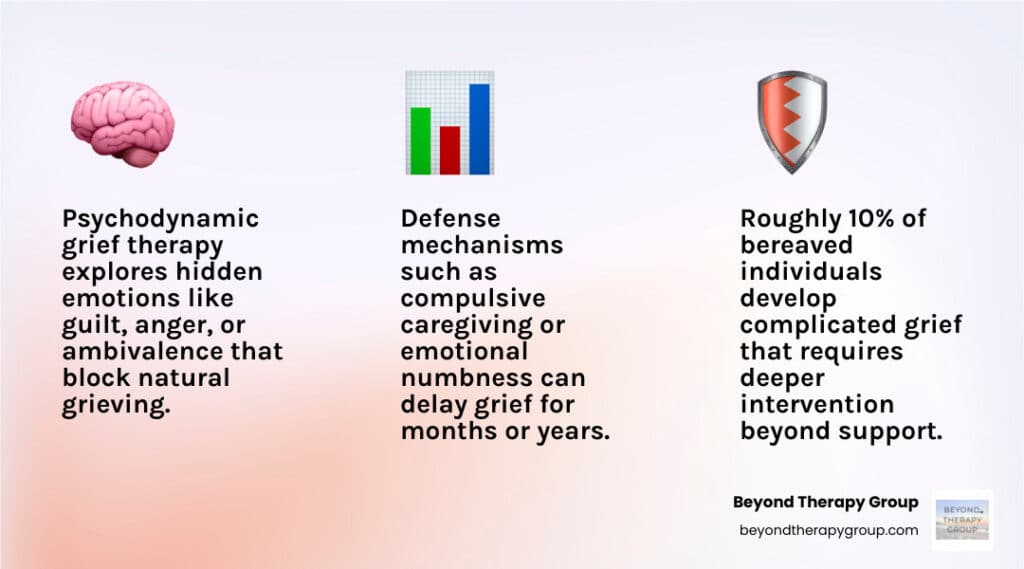
Most people move through grief naturally over time. But roughly 10% of bereaved individuals develop complicated grief, where the pain becomes prolonged, disabling, or stuck. For these people, simply talking about their feelings is often not enough.
Consider this: a young man whose father dies suddenly throws himself into caring for his mother, stays constantly busy, and feels almost nothing. Six months later, a distant acquaintance’s death sends him into a breakdown. The original grief never disappeared. It was buried under activity and defense.
That is exactly the kind of experience psychodynamic grief therapy is designed to address.
Here is a quick overview of what this approach covers:
- Unconscious conflict: Hidden emotions like guilt, anger, or ambivalence toward the deceased
- Object relations: The unique relational bond the bereaved had with the person they lost
- Transference: How unresolved feelings toward the deceased show up in therapy
- Two-Track Model: Assessing both daily functioning and the ongoing inner relationship with the deceased
- Defense mechanisms: Patterns like avoidance or compulsive caregiving that delay grief
This article breaks down how this approach works, why it differs from standard grief counseling, and what real clinical practice looks like for people navigating deep or complicated loss.
Core Principles of the Psychodynamic Grief Counseling Approach
To truly understand how we use this approach in therapy, we have to look at the foundational ideas of psychodynamic theory. Unlike therapies that focus purely on immediate behaviors, psychodynamic therapy focuses on the deep, often hidden psychological forces that drive our reactions.
When applied to bereavement, this means we integrate three distinct paradigms: drive and defense (unconscious conflict), object relations (relational schemas), and transference. By listening for these three elements, a skilled therapist can help a client unpack why a specific loss has felt so impossible to process.
To explore these core dynamics in clinical detail, you can read the foundational work on Psychodynamic Therapy with the Bereaved: Listening for Conflict, Relationship and Transference.
Unconscious Conflict and the Experience of Loss
At the heart of the psychodynamic model is the unconscious mind. When we lose someone, we do not just lose a person; we lose a complex web of shared history, unspoken dynamics, and emotional investments.
Sometimes, the emotions we feel after a death are highly conflicting. We might feel deep sadness, but we might also feel:
- Anger at the person for leaving us.
- Guilt over things we said or did not say.
- Relief, especially if the person was abusive or had a long, painful illness.
Because society tells us we should only feel pure sadness when someone dies, these “unacceptable” feelings of anger, relief, or guilt are often pushed down into our unconscious. This creates an internal conflict. The mind uses defense mechanisms to protect us from the pain of these feelings, which can cause the mourning process to stall or become disordered.
Relational Schemas and Object Relations in Bereavement
Object-relations theory is a branch of psychodynamics that looks at how we form mental representations of ourselves and others based on our earliest relationships. These mental blueprints are called relational schemas.
When we lose a loved one, our mind has to navigate a massive shift in these schemas. In normal grief, we gradually update our internal world to accept that the person is physically gone while still keeping a loving memory of them.
However, in complicated grief, the internal representation of the deceased (the “introject”) fails to integrate with our self-representation. It maintains an independent, sometimes haunting existence in our mind. We might feel like a part of our own ego has been destroyed. To learn more about how different therapeutic tools address these relational dynamics, see our guide on What Is Grief Counseling? Techniques and How It Helps.
Transference Dynamics and the Deceased as a Central Figure
In traditional psychodynamic therapy, transference happens when a client projects feelings and expectations from past relationships onto the therapist.
In grief therapy, however, this dynamic is uniquely shifted. Because the bereaved individual’s intrapsychic world is so entirely occupied by the person who died, the deceased often acts as the dominant transference figure.
Instead of projecting unresolved conflicts onto the therapist, the client projects them onto the memory of the deceased. The therapist’s role is to help the client identify and navigate these projections, serving as a safe, steady witness to the conversation the client is trying to have with the memory of the lost loved one.
The Two-Track Model of Bereavement in Psychodynamic Practice
To help clinicians organize and assess the complex experience of loss, researchers like Simon Shimshon Rubin developed the Two-Track Model of Bereavement. This model is incredibly useful because it divides the assessment of a grieving person into two distinct areas of focus.
Instead of just asking “Is this person depressed?” or “Are they back at work?”, this model looks at both daily functioning and the deep, ongoing relationship with the deceased. For a closer look at what to expect when navigating these therapeutic steps, explore The Healing Journey: What to Expect in Overcoming Grief Therapy Sessions.
Track One and Functional Adaptation in Daily Life
Track One focuses on the individual’s biopsychosocial functioning. It looks at how the loss has impacted their ability to navigate daily life. When assessing Track One, we look at:
- Behavioral adaptation: Are they able to work, care for themselves, and manage daily responsibilities?
- Somatic symptoms: Are they experiencing physical reactions like insomnia, chronic fatigue, or changes in appetite?
- Interpersonal relationships: Are they maintaining social contacts, or are they withdrawing from friends and family?
While Track One is highly important, focusing only on functioning can miss the deeper emotional reality. A person might look perfectly fine on the outside while remaining deeply frozen on the inside.
Track Two and Reordering the Internal Relationship with the Deceased
Track Two is where the core of psychodynamic work happens. It evaluates the client’s ongoing relationship and emotional attachment to the deceased.
Rather than focusing on “breaking bonds” or trying to get the client to “let go” of the person who died, modern psychodynamic therapy focuses on maintaining continuing bonds. We help the client construct a coherent narrative of the death and reorder their internal relationship with the deceased. This involves:
- Processing ambivalent feelings (like anger or guilt) to make the memory of the deceased more realistic and less idealized.
- Integrating the memory of the deceased into the client’s ongoing life narrative.
- Allowing the client to carry the love and lessons of the relationship forward without being paralyzed by the physical absence.
Clinical Interventions and Navigating Resistance
When people experience a loss that feels too painful to bear, their minds naturally build up walls to protect them. In therapy, we call these walls resistance and defense mechanisms. Helping a client safely dismantle these walls requires patience, empathy, and specific clinical interventions. For practical strategies on navigating this terrain, refer to our Grief Treatment Survival Guide.
Addressing Defense Mechanisms and Compulsive Caregiving
In the wake of a sudden death, it is common to see defense mechanisms like emotional numbness, avoidance, or compulsive caregiving.
For example, a client might become highly active in organizing family affairs, taking care of everyone else’s needs, and refusing to slow down. While this looks like strength, it is often a defense against the terrifying reality of their own pain. If left unaddressed, this delayed mourning can eventually show up as physical illness, sudden panic attacks, or severe depression.
In therapy, we gently point out these patterns, helping the client see that their constant activity is a way to keep their pain at bay. By creating a safe, slow space, we allow them to drop the caregiving shield and finally feel their own grief.
Implementing a Short-Term Psychodynamic Grief Counseling Approach
While some deep-seated emotional issues require years of therapy, short-term psychodynamic therapy can be incredibly effective for focused grief work.
Consider the clinical case of Amit, a 23-year-old art student. Following the sudden death of his father, Amit became highly anxious, experienced intrusive thoughts, and spent all his time compulsively caregiving for his mother. In therapy, we uncovered that Amit’s intense anxiety was masking a deep, unconscious conflict: he felt immense guilt because his father had never valued his artistic interests, and he harbored secret anger toward his father for not truly “seeing” him.
By utilizing a short-term, focused psychodynamic approach, Amit was able to voice these unacceptable feelings of anger and guilt. This rapid insight allowed him to stop his compulsive caregiving, resolve his anxiety, and begin a healthy, genuine mourning process.
Research supports this approach, and studies show that short-term psychodynamic therapy significantly improves the cognitive and emotional components of grief, such as guilt and somatic reactions. For more on the clinical evidence behind these outcomes, see the Effectiveness of Intensive and Short-Term Psychodynamic Therapy on Anger and Grief Symptoms.
Psychoanalytic Paradoxical Therapy and Symptom Scheduling
For individuals struggling with severe Prolonged Grief Disorder, traditional talk therapy can sometimes meet intense psychological resistance. In these cases, a specialized approach called Psychoanalytic Paradoxical Therapy can be highly effective.
This intervention combines classical psychoanalytic free association with the strategic technique of symptom prescription. Instead of telling a client to try not to ruminate or cry, the therapist instructs them to deliberately schedule their grief.
The client is asked to dedicate a specific time of day (for example, 15 minutes, twice a day) to sit quietly, focus entirely on their pain, and allow their mind to free-associate about the deceased.
- By scheduling the symptom, we reduce the client’s unconscious resistance to the pain.
- It provides a structured, exposure-based container for overwhelming emotions, preventing them from bleeding into the rest of the day.
- Over a typical 6-session protocol, the frequency and duration of these scheduled sessions are gradually reduced, helping the client regain a sense of control over their emotional life.
To read a detailed clinical study on how this structured protocol yields stable, long-term therapeutic gains, you can review the paper Evaluating the Efficacy of Paradoxical Therapy.
Outcomes of the Psychodynamic Grief Counseling Approach
When evaluating different types of therapy, it is helpful to look at how insight-oriented psychodynamic reflection compares to purely supportive work (like basic problem-solving or active listening).
While supportive work is wonderful for helping people get through the immediate, acute phase of a loss, research suggests that insight-oriented psychodynamic work produces deeper, more durable outcomes for complicated grief. By helping clients identify the personal history, childhood attachment styles, and early separation anxieties that make them vulnerable to abnormal grief, we help them heal the root of the issue rather than just managing the symptoms.
To explore the ongoing clinical discussion around designing patient-centered, relational approaches to complicated mourning, see the article on Abnormal Grief: Should We Consider a More Patient-Centered Approach?.
Countertransference and the Therapist’s Emotional Response
In psychodynamic therapy, the therapist’s own emotional reactions, known as countertransference, are not seen as mistakes. Instead, they are treated as highly valuable diagnostic tools.
When working with a bereaved client, a therapist might find themselves feeling strangely ignored, neglected, or emotionally shut out during sessions. Rather than reacting to this, the therapist reflects on it: Why am I feeling this way?
Often, this feeling of being “neglected” by the client reflects the client’s own internal dynamic. The client is so entirely consumed by their internal relationship with the deceased that they have no emotional energy left for anyone in the room. By recognizing this, the therapist can better understand the sheer weight of the client’s attachment and gently help them bring that relationship into the open.
This nuanced approach is particularly vital when treating complex, layered cases, such as those discussed in the clinical study of Psychodynamic Treatment of a Case of Grief Superimposed on Melancholia.
Frequently Asked Questions about Psychodynamic Grief Therapy

What is the difference between normal and abnormal grief?
Normal grief (often called acute grief) involves intense sadness, yearning, and physical reactions, but it gradually transitions into integrated grief over about six months. Integrated grief means you still miss the person, but the pain is no longer paralyzing, and you can reinvest in your life.
Abnormal or complicated grief (such as Prolonged Grief Disorder) persists past the six-to-twelve-month mark. It is characterized by severe emotional numbness, an inability to accept the death, intense anger, or feeling like life has no meaning without the deceased.
Why is the deceased considered the primary transference figure?
Because the client’s internal world is completely occupied by the memory of the person they lost, their unresolved conflicts, wishes, and emotional projections are naturally directed toward that memory. The therapist’s job is not to step in the way of that, but to help the client understand and resolve those projected feelings safely.
How long does psychodynamic grief therapy typically last?
It varies depending on the client’s needs. Focused, short-term psychodynamic therapy can produce excellent results in as few as 6 to 12 sessions, especially when addressing specific blocks or defenses. However, if the grief is superimposed on pre-existing chronic depression, trauma, or complex childhood losses, a longer-term approach (sometimes lasting a year or more) may be necessary to rebuild ego strength and process the loss fully.
Conclusion
Grief is rarely a straight line. When a loss feels too heavy to carry, or when you find yourself stuck in patterns of avoidance, anger, or constant busyness, the psychodynamic grief counseling approach offers a compassionate, deep, and lasting path forward.
At Beyond Therapy, we understand that healing from a profound loss is not about “getting over it” or cutting ties with the person you love. It is about understanding your unique relationship with them, processing the complex emotions beneath the surface, and finding a way to carry their memory forward into a meaningful life.
If you are in Redondo Beach or the South Bay and are looking for professional, tailored support, we are here for you. We invite you to explore our Professional Grief & Loss Therapy page to learn more about our approach.
Contact us today to schedule a free 15-minute consultation with a therapist who can answer your questions, guide your booking, and help you take the first step on your healing journey.
Recent Posts