
October 15, 2026
Stop Talking Past People: Actionable Strategies for Clearer Conversations

How to Improve Interpersonal Communication Skills
Key takeaways
- Listen without planning your reply. Then check what you heard.
- Ask a question before you offer advice.
- Say what you need clearly and respectfully.
- Pause when stress makes it hard to respond with care.
To improve interpersonal communication skills, start with one habit: reflect back what the other person means before sharing your view. You might say, “It sounds like the changing deadline has been frustrating. Did I get that right?”
At work or at home, this small check can catch a misunderstanding before it grows. Developing effective communication takes practice, and exploring the complete guide to effective communication skills helps you build trust in every setting. The steps below show how to pair better listening with clear words and calmer responses.
Understanding the Foundations of Interpersonal Interaction
We have all experienced conversations where words bounce around without landing. You finish speaking, yet you feel completely unheard. Moments like these happen when interaction becomes a contest of waiting to talk rather than a mutual effort to understand.
Interpersonal interaction relies on core pillars: active listening, emotional awareness, verbal clarity, and thoughtful timing. When these elements operate together, conversations flow with ease and purpose. As highlighted in evidence-based research on communication skills, genuine human connection depends as much on our receptive ability as our speaking precision.
Building strong dialogue requires understanding the essential traits of great communicators. Great communicators recognize that a conversation is not a monologue delivered to an audience. It is an ongoing dance where tone, body language, and shared respect matter deeply.
Why Traditional Transmission Models Fail
Many people view communication through an outdated transmission lens. In this model, Person A transmits information, and Person B receives it like a radio antenna.
This linear model regularly fails because human beings are not simple machines. We filter incoming words through our stress levels, past experiences, and emotional state. When a conversation focuses solely on transmitting facts, cognitive overload can occur. Misunderstanding risks multiply quickly.
When you replace the transmission mindset with a connection mindset, the goal shifts. You no longer aim merely to deliver information. You aim to foster mutual understanding and psychological safety.

The Role of Emotional Intelligence in Daily Dialogue
Emotional intelligence serves as the stabilizing force behind daily conversations. Without self-regulation, minor disagreements can escalate into defensive standoffs.
When we maintain an internal locus of control, we choose our responses thoughtfully instead of reacting impulsively to perceived tension. Empathetic attunement allows us to read between the lines, noticing when someone feels anxious or overwhelmed. Learning empathetic listening techniques allows us to acknowledge another person’s feelings without necessarily agreeing with every opinion they hold.
5 Practical Steps to Improve Interpersonal Communication Skills
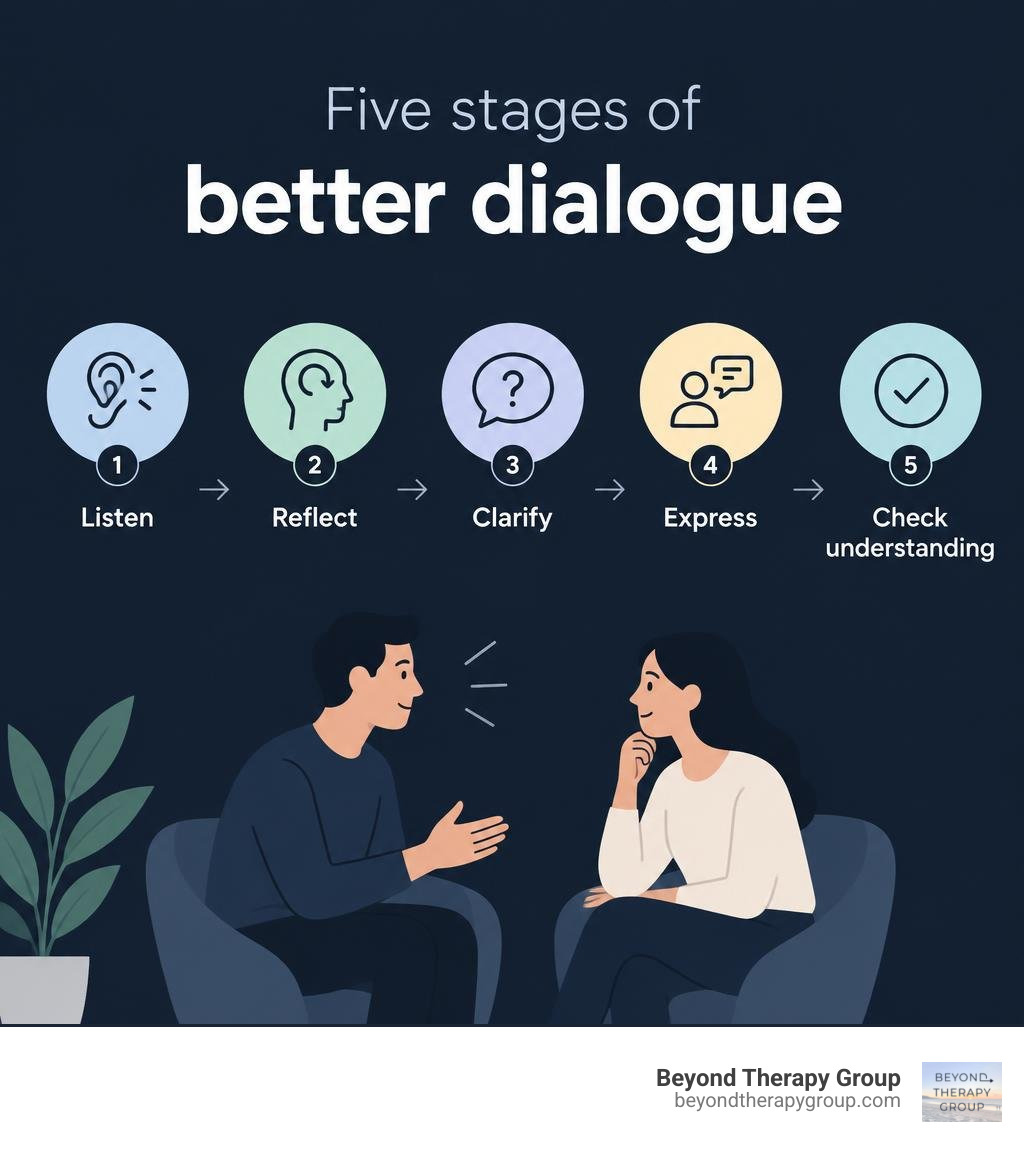
Improving everyday dialogue does not require a complete personality overhaul. Instead, it involves practicing small, repeatable micro-habits. Using structured communication methods like the LACE framework (Listen, Acknowledge, Clarify, Express) helps establish clarity in environments.
To see how everyday communication choices shape our outcomes, consider the distinct approaches outlined below:
| Communication Style | Typical Behaviors | Vocal and Physical Cues | Common Outcome |
|---|---|---|---|
| Passive | Hiding true thoughts, excessive apologizing | Soft voice, avoiding eye contact, slouching | Built-up resentment, overlooked needs |
| Aggressive | Interrupting, demanding, blaming others | Loud volume, finger pointing, tense posture | Damaged trust, defensiveness, retaliation |
| Assertive | Direct statements, collaborative problem solving | Steady tone, open posture, relaxed eye contact | Mutual respect, clear boundaries, quick resolution |
Adopting an assertive style forms the foundation for healthy personal and professional interactions. When you focus on mastering assertive communication skills, conversations become honest, respectful, and effective.
Step 1: Practice Reflective Listening to Improve Interpersonal Communication Skills
Most people listen with the intent to reply rather than to understand. The moment another person begins speaking, our brains start preparing a rebuttal, an anecdote, or a quick fix.
You can break this reflex by introducing a simple two-second pause before responding. Give the other person space to finish their complete thought. Follow that pause with intentional paraphrasing.
Try using open-ended inquiries such as:
- “What I am taking away from this is that the schedule feels unrealistic. Is that accurate?”
- “It sounds like you felt unsupported during the presentation. Can you share more about that?”
Practicing simple reflective listening exercises ensures that the other person feels respected and understood before you move forward.
Step 2: Use Assertive Boundary Drills to Improve Interpersonal Communication Skills
Assertiveness is the middle ground between passive withdrawal and aggressive confrontation. It means asking for what you need clearly without stepping on the rights of others.
A reliable tool for direct communication is the first-person statement structure:
- “I feel concerned when updates are missed because it puts our delivery timeline at risk.”
- “I need uninterrupted time to finish this report this afternoon.”
Using assertive drills to stop mumbling helps you speak with steady volume and crisp articulation, ensuring your ideas are heard without unnecessary apology.
Step 3: Align Nonverbal Signals with Spoken Words
Nonverbal signals carry significant emotional weight in human communication. If your words offer praise while your arms are crossed and your eyes are fixed on a phone screen, the listener registers the disconnection immediately.
Keep your posture open, lean gently forward to show engagement, and maintain steady, natural eye contact. As detailed in academic research on interpersonal development, congruent nonverbal signals build trust and reinforce the clarity of your spoken words.
Step 4: Regulate Emotional Reactions Before Responding
When conversations touch on sensitive topics, our nervous system can kick into a defensive state. In that state, rational thinking diminishes and reactive statements slip out.
Before responding to a challenging comment, practice physical grounding. Take a slow, diaphragmatic breath. Feel your feet firmly planted on the floor. This brief pause acts as a physiological buffer against stress, allowing you to identify your emotional triggers and respond thoughtfully rather than reacting defensively.
Step 5: Establish Structured Feedback Loops
Misunderstandings often linger because individuals hesitate to clarify expectations. Establishing a clear feedback loop solves this challenge.
A proven method is the Situation-Behavior-Impact model:
- Situation: Anchor your comment in a specific time and place.
- Behavior: Describe the objective, observable action without personal labels.
- Impact: Explain how that action affected the team or workflow.
Using this structured format keeps conversations constructive, objective, and centered on shared goals.
Navigating Conflict and High-Stakes Conversations
High-stakes discussions often trigger fear and defensive behavior. When opinions differ and emotions run high, having a reliable conversational framework keeps interactions grounded.

One reliable approach is the DEAR MAN framework from Dialectical Behavior Therapy:
- Describe the facts of the situation objectively.
- Express your feelings or concerns clearly.
- Assert your wishes or request directly.
- Reinforce the mutual benefit of resolving the issue.
- Mindful focus on the primary topic without getting sidetracked.
- Appear confident with calm, steady posture.
- Negotiate feasible solutions collaboratively.
Mastering this approach supports speaking your truth in relationships in a way that protects both your boundaries and your connection with others.
De-Escalating Tension with Emotional Validation
During a heated disagreement, jumping straight to logical solutions often increases tension. When individuals feel unheard, they tend to repeat themselves more emphatically.
You can de-escalate tension by validating feelings before offering answers:
- “I can see why this situation feels overwhelming.”
- “It makes complete sense that you are frustrated by this delay.”
Validation does not mean you agree with every detail. It simply signals that you understand the emotional reality of the person in front of you. Once emotional intensity cools, collaborative problem solving becomes possible.
Setting Clear Expectations Under Pressure
Clear expectations prevent future misunderstandings. When managing tight deadlines or high-stakes projects, replace ambiguous requests with specific, actionable details.
Instead of saying, “Please send that report soon,” try saying, “Please send the finalized draft by Thursday at two o’clock so I can review it before our team check-in.” Coupling direct phrasing with assertive boundary setting in relationships ensures that everyone understands project scopes and personal limits.
Frequently Asked Questions About Interpersonal Communication
What is the single most important interpersonal communication skill to develop first?
Active listening is the cornerstone skill to master first. When you demonstrate accurate comprehension, you build trust and diffuse defensiveness immediately. Listening with genuine curiosity provides the essential context needed for all other communication strategies to succeed.
How can introverts build stronger interpersonal communication habits?
Introverts can excel in interpersonal communication by leaning into their natural capacity for deep focus. Practice micro-habits in low-stakes situations, such as asking one prepared open-ended question during a casual interaction. Introverts can also use deliberate pauses to process thoughts comfortably before speaking, ensuring their contributions are clear and impactful.
What are the most common mistakes that derail daily conversations?
The most common pitfalls include offering unsolicited advice before fully understanding the issue, interrupting while others are speaking, and sending conflicting nonverbal signals. Defensiveness also shuts down dialogue quickly. Choosing curiosity over the urge to be right keeps interactions open and productive.
Conclusion
Developing clearer conversations takes practice, self-awareness, and a willingness to listen with genuine curiosity. By applying structured frameworks, regulating your emotions, and aligning your body language with your words, you can turn tense moments into opportunities for connection.
If you are ready to strengthen your communication patterns and build more fulfilling personal and professional relationships, we are here to help. Beyond Therapy offers dedicated support from experienced clinicians in Redondo Beach and the wider South Bay area. Reach out to schedule a free 15-minute consultation through our personalized therapy services and consultations to begin your journey toward confident, authentic communication.
Recent Posts


