
June 18, 2026
A Comprehensive Guide to Defining Personal Boundaries

Key Takeaways
- Personal boundaries are internal rules that guide your own actions rather than controlling the behavior of others
- Defining your limits helps protect your mental health and prevents emotional burnout
- Healthy boundaries are flexible and can be adjusted as your relationships evolve over time
- Clear communication and consistent follow-through are essential for enforcing your limits
What Defining Personal Boundaries Actually Means (And Why It Changes Everything)
Defining personal boundaries means identifying the internal rules you set for yourself about what you will and will not accept in your relationships and daily life.
Here is a quick answer if you need it now:
Personal boundaries defined:
| Element | What It Means |
|---|---|
| What they are | Limits you set based on your values and comfort |
| What they protect | Your time, energy, emotions, and physical space |
| Who controls them | You, through your own actions and responses |
| What they are NOT | Demands placed on other people’s behavior |
| How to set them | Identify your values, communicate clearly, follow through |
Most people first hear about boundaries when something already feels wrong. A coworker keeps overstepping. A family member won’t stop calling during work hours. A relationship leaves you feeling drained instead of supported.
Sound familiar?
The problem is that many of us were never taught how to recognize our own limits, let alone how to name them. From childhood, the message was often to accommodate others first and push your own needs aside.
That pattern has a cost. Research consistently shows that people who lack clear personal limits report higher rates of anxiety, depression, and burnout.
The good news: boundaries are a skill. And like any skill, they can be learned, practiced, and refined over time.
This guide walks you through everything, from understanding what boundaries actually are, to communicating them clearly, to holding them when things get uncomfortable.
Basic defining personal boundaries glossary:
Understanding Personal Boundaries: What They Are and Why They Matter
When we talk about personal boundaries, it is helpful to think of them as an invisible property line. Just as a fence defines where your yard ends and your neighbor’s begins, a personal boundary clarifies where you end and another person starts. In psychological terms, this is closely linked to the concept of self-differentiation. Self-differentiation is our ability to separate our own emotional and intellectual functioning from that of others. It ensures that we do not lose our unique identity, even when we are deeply connected to a partner, family member, or friend.
Without clear limits, we run the risk of emotional fusion. Fusion happens when our emotions, decisions, and sense of self become so tangled up with someone else that we can no longer tell where our feelings stop and theirs begin. When we are fused with others, we tend to react to their moods, take on their stress, and feel responsible for their happiness.
Essentially, boundaries define where you end and others begin. They are not designed to keep people out or to build a cold, unyielding wall around your life. Instead, they act like a gate that you control. They allow you to maintain your autonomy and self-respect while still participating in warm, meaningful connections.
To explore this concept further, you can read The Ultimate Guide to Drawing Lines in the Sand, which breaks down the foundational steps of establishing these personal property lines.
Distinguishing Boundaries from Requests and Ultimatums
One of the most common reasons boundary-setting fails is that we confuse boundaries with requests or ultimatums. Understanding the difference is crucial for maintaining control over your own well-being.
- A Request is collaborative. You are asking someone else to change their behavior, but they have the right to say no. Because a request relies on the other person’s cooperation, it does not guarantee your protection.
- An Ultimatum is a demand aimed at controlling someone else’s actions, often accompanied by a threat of punishment. It focuses outward, attempting to force compliance.
- A Boundary is entirely about your own actions. It is a rule that guides your behavior, not theirs. It focuses on what you will do when a certain limit is crossed. It does not require the other person’s agreement or participation because you have complete control over your response.
| Feature | Request | Ultimatum | Boundary |
|---|---|---|---|
| Focus | Outward (asking others) | Outward (demanding of others) | Inward (guiding your own actions) |
| Goal | Collaboration | Control / Compliance | Self-protection and autonomy |
| Control | Low (depends on their choice) | Low (attempts to force their choice) | High (depends entirely on your actions) |
| Example | “Could you please stop calling me during my work hours?” | “If you call me during work hours again, I am going to block your number forever.” | “I am focused on work during the day, so I will not be answering phone calls between 9 AM and 5 PM.” |
By shifting your focus from trying to change other people to managing your own responses, you regain your personal power. You no longer have to wait for someone else to behave differently to feel safe and respected.
The Psychological Importance of Defining Personal Boundaries
Establishing clear limits is not just a social convenience. It is a fundamental pillar of mental health. Research consistently highlights that individuals who regularly define and maintain clear interpersonal boundaries report significantly lower levels of anxiety, depression, and burnout.
When we lack boundaries, we live in a state of constant hyper-vigilance. We are always trying to anticipate the needs of others, avoid conflict, and keep the peace. This continuous self-sacrifice drains our emotional reserves, leading to deep resentment and exhaustion. By protecting our personal space and energy, we preserve our emotional sovereignty, ensuring that we have the capacity to show up fully for ourselves and the people who matter most.
For a deeper look into how establishing limits can transform your well-being, read How to Set Healthy Boundaries & Build Positive Relationships and consult our Ultimate Checklist for Healthy Boundaries.
The Six Core Types of Boundaries
To begin the process of defining personal boundaries, we must look at the different areas of our lives where limits are necessary. Personal boundaries generally fall into six distinct categories:
- Physical Boundaries: These protect your personal space, physical body, and comfort levels with touch. This might look like choosing to wave instead of shaking hands, or expressing your comfort levels regarding physical proximity.
- Emotional Boundaries: These protect your internal feelings and mental energy. They involve separating your emotions from another person’s emotions and refusing to take responsibility for their mood swings.
- Time Boundaries: These govern how you spend your time and protect you from overcommitting. A time boundary might involve setting a limit on how long you will wait for a chronically late friend or declining weekend work demands.
- Material Boundaries: These protect your belongings, home, and financial resources. They define what you are willing to share, who you are willing to lend items to, and how those items must be treated.
- Intellectual Boundaries: These protect your thoughts, ideas, and beliefs. They ensure that your opinions are respected, even when others disagree, and prevent you from being belittled or dismissed.
- Digital Boundaries: These govern your relationship with technology and online spaces. They include setting device-free hours, deciding when you will respond to messages, and protecting your privacy on social media.
Healthy versus Unhealthy Boundary Styles
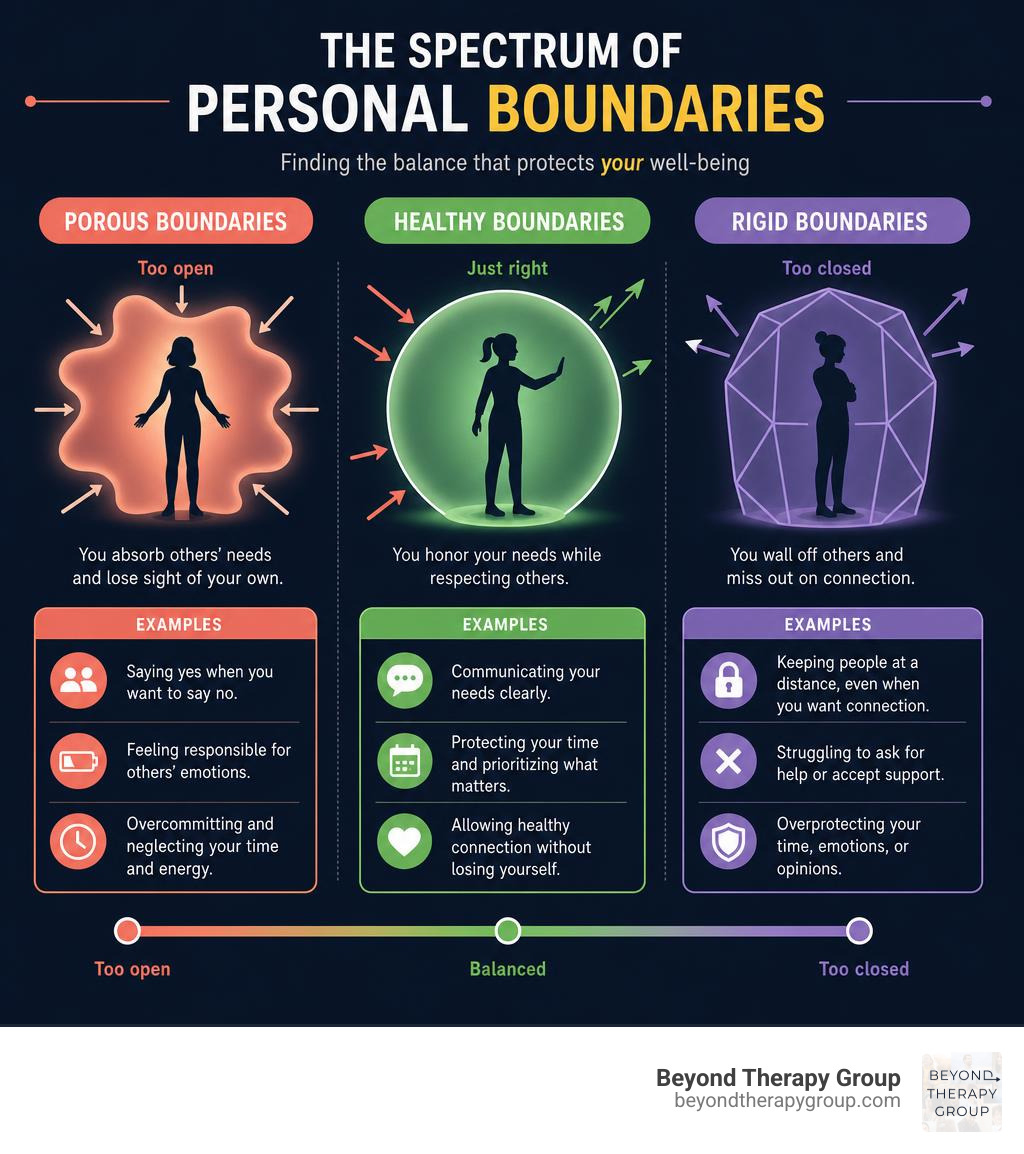
Everyone has a unique way of managing their personal space. Psychologists often categorize these patterns into three primary boundary styles:
- Porous Boundaries: If you have porous boundaries, you may find it incredibly difficult to say no, frequently overextend yourself to please others, and share too much personal information too quickly (oversharing). This style often stems from a fear of rejection or low self-esteem.
- Rigid Boundaries: If your boundaries are rigid, you might build high emotional walls, keep others at a distance, and struggle to show vulnerability. While this style protects you from pain, it can lead to isolation and prevent you from building deep, meaningful connections.
- Flexible Boundaries: This is the healthiest style. Flexible boundaries are strong yet permeable. They allow you to protect yourself when necessary while remaining open to connection, intimacy, and compromise. You can adjust your limits based on the situation and the level of trust in the relationship.
How to Identify and Establish Your Comfort Zones
Before you can communicate your limits to others, you must first understand what your comfort zones actually are. This requires a high degree of self-awareness and a willingness to tune into your own internal signals.
Often, our bodies tell us we need a boundary long before our logical minds catch up. Pay close attention to your visceral signals. If your chest gets tight, your stomach drops, or you feel a sudden wave of resentment or exhaustion during an interaction, your gut is telling you that a limit has been crossed. Resentment is particularly informative. It is almost always a sign that you have said “yes” when you wanted to say “no,” or that you are allowing your needs to be overlooked.
Step-by-Step Process for Defining Personal Boundaries
If you are ready to start defining personal boundaries in a structured way, we recommend using this practical, step-by-step process:
- Identify Your Core Values: Your boundaries should always align with what matters most to you. If you value family time, you need boundaries around work hours. If you value peace and quiet, you need boundaries around unannounced visitors.
- Run a 24-Hour Boundary Inventory: Use a digital notebook or a simple journal to track your daily stressors. Note down every time you feel a pinch of irritation, guilt, or exhaustion. Write down who you were with, what happened, and what you felt.
- Define Your Limits and Actions: For each stressor, write down a clear limit and a corresponding action you will take to protect it. Focus on your behavior, not theirs.
- Practice Small: Do not start with your most challenging relationship. Begin by practicing low-stakes boundaries, like declining an invitation to an event you do not want to attend, to build your confidence.
Maintaining and Adjusting Boundaries Over Time
It is a common misconception that once a boundary is set, it is carved in stone forever. In reality, healthy boundaries are dynamic. As your life circumstances change, your relationships evolve, and you go through major transitions, your limits will naturally need to be reevaluated.
For example, a boundary you set with your parents as a teenager will look very different from the limits you maintain with them as an adult. Similarly, a boundary in a new romantic relationship may soften as trust is established over time. Regular reevaluation ensures that your boundaries continue to serve your well-being without turning into rigid walls that block out positive experiences.
Practical Strategies for Communicating and Enforcing Limits
The gap between knowing you need a boundary and actually stating it out loud can feel incredibly daunting. This is often called the assertiveness gap. The key to closing this gap is direct, calm, and respectful communication.
When stating a limit, avoid the temptation to apologize, over-explain, or defend your decision. You do not need a three-page essay to justify your personal space. Keep your message short, clear, and focused on your needs. Using “I-statements” is highly effective here because it allows you to express your limits without sounding accusatory or starting an argument.
To build your assertiveness skills, you can read more about How To Set Boundaries in Healthy Ways and explore our guide on Mastering Assertiveness and Boundary Training for Better Relationships.
Scripts for Setting Boundaries in Different Contexts
Here are a few practical, real-life scripts you can adapt for various situations:
Workplace Boundaries
- The Situation: A colleague or supervisor emails you late on Friday evening expecting an immediate response.
- The Script: “I am signing off for the weekend to spend time with my family. I will review this first thing on Monday morning and get back to you by noon.”
Family Dynamics
- The Situation: A parent drops by your home unannounced, disrupting your evening routine.
- The Script: “I love seeing you, but I need to know ahead of time when people are coming over so I can prepare. Please call or text me a day in advance before stopping by.”
Friendships
- The Situation: A friend constantly calls you to vent about their problems, leaving you feeling emotionally drained.
- The Script: “I want to support you, but I do not have the emotional bandwidth to hold this right now. Can we talk about this tomorrow when I have more energy?”
Romantic Relationships
- The Situation: Your partner makes jokes at your expense in front of other people.
- The Script: “I feel hurt and embarrassed when you joke about my personal life in front of our friends. If you do it again, I will leave the gathering and go home.” For additional relational strategies, check out How to Set Boundaries in Your Relationship Without Being a Jerk.
Enforcing Consequences When Boundaries Are Violated
A boundary without a consequence is merely a suggestion. If someone ignores your stated limit, you must be prepared to follow through with the action you decided on.
Enforcing a boundary does not require you to raise your voice, argue, or demand that the other person apologize. It simply requires a calm, consistent response. If someone continues to bring up a sensitive topic you have asked them to avoid, you can say, “I am not going to discuss this,” and politely end the call or walk out of the room.

You can also use physical rituals to help you transition and hold the line. For example, if you work from home, taking a quick shower or changing your clothes at the end of the workday can serve as a physical boundary, helping your brain transition from “work mode” to “personal mode” and preventing professional stress from bleeding into your home life.
Overcoming Obstacles to Healthy Boundary Setting
If setting boundaries were easy, everyone would do it. The truth is, drawing lines in the sand can trigger a lot of internal and external resistance.
Many of us struggle with deep-seated people-pleasing tendencies, a fear of rejection, or intense guilt. We worry that if we say “no,” others will think we are selfish, cold, or uncaring. It is vital to remember that guilt is a natural part of the process when you start doing something new. Feeling guilty does not mean you have done something wrong. It simply means you are breaking an old, unhealthy habit of prioritizing everyone else’s comfort over your own sanity.
Common Challenges When Defining Personal Boundaries
When you begin establishing limits, you may run into several common challenges:
- The Assertiveness Gap: Knowing what you need but feeling your throat lock up when it is time to say it. This is normal. Practice your scripts in front of a mirror or with a trusted friend to build muscle memory.
- Pushback and Resistance: People who are used to you having porous boundaries will often react with anger, defensiveness, or guilt trips when you start standing up for yourself. Their reaction is a reflection of their own discomfort, not proof that your boundary is wrong.
- Codependency: Believing that you are responsible for fixing other people’s problems or managing their feelings. Learning to step back and let others carry their own emotional weight is essential for both of you.
For more insights on navigating these relational dynamics, you can read Setting Boundaries With Others
Frequently Asked Questions about Personal Boundaries
Can you set boundaries with a narcissist?
Yes, but you must adjust your expectations. Individuals with strong narcissistic traits rarely respect boundaries voluntarily. With them, verbal agreements are rarely enough. You must enforce your limits through consistent, unilateral actions rather than trying to have a collaborative conversation. Avoid justifying, arguing, or defending your choices. Simply state your limit, and if they violate it, immediately remove yourself from the interaction.
How do I set boundaries without feeling guilty?
The short answer is: you don’t, at least not at first. Guilt is a very common side effect of setting boundaries, especially if you have spent years putting others first. The key is to tolerate the temporary discomfort of guilt rather than giving in to keep the peace. Over time, as you experience the benefits of protected energy and improved self-worth, the guilt will naturally fade.
What is the difference between a boundary and an ultimatum?
A boundary is an internal rule focused entirely on your own behavior and what you will do to protect your peace (e.g., “I will leave the room if I am being yelled at”). An ultimatum is an external demand designed to force someone else to change their behavior under threat of punishment (e.g., “If you don’t stop yelling at me, I’m going to ruin your weekend”). Boundaries are about self-control, while ultimatums are about controlling others.
Conclusion
Defining personal boundaries is a continuous journey of self-care and self-discovery. It is the architectural foundation of your cognitive sovereignty, ensuring that you remain the author of your own life, your own time, and your own emotional well-being.
If you find yourself struggling to identify your comfort zones, feeling overwhelmed by guilt, or facing intense pushback from the people in your life, you do not have to navigate this journey alone.
At Beyond Therapy, we are dedicated to helping individuals in Redondo Beach and the South Bay build the skills they need to thrive. We invite you to explore our relationship and relational therapy services to learn how we can support you.
We offer a free 15-minute consultation with our experienced therapists to answer your questions, discuss your needs, and help guide your booking process. Reach out to us today, and let us help you build the firm, flexible gates you need to protect your peace.
Recent Posts


