
June 30, 2026
How to Master Assertive Communication Skills in 5 Easy Changes

Why an Assertive Communication Training Course Can Change Your Career
Key Takeaways:
- Assertive communication sits in the middle ground between passive and aggressive styles, helping you express needs while respecting others.
- Professional training programs teach practical techniques like I-statements, active listening, and boundary setting.
- Both individuals and organizations benefit from assertiveness training through reduced stress, better relationships, and stronger career growth.
An assertive communication training course gives you the tools to speak up clearly, set boundaries confidently, and get your point across without offending others.
Not sure which type of course fits your needs? Here is a quick overview:
| Course Type | Best For | Typical Duration |
|---|---|---|
| Self-paced online | Busy professionals, flexible schedules | A few hours to several weeks |
| Virtual classroom | Remote teams, interactive learning | 1 to 3 days |
| On-site workshop | Hands-on practice, team training | 1 to 5 days |
| Corporate program | Organization-wide skill building | Custom |
Most people struggle to speak up at work not because they lack intelligence or experience, but because no one ever taught them how. They either hold back and feel invisible, or push too hard and damage relationships.
That gap is exactly what assertive communication training is designed to close.
The stakes are real. Workplace stress tied to poor communication costs U.S. businesses an estimated $200 to $300 billion every year in lost productivity, absenteeism, and burnout. Learning to communicate assertively is not just a soft skill. It is a career-protecting, stress-reducing, relationship-building investment.
Whether you are a professional who stays quiet in meetings, a manager who struggles to give direct feedback, or someone who simply wants more confidence in everyday conversations, the right training can make a measurable difference fast.
Learn more about assertive communication training course:
Understanding the Core of Assertive Communication
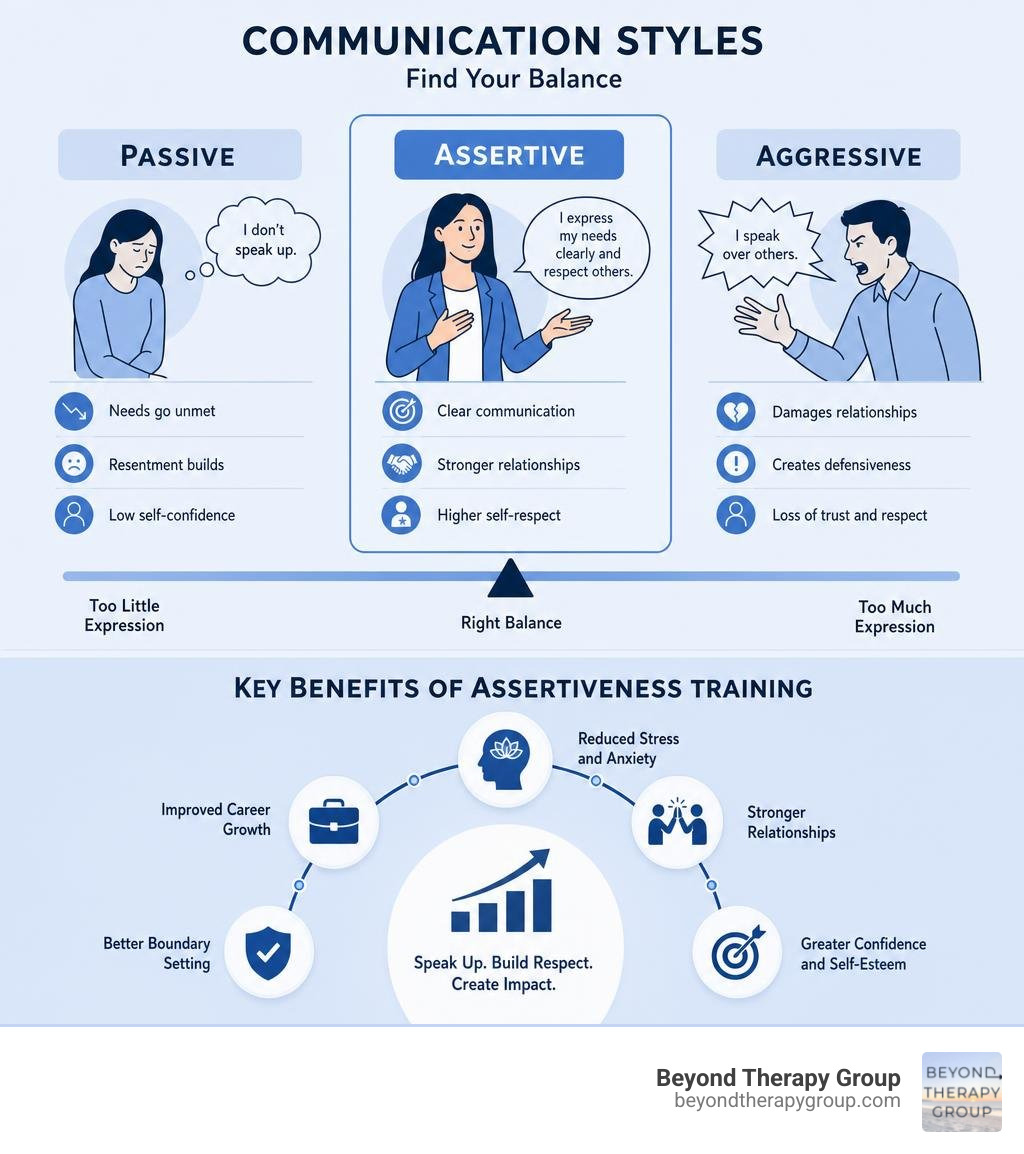
To build a strong presence, you must first understand where your current communication style falls. Communication generally exists on a spectrum. The four primary styles are passive, aggressive, passive-aggressive, and assertive.

- Passive communication involves putting the needs of others ahead of your own. Passive communicators often keep quiet, avoid conflict, and struggle to say no. While this style might seem safe, it leads to hidden resentment and burnout.
- Aggressive communication is the opposite. It involves pushing your own needs forward while ignoring the feelings and rights of others. Aggressive communicators may shout, interrupt, or use intimidating body language. This style destroys trust and damages professional relationships.
- Passive-aggressive communication occurs when someone expresses anger or frustration indirectly. This might look like sarcasm, silent treatment, or subtle sabotage. It creates a toxic environment because the real issues are never openly discussed.
- Assertive communication is the ideal balance. It is the ability to express your thoughts, feelings, and needs directly and honestly while still respecting the people around you. Assertive individuals use active listening, maintain open body language, and focus on collaborative problem-solving.
Developing these skills is a journey of self-awareness. When you learn to balance advocacy for yourself with enquiry into others, you build lasting trust. For a deeper look at what makes someone a truly impactful speaker, you can Learn the essential traits of great communicators to help guide your growth.
Why You Should Enroll in an Assertive Communication Training Course
Enrolling in a professional training program is one of the fastest ways to build communication confidence. While some people believe that assertiveness is a natural talent, it is actually a highly teachable skill. Training provides structured practice, expert feedback, and a safe space to try new techniques.

The benefits of taking a dedicated course extend to every area of your career. In a professional setting, assertive individuals are much more likely to be considered for leadership roles. They know how to delegate tasks effectively, provide constructive feedback, and handle difficult conversations without creating unnecessary tension.
For organizations, communication training is a powerful tool to reduce conflict and retain top talent. When team members can express their ideas clearly, productivity rises, and stress-related inefficiencies drop. If you want to understand how these dynamics play out in your everyday interactions, you can Discover the secret sauce of effective communication to see how clarity transforms professional relationships.
What to Expect from a Professional Assertive Communication Training Course
A high-quality training program is highly interactive. You will not just sit and listen to lectures. Instead, you will actively participate in workshops designed to build your skills in real time.
During a typical course, you can expect:
- Interactive role-playing exercises where you practice handling tough workplace scenarios.
- Collaborative discussions that help you understand different communication patterns.
- Self-assessment tools to identify your personal communication blind spots.
- Personalized feedback from experienced instructors to help you refine your approach.
You will also learn specific verbal frameworks, such as the DESC approach, which stands for Describe, Express, Specify, and Consequences. This structured method helps you address difficult issues calmly and professionally.
Selecting the Right Assertive Communication Training Course for Your Career
Choosing the right course depends on your schedule, learning style, and career goals. There are several excellent options available for professionals looking to upgrade their skills.
For those who prefer structured, multi-day seminars, the Assertive Communication Training | Learning Tree course offers deep dives into behavioral patterns and personal empowerment. Another excellent option is the Assertiveness Skills Course Online & Washington, D.C., which blends theoretical models with practical exercises.
If you are looking for leadership-specific training, the Secrets to Leading with Assertiveness – Dale Carnegie Training program is highly regarded. For self-paced digital learning, you can explore courses like Mastering Assertiveness and Communication or Assertive Communication for Leadership on Udemy.
If you want a highly practical, conversation-focused workshop, consider the Assertive Communication and Conversation Skills: Practical Training Course | CCE. For international options or comprehensive management seminars, the Effective Communication and Assertiveness – London Management Centre offers robust training. Organizations looking to train entire teams often turn to customized solutions like the Assertive Communication Training Program or regional workshops such as Assertiveness Skills Training in San Jose – The Knowledge Academy. You can also find helpful introductory material by watching the Assertive Communication Skills Training overview on YouTube.
5 Easy Changes to Master Assertive Communication Today
While a formal course provides the deepest training, you can start improving your communication right now by making five simple adjustments to your daily interactions.
- Use I-statements: Replace accusatory statements like “You always interrupt me” with “I would like to finish my thought before we discuss other ideas.” This keeps the focus on your experience rather than putting the other person on the defensive.
- Set clear boundaries: Clearly define what you can and cannot accept. If you want to build this skill, you can Master assertiveness and boundary training to learn how to draw healthy lines in the sand at work and in life.
- Speak up for yourself: Do not wait for others to guess what you need. Learn to articulate your expectations openly. To build your confidence in doing this, you can Master the art of speaking up for yourself in a professional, constructive way.
- Practice vocal clarity and presence: Avoid mumbling or using filler words that weaken your message. If you want practical drills to improve your delivery, you can check out how to Stop Mumbling and Start Speaking with These Assertive Drills.
- Use the broken record technique: When dealing with difficult or manipulative individuals, state your position calmly and repeat it as necessary without getting emotional. You can Learn how to use the broken record technique to stand your ground firmly and politely.
Frequently Asked Questions About Assertiveness Training
How long does it take to see results from assertiveness training?
Many participants notice an immediate shift in their mindset after just a single session. However, turning these insights into natural habits takes consistent practice. Most people report a significant increase in their communication confidence within three to six weeks of daily practice.
Are there any prerequisites for enrolling in these courses?
No prior experience is required. These courses are designed for professionals at all levels, including individual contributors, new managers, and senior executives. The only prerequisite is an open mindset and a willingness to practice new communication techniques.
How can organizations measure the ROI of communication training?
Organizations can track the effectiveness of training through several key metrics. These include lower rates of employee turnover, fewer internal conflicts escalated to HR, and improved scores on employee engagement surveys. Reducing communication-related stress also directly lowers costs associated with burnout and absenteeism.
Conclusion
Mastering assertive communication is one of the most powerful steps you can take for your career and your personal well-being. By learning to balance your own needs with respect for others, you can build stronger professional relationships, reduce stress, and step into leadership roles with confidence.
At Beyond Therapy, we support professionals in Redondo Beach and the South Bay who want to build deep, lasting confidence in their personal and professional lives. We provide tailored consultations to help you identify your goals and overcome communication barriers.
Ready to take the next step? We offer a free 15-minute consultation with our therapists to guide your booking and answer any questions you may have. Explore our professional therapy services today to start your journey toward confident, assertive communication.
Recent Posts