
May 28, 2026
Mastering Assertiveness and Boundary Training for Better Relationships

- Key takeaways
- Assertiveness is the balanced middle ground between staying silent and being aggressive
- Boundaries protect your time, energy, and emotional well-being
- Core skills like “I” statements, calm body language, and the broken record technique can be learned by anyone
- Research links assertiveness training to lower stress, less anxiety, and stronger self-esteem
- Daily practice makes boundary setting feel natural over time
Why Assertiveness and Boundary Training Changes Everything
Assertiveness and boundary training gives you the tools to speak up for yourself clearly and respectfully, without losing your cool or pushing people away.
If you have ever walked away from a conversation wishing you had said something, or stayed quiet to keep the peace and felt worse for it, you already know what it costs to leave your needs unspoken.
Here is a quick overview of what this means in practice:
| What It Is | What It Is Not |
|---|---|
| Expressing your needs honestly and calmly | Demanding, threatening, or controlling others |
| Saying no without guilt or over-explaining | Staying silent to avoid discomfort |
| Setting limits that protect your well-being | Being cold, harsh, or dismissive |
| Respecting yourself and the other person | Passive-aggressive behavior or manipulation |
The good news is that assertiveness is not a personality trait you either have or do not have. It is a learnable skill, like playing an instrument. Research suggests assertiveness training can reduce stress, ease anxiety and low mood, and build confidence, even with self-guided practice.
Whether you are a busy professional trying to stop overcommitting, a parent looking for calmer ways to set limits with your kids, or someone who simply wants to stop feeling drained by their relationships, this guide walks you through exactly how to get there.
What Assertiveness and Boundary Training Really Means
At its core, assertiveness and boundary training helps us communicate from an “I count and you count” position. We matter. The other person matters too. That balance is the whole game.
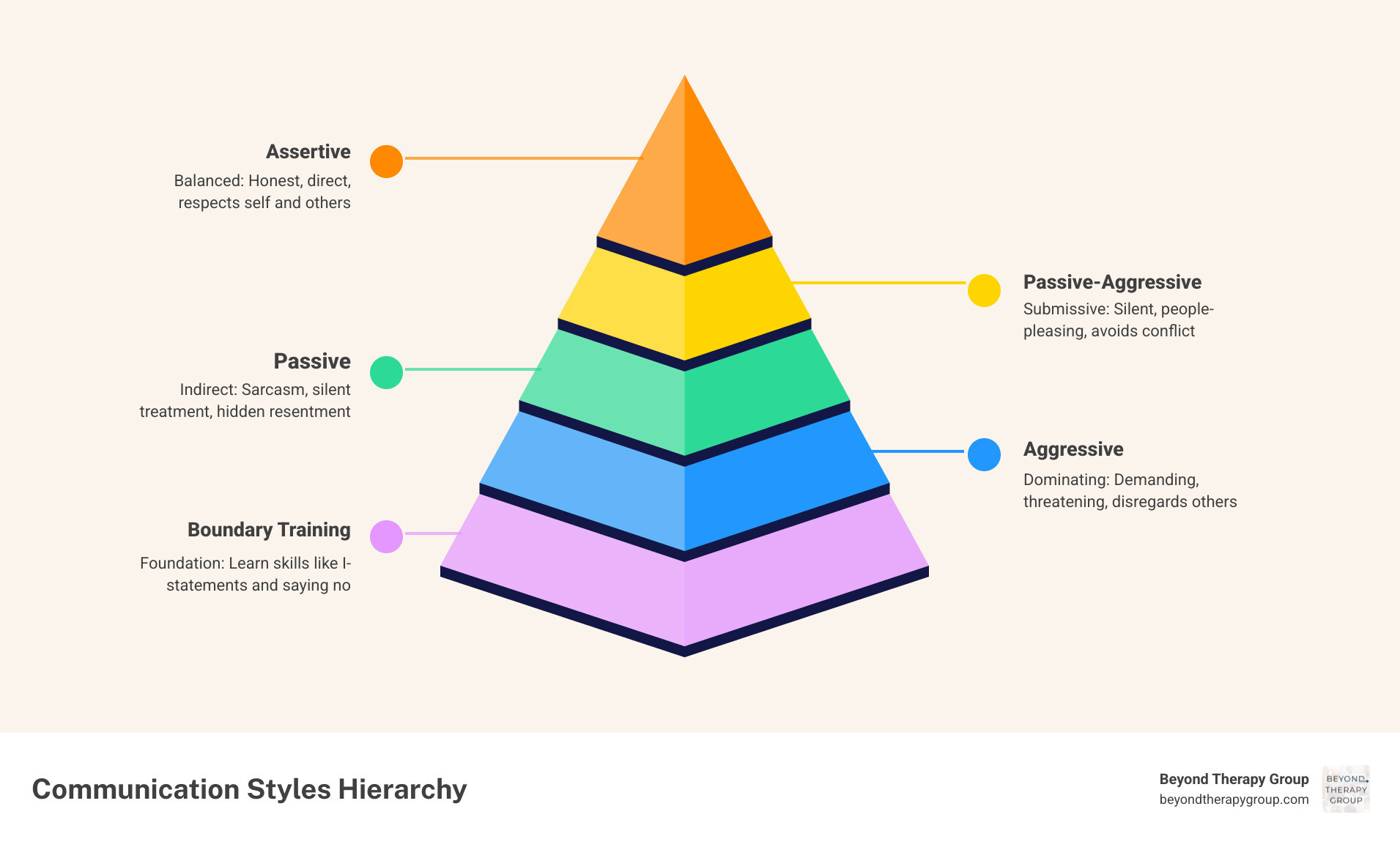
What is assertiveness and how is it different from being passive or aggressive
Assertiveness means expressing thoughts, feelings, preferences, and limits directly while respecting the other person’s rights and dignity.
Here is the simplest comparison:
| Style | What it sounds like | What usually happens |
|---|---|---|
| Passive | “Whatever you want is fine” | Needs go unmet and resentment grows |
| Aggressive | “Do it my way” | Conflict, defensiveness, and power struggles |
| Passive-aggressive | “Fine. Do whatever.” | Mixed messages, tension, and distrust |
| Assertive | “That does not work for me. Here is what I can do.” | Clarity, respect, and healthier outcomes |
Passive communication often looks polite on the surface but can lead to burnout. Aggressive communication may get quick compliance, but it damages trust. Passive-aggressive communication hides anger behind sarcasm, silence, or guilt. Assertiveness is the healthy middle path.
If this sounds familiar, Mastering the Art of Speaking Up for Yourself is a helpful next read.
What boundaries are and why they matter in everyday life
Boundaries are the limits and expectations that protect our time, energy, privacy, body, emotions, and values.
Common types include:
- Time boundaries
- Emotional boundaries
- Physical boundaries
- Sexual boundaries
- Digital boundaries
- Work boundaries
- Family boundaries
Examples:
- “I am not available for work messages after 6 p.m.”
- “I want to talk about this, but not while voices are raised.”
- “Please ask before using my things.”
- “I can help on Saturday, but not every weekend.”
Boundaries are not punishments. They are guidelines for how we participate in relationships. Clear limits help us feel safer, steadier, and less resentful. For more on this, see The Ultimate Guide to Drawing Lines in the Sand and the Ultimate Checklist for Healthy Boundaries.
Why assertiveness and boundary training works better than people-pleasing or conflict avoidance
People-pleasing can feel kind, but it often comes from fear of conflict, guilt, or rejection. Conflict avoidance can keep the room quiet for five minutes and your nervous system loud for three days.
When we do not set limits, we often:
- Say yes when we mean no
- Overcommit and feel trapped
- Walk on eggshells
- Become resentful
- Snap later in ways that feel unlike us
Assertiveness works better because it increases clarity and lowers emotional buildup. Instead of stuffing feelings until they burst, we address issues earlier and more respectfully.
Why Boundaries Improve Mental Health Relationships and Well-Being
Healthy limits are not just nice communication skills. They support mental health, relationship quality, and daily functioning.
What research says about the benefits of assertiveness training
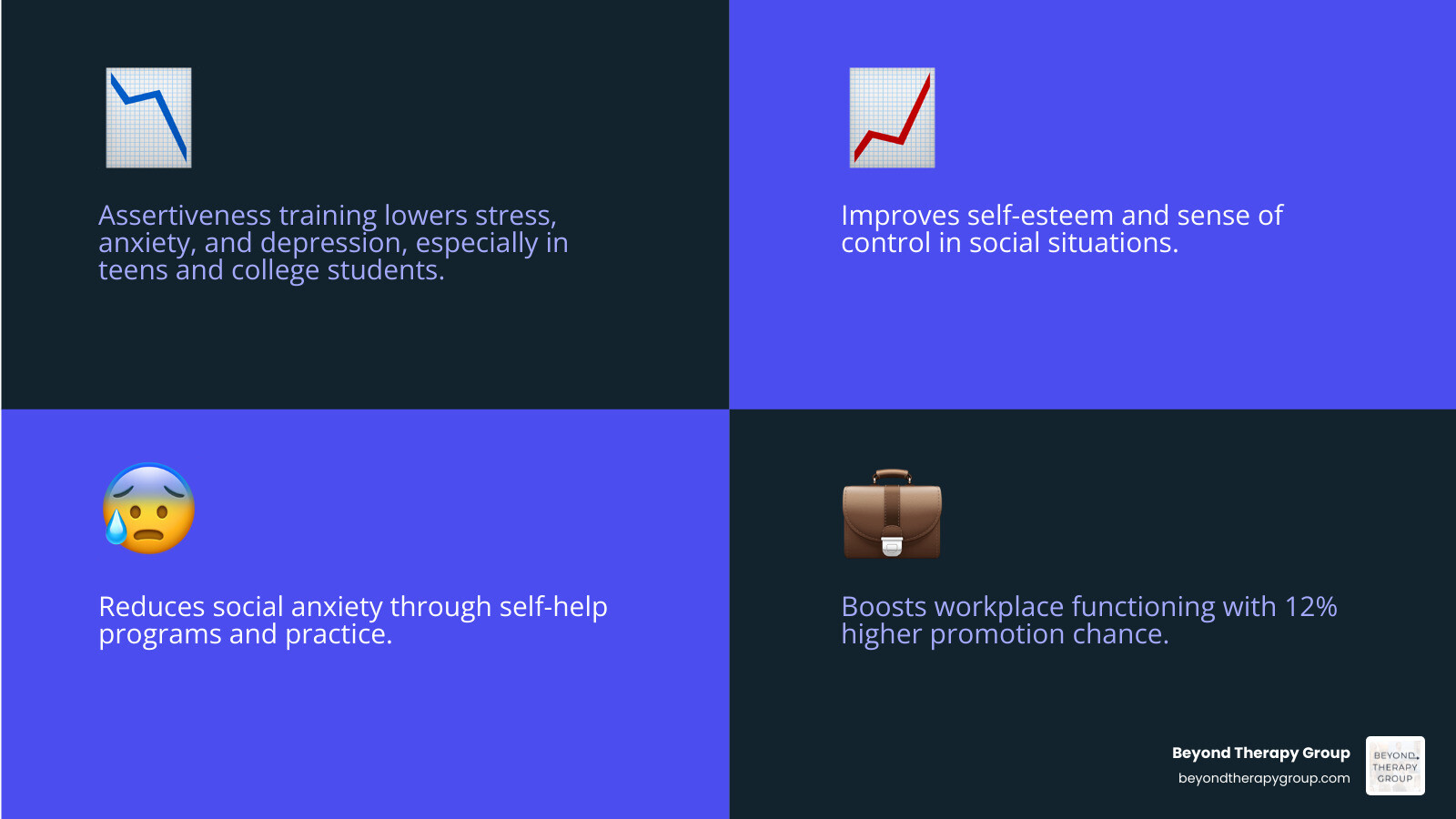
Research summarized across the sources shows several consistent benefits:
- Lower stress, anxiety, and depression, especially among teens and college-aged people
- Better self-esteem and a stronger sense of control in social situations
- Reduced social anxiety, including from self-help based programs
- Improved communication habits and emotional regulation
- Better workplace functioning and greater confidence in professional settings
Why does this happen? Because speaking up clearly reduces helplessness. When we can name what we need, say no, and manage uncomfortable conversations, we feel less trapped.
For additional practical exercises, general psychoeducational resources on assertiveness can be useful, and the overview of assertiveness offers a simple starting point for understanding the concept.
How clear limits strengthen relationships instead of damaging them
A lot of people worry that boundaries will hurt closeness. Usually the opposite is true.
Clear limits can create:
- More trust
- Less guessing
- Fewer blowups
- More consistency
- Less resentment
- More mutual respect
Boundaries help relationships move toward interdependence instead of overdependence or emotional distance. In real life, the sentence “I cannot do that, but I can do this” is often much more loving than silently agreeing and then simmering like an angry tea kettle.
If relationships are your main concern, these may help:
- Protect Your Relationship: 6 Boundaries Every Couple Needs
- Speak Your Truth and Save Your Relationship
- How to Set Boundaries in Your Relationship Without Being a Jerk
Who benefits most from assertiveness and boundary training
Most people can benefit, but it is especially useful for:
- Students managing peer pressure and workload
- Professionals trying to prevent burnout
- Parents setting calm, consistent limits
- People with social anxiety
- Caregivers who overextend themselves
- People-pleasers
- Leaders who need to be clear without becoming harsh
- Neurodiverse adults who want more direct communication tools
Core Skills Taught in Assertiveness and Boundary Training
The best training teaches both what to say and how to say it.
How to use I statements body language and tone without sounding harsh
“I” statements reduce blame and increase clarity.
A simple formula:
- I feel…
- When…
- Because…
- I need or I would prefer…
Example:
- “I feel frustrated when meetings run over because it affects the rest of my day. I need us to end on time.”
Helpful nonverbal cues:
- Stand or sit upright
- Keep an open posture
- Use steady eye contact
- Speak in a calm, even tone
- Avoid nervous laughing if possible
- Pause instead of rushing
Assertive tone should sound like you are stating a fact, not starting a duel.
The broken record technique fogging and respectful ways to say no
Two classic boundary tools are especially effective.
Broken record
- Calmly repeat your limit without escalating
Example:
- “I am not available tonight.”
- “I hear you. I am still not available tonight.”
- “I understand this is inconvenient. I am not available tonight.”
Fogging
- Acknowledge part of what the other person says without giving up your boundary
Example:
- “I get why you are disappointed. I am still not able to lend my car.”
Respectful ways to say no:
- “That will not work for me.”
- “I cannot take that on.”
- “I am not available.”
- “No, but I can help next week.”
- “I need to pass.”
You do not need a courtroom level defense for every no.
Practical tools from NVC DBT and CBT for difficult conversations
Several evidence-based approaches fit beautifully with assertiveness work.
From Nonviolent Communication Focus on:
- Observation
- Feeling
- Need
- Request
Example:
- “When plans change at the last minute, I feel stressed because I need more predictability. Can we confirm earlier next time?”
From DBT DEAR MAN is useful for high-stakes conversations:
- Describe
- Express
- Assert
- Reinforce
- Mindful
- Appear confident
- Negotiate
Example:
- “When emails come in late at night, I feel pressure to respond immediately. I need work requests sent during business hours. That will help me stay focused and responsive the next day.”
From CBT Challenge unhelpful beliefs like:
- “If I say no, they will hate me.”
- “Good people never disappoint anyone.”
- “I should be able to handle everything.”
Replace them with:
- “I can be kind and still set a limit.”
- “Discomfort is not danger.”
- “Other people’s feelings are real, but they are not mine to manage for them.”
Common mistakes when learning assertiveness and how to correct them
Common beginner mistakes include:
- Overcorrecting from passive to aggressive
- Overexplaining
- Apologizing for normal needs
- Sending mixed messages
- Setting a boundary once and then not following through
- Expecting zero guilt right away
How to correct them:
- Use fewer words
- Slow your pace
- Repeat your main point once or twice
- Validate feelings without changing your limit
- Practice on lower-stakes situations first
How to Practice Assertiveness and Boundary Training in Daily Life
Skill beats inspiration. Practice is where confidence comes from.
A simple step-by-step daily routine for speaking up and setting limits
Use this routine:
- Pause and notice
- Name the feeling
- Identify the need or limit
- Choose a short script
- Say it calmly
- Offer an option if appropriate
- Hold the boundary
Example:
- Pause: “I feel tense.”
- Need: “I need uninterrupted time.”
- Script: “I cannot talk right now. I can check in after dinner.”
A 7-day weekly action plan to build confidence fast
Day 1: Notice one moment when you stay quiet but want to speak up
Day 2: Make one small request
Day 3: Say no to one low-stakes request
Day 4: Practice a script out loud
Day 5: Role-play with someone you trust
Day 6: Journal what worked and what felt hard
Day 7: Review wins and choose one next boundary
Beginner scripts:
- “I need more notice before I can commit.”
- “I am not able to help today.”
- “Please do not speak to me that way.”
- “I need a few minutes before we continue this conversation.”
- “That does not work for me.”
You can also build communication foundations with Talk the Talk: Essential Traits of Great Communicators and The Secret Sauce of Effective Communication for Work and Life.
Real-world examples for work relationships and parenting
At work
- “I can finish project A by Friday, or I can start project B today. I cannot do both well on the same deadline.”
With a partner
- “I want to talk about this, but not while we are interrupting each other. Let us take ten minutes and come back.”
With family
- “I love you, and I am not available to host this weekend.”
With a roommate
- “I need the kitchen cleaned the same day after cooking.”
With a teen
- “I hear that you are upset. You still need to be home by 10.”
For more practical reading, general educational resources on everyday assertiveness can offer useful examples.
The A.C.T. Strategy for Setting Limits With Children
One of the most practical parenting tools from Conscious Discipline is A.C.T.
What A.C.T. stands for and why it helps children cooperate
A.C.T. means:
- Acknowledge the feeling
- Communicate the limit
- Target an acceptable alternative
This works because children need both connection and structure. Kindness without limits becomes mushy. Limits without connection become harsh. A.C.T. keeps both.
Scripts for hitting throwing toys and refusing cleanup
Throwing toys
- “You feel frustrated that the tower fell. You may not throw toys. You can ask for help or take a break.”
Hitting a sibling
- “You feel angry because you wanted a turn. You may not hit. You can say, ‘My turn please,’ or ask me for help.”
Refusing cleanup
- “You did not want to stop playing. It is cleanup time. You can put away the blocks or the books. Which do you choose?”
Notice the pattern:
- Feeling is acknowledged
- Limit is clear
- Alternative is specific
No yelling. No threats. No bribery. Just calm leadership.
How to adapt child boundary skills for adults and teens
A.C.T. also works surprisingly well with older kids and adults.
Example with a teen:
- “I get that you are disappointed. Curfew is still 10. You can text me if plans change.”
Example with an adult:
- “I understand you are stressed. I am not able to answer work messages late at night. Please send it tomorrow morning.”
The principle is the same: validate emotion, state the limit, offer a workable next step.
Frequently Asked Questions about Assertiveness and Boundary Training
How do I become assertive if I am afraid of conflict
Start small. Fear of conflict often decreases with gradual practice.
Try this:
- Breathe slowly before speaking
- Rehearse one sentence
- Start with low-stakes situations
- Remind yourself that discomfort is not the same as danger
- Celebrate small wins
If your body freezes, that does not mean you failed. It means your nervous system needs repetition and safety.
Can assertiveness be respectful in cultures that value quietness and harmony
Yes. Assertiveness does not require being loud, blunt, or confrontational. In cultures that value harmony, assertiveness may look softer and more indirect, but it still includes clarity and self-respect.
Examples:
- “I am not able to do that.”
- “I would prefer a different arrangement.”
- “I need some time to think before answering.”
Respectful tone, timing, and wording can be adapted without abandoning the boundary itself.
When should I get extra support for boundary problems
Extra support can help if you notice:
- Chronic people-pleasing
- Panic when disappointing others
- Repeated unhealthy relationship patterns
- Trouble identifying your own needs
- Low self-worth or intense guilt after setting limits
- Social anxiety that makes practice feel impossible
In those cases, therapy can help us work on the deeper beliefs and emotional blocks underneath the communication habit. Support is especially useful when assertiveness struggles are tied to anxiety, depression, past invalidation, or long-standing relationship dynamics.
If you are looking for professional development options, general educational resources on assertiveness skills can help you learn more about the field. For confidence and self-worth support, working with a licensed mental health professional may also be helpful.
Final Thoughts
Learning assertiveness and boundary training is really about building long-term emotional intelligence. We become better at recognizing feelings, naming needs, communicating clearly, and staying grounded when someone does not love our limit. That is not selfish. That is healthy adulthood.
Over time, these skills can lead to:
- Stronger confidence
- Healthier relationships
- Less resentment
- Better work-life balance
- More consistency in parenting
- A greater sense of self-respect
If you want support putting these skills into practice, Beyond Therapy offers tailored therapy services and a free 15-minute consultation to help guide booking and answer questions. You can also explore our relationship and relational therapy services if boundary challenges are affecting your partnership or family life.
And if you want to keep learning, start here:
- Ultimate Checklist for Healthy Boundaries
- Mastering the Art of Speaking Up for Yourself
- Protect Your Relationship: 6 Boundaries Every Couple Needs
Small, steady practice really does change relationships. One clear sentence at a time.
Recent Posts


