
June 9, 2026
How to Master Reflective Listening Practice Exercises

Why Reflective Listening Practice Exercises Are Worth Your Time
Key takeaways:
- Reflective listening means restating what someone said to confirm you understood both their words and feelings
- It goes a step further than active listening by mirroring content AND emotion back to the speaker
- Regular practice builds trust, reduces conflict, and improves relationships at work and at home
- Simple exercises like partner practice, role-play, and journaling can sharpen this skill fast
- Worksheets and structured activities help track progress and make the skill stick
Reflective listening practice exercises can transform the way you connect with people, whether you are managing a stressful team at work or navigating a difficult conversation at home.
Here are the core exercises to get started:
- Partner Practice – One person speaks for 60 seconds. The other only reflects back what they heard, without advice or opinions.
- Role-Play Scenarios – Act out real-life situations (workplace conflict, relationship tension) and practice mirroring feelings and content.
- The Dream Vacation Exercise – A speaker describes their ideal trip. The listener summarizes everything before offering any response.
- Journaling Conversations – After a real conversation, write down what the other person said and what feelings you noticed. Compare with what you actually reflected back.
- The Loud Brain Check – During a conversation, notice when your inner voice starts planning a response. Pause. Refocus on the speaker.
Most of us think we are better listeners than we actually are.
Think about the last time someone introduced themselves to you. Were you really listening, or were you already planning what to say next?
That gap between hearing and understanding is exactly what reflective listening closes.
It is not just about being polite or nodding along. Reflective listening is a specific communication skill where you restate, paraphrase, or mirror back what someone said, including how they feel, so they know they were truly heard. Research shows it is a core skill in therapy that strengthens the bond between people and supports real progress in difficult conversations.
And here is the good news: it is a learned skill. With the right exercises, anyone can get better at it.
Understanding the Mechanics of Reflective Listening
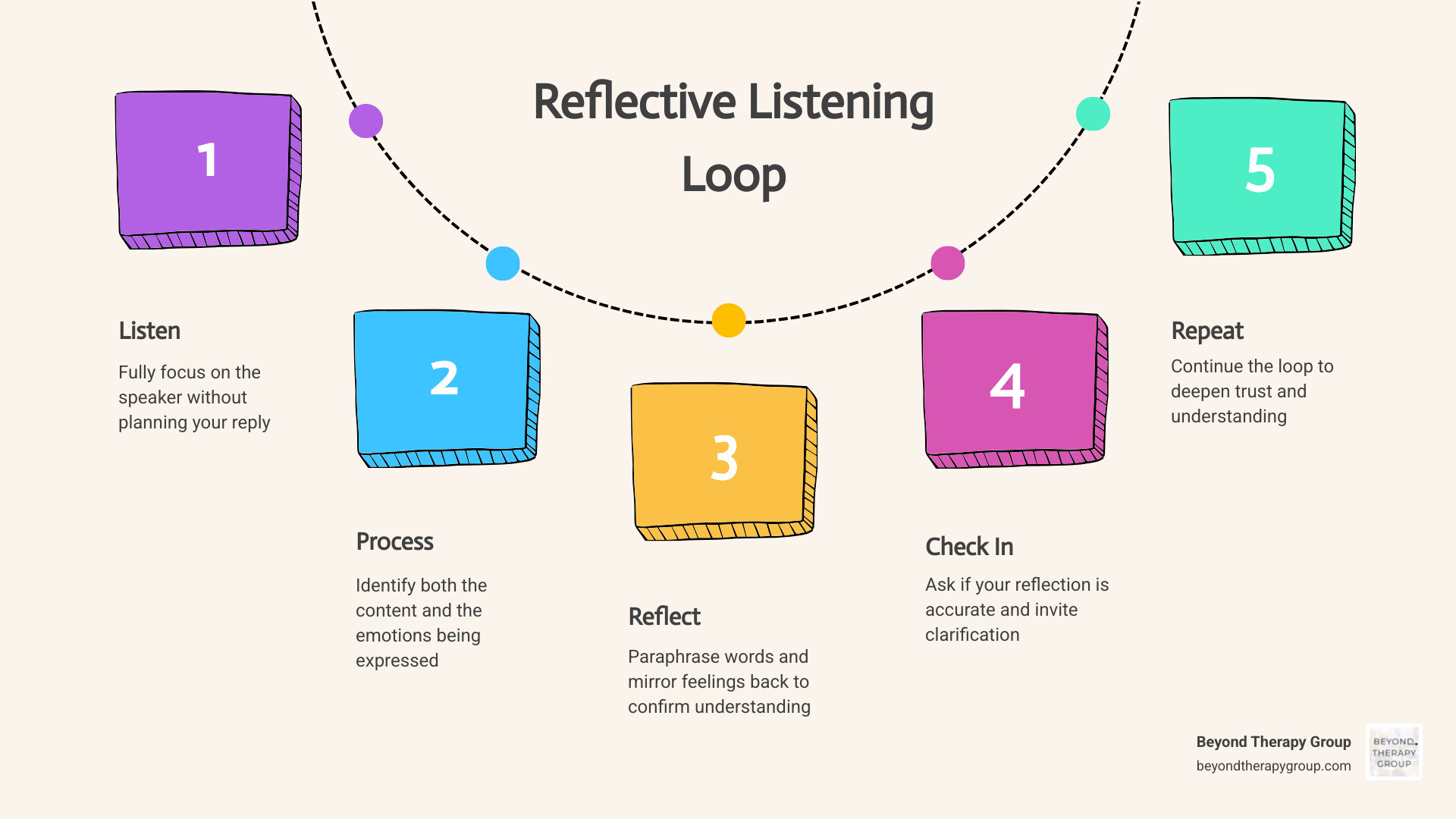
To master this skill, we first need to understand how it differs from standard active listening. While active listening involves showing you are paying attention through eye contact and nodding, reflective listening goes a step further. It is a specialized form of communication where the listener actively seeks to confirm the other person’s perspective.
Think of it as a loop. You listen to the words, process the underlying emotion, and then reflect that back to the speaker. This creates a sense of validation that is often missing in our daily interactions. By using a reflective listening worksheet, we can begin to see the patterns in how we respond to others and where we might be jumping to conclusions too quickly.
At its core, this practice is about empathy. It is the secret sauce of effective communication because it shifts the focus from “What do I want to say?” to “What are they actually experiencing?” This shift is vital for both personal growth and professional success in the mental health industry and beyond.
Key Benefits of Reflective Listening Practice Exercises
Why should we put in the effort to practice these techniques? The benefits are far-reaching. When we use reflective listening practice exercises, we are doing more than just improving our ears. We are building a foundation for deep trust.
- Conflict Resolution: Most arguments stem from someone feeling misunderstood. Reflecting back a partner’s or colleague’s frustration can de-escalate a situation before it turns into a full-blown fight.
- Emotional Regulation: When we reflect someone’s feelings, it helps them process their own emotions. Hearing their own thoughts reflected back can lead to “aha” moments where they realize they already have the solution.
- Trust Building: In any relationship, feeling heard is the fastest way to feel safe. This is especially true when mastering the art of speaking up for yourself, as it ensures that boundaries are understood and respected by both parties.
Reflective Listening in Professional Contexts
In the workplace, communication-related issues are among the top three reasons people leave their jobs. Whether you are in Redondo Beach or the South Bay, professional success often hinges on how well you can navigate interpersonal dynamics.
In patient-provider interactions, reflective listening is crucial. It helps clients feel accepted, which is a key driver for healing and progress. Managers who use these techniques find that their teams are more collaborative and less prone to misunderstandings. If you want to become a great communicator, you must move beyond just hearing instructions and start reflecting the goals and anxieties of those you lead.
Core Techniques for Effective Reflection

To make your reflection feel natural rather than robotic, you need a toolkit of different techniques.
- Paraphrasing: This involves restating the speaker’s main points in your own words. It shows you captured the “facts” of the story.
- Mirroring: This is a simple repetition of a few key words the speaker used. It encourages them to keep going without you having to interject much.
- Summarizing: At the end of a long explanation, a summary pulls all the threads together to ensure you have the big picture right.
- The OARS Framework: This is a structured approach often used in coaching and therapy. It stands for Open-ended questions, Affirmative statements, Reflective listening, and Summary reflections.
Reflecting Feelings vs Content
There is a big difference between reflecting what someone did and how they felt about it.
- Content Reflection: “So, you had a long meeting today and the project deadline was moved up.”
- Feeling Reflection: “It sounds like you’re feeling really overwhelmed and pressured by your boss right now.”
The second one is where the real magic happens. By practicing the art of reflective listening, we learn to use “hedging language.” Instead of saying “You are angry,” we say “It seems like you might be feeling frustrated.” This gives the speaker room to correct us if we are slightly off, which is a vital part of the process.
Clarification and Follow-up Questions
Even the best listeners get it wrong sometimes. That is why follow-up questions are essential. We call this “perceptual verification.” You might ask, “Did I hear that correctly?” or “Is there anything I missed?”
Using a curiosity reframe helps us stay in the moment. Instead of judging what the person is saying, we stay curious about why they are saying it. This prevents us from becoming defensive and keeps the conversation productive.
Top Reflective Listening Practice Exercises to Try Today

Ready to put these skills to the test? Here are some of the most effective reflective listening practice exercises used by therapists and communication experts.
- The Dream Vacation Exercise: Pair up with a partner. Have them describe their dream vacation for 60 seconds without naming specific locations. Your job is to summarize the vibe and the activities they described before guessing the destination.
- The Loud Brain Activity: Sit in a circle or with a partner. As the other person speaks, raise your hand every time you notice your own inner dialogue starting to plan a response. This builds awareness of how often we stop listening to “reload” our own arguments.
- Role-Playing Scenarios: Use common stressors, such as a roommate failing to do the dishes or a colleague missing a deadline. Practice reflective listening exercises where the goal is simply to make the “problem holder” feel understood, not to solve the problem for them.
Using a Reflective Listening Practice Exercises Worksheet
Structure is your friend when learning a new skill. Using a worksheet allows you to track your progress and identify where you struggle. For example, do you find it easy to reflect content but hard to reflect feelings?
Worksheets often include session prompts like “I hear you saying…” or “It sounds like the most important part of this is…” These are great for homework assignments between therapy sessions or for self-study. Understanding how these tools fit into broader frameworks like Relational Life Therapy can help couples and individuals see the long-term value of changing their communication habits.
Collaborative Activities for Skill Development
If you are practicing in a group, try Listening Triads. In this setup, there is a speaker, a listener, and an observer. The observer’s job is to watch for non-verbal cues and provide feedback on whether the listener’s reflection matched the speaker’s body language.
Another powerful tool is Strategic Silence. After asking a question, wait at least five seconds before speaking again. This gives the speaker space to think and often leads to deeper disclosures. If you feel yourself getting triggered during a conversation, use the Five-Breath Pause. Take five deep breaths before you respond to ensure you are operating from a place of calm rather than reaction.
Overcoming Barriers to Deep Listening
Even with the best intentions, several barriers can get in the way of effective listening.
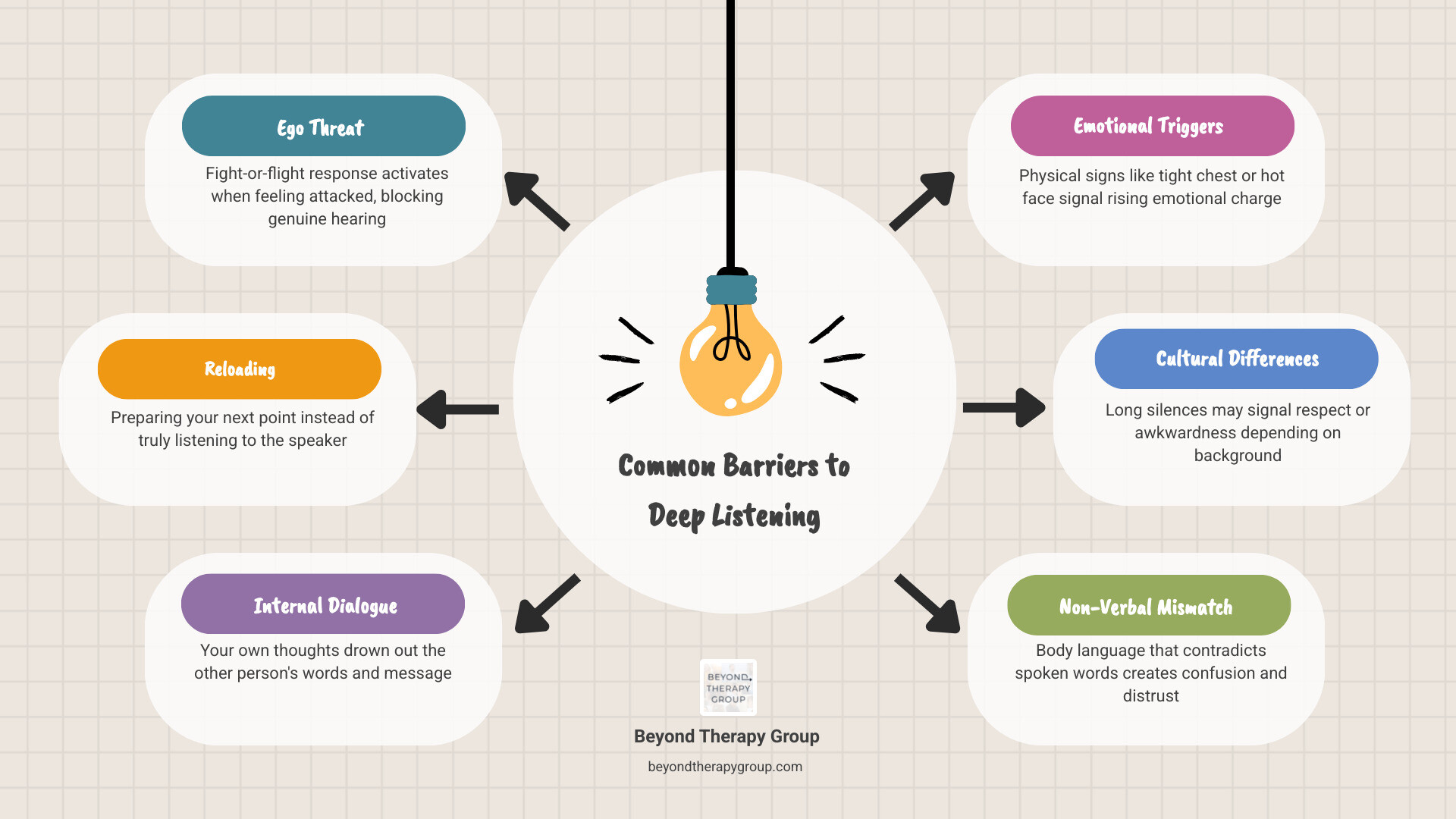
- Ego Threat: When we feel attacked, our brains go into “fight or flight” mode. It becomes almost impossible to listen because we are too busy defending ourselves.
- Reloading: This is the habit of preparing our next point while the other person is still talking. If you are reloading, you aren’t listening.
- Internal Dialogue: Sometimes our own thoughts are just louder than the person speaking. Recognizing this is the first step to silencing it.
Learning how to set boundaries in your relationships can actually help with listening. When you know your boundaries are safe, you feel less threatened and more able to truly hear what someone else is saying without feeling like you have to give up your own ground.
Managing Emotional Triggers
We all have “trigger signatures”—physical signs that we are becoming emotionally charged. Maybe your chest gets tight or your face gets hot. By developing self-awareness through reflective listening practice exercises, we can catch these triggers early.
The goal is non-judgment. We want to listen to the other person’s experience without immediately labeling it as “right” or “wrong.” This requires immense patience and a commitment to staying grounded in the moment.
Cultural Considerations in Listening
Listening styles vary wildly across the globe. In some cultures, long silences are a sign of respect and deep thought. In others, they are seen as awkward or a sign of disagreement.
When practicing reflective listening, we must be mindful of these non-verbal norms. If you are communicating with someone from a different cultural background, your “reflection” might need to be more subtle. Global empathy involves recognizing that the way we listen is just as important as what we hear.
Conclusion and Frequently Asked Questions
Mastering reflective listening practice exercises is a journey, not a destination. It takes time to move from “robotic” mirroring to natural, empathic connection. At Beyond Therapy Group, we see every day how these skills can save relationships and transform careers.
If you feel like your communication could use a tune-up, we are here to help. We offer a free 15-minute consultation with our therapists to help guide you toward the right support and answer any questions you might have about our therapy services. Whether you are looking for individual growth or to improve your connection with a partner, our team in Redondo Beach and the South Bay is ready to support you.
How does reflective listening differ from active listening?
Active listening is the broad umbrella that includes paying attention, using non-verbal cues (like nodding), and not interrupting. Reflective listening is a more specialized “sub-skill.” It involves the specific act of mirroring or paraphrasing the speaker’s words and emotions back to them to confirm that you have truly understood their perspective. While active listening shows you are paying attention, reflective listening proves you have captured the meaning.
Can you overuse reflective techniques in daily life?
Yes, if you do it in a way that feels like a script, it can come across as robotic or even condescending. The key is to maintain a natural flow. You don’t need to reflect every single sentence. Save the deep reflections for moments when the other person is sharing something emotionally significant or when there is a risk of a major misunderstanding. Balance your reflections with open-ended questions and authentic dialogue to keep the conversation feeling human.
How do I handle a mismatch between verbal and nonverbal cues?
Sometimes a person says they are “fine” while their arms are crossed and they are scowling. In these cases, use your intuition and gentle curiosity. You might say, “You’re saying you’re fine, but I’m noticing you seem a bit tense. Is there something more on your mind?” This is called “verbal checking.” It’s important not to be dogmatic or accusatory; simply observe what you see and give them the space to explain the mismatch.
Ready to take the next step in your communication journey? Start your journey with our therapy services today and discover the power of being truly heard.
Recent Posts