
August 13, 2026
All About Attachment Styles in Therapy

How Attachment Styles Shape Your Ability to Set Boundaries in Therapy and Relationships
Key Takeaways:
- Your attachment style forms in childhood and directly affects how you set and respect limits in adult relationships.
- Anxious attachment makes it hard to say no due to fear of abandonment. Avoidant attachment uses distance as a defense instead of a true boundary.
- About 56% of adults are securely attached. The remaining 44% carry insecure patterns that create real boundary challenges.
- Therapy helps you build healthier limits and move toward what researchers call “earned secure attachment.”
- Evidence-based approaches like CBT, DBT, EFT, and AEDP all offer tools tailored to different attachment patterns.
Understanding boundaries in therapy and attachment styles starts with one simple idea: the way you learned to connect with your earliest caregivers becomes the blueprint for how you relate to everyone else.
That blueprint shapes everything. How close you let people get. How quickly you pull away. Whether you say yes when you mean no. Whether you push harder when someone needs space.
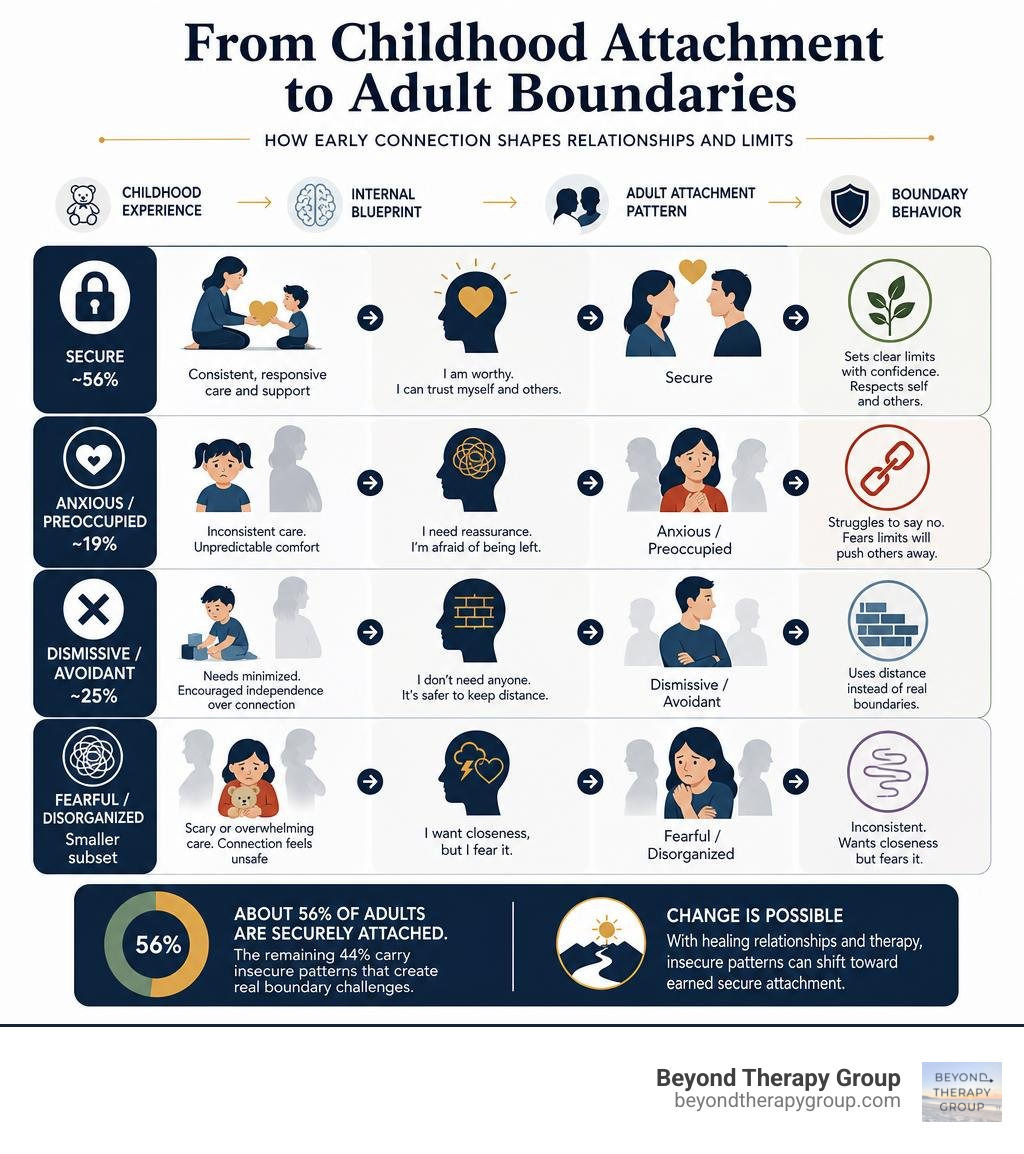
Here is a quick overview of how each attachment style relates to boundary setting:
| Attachment Style | Prevalence in Adults | Common Boundary Pattern |
|---|---|---|
| Secure | ~56% | Sets limits clearly and with confidence |
| Anxious/Preoccupied | ~19% | Struggles to say no. Fears limits will push others away |
| Dismissive/Avoidant | ~25% | Uses emotional distance as a substitute for real limits |
| Fearful/Disorganized | Smaller subset | Inconsistent. Wants closeness but fears it |
Most people do not realize their boundary struggles are rooted in attachment. They just know that saying no feels terrifying. Or that getting close feels suffocating. Or that they keep attracting the same kinds of relationships.
That is attachment at work.
The good news is that attachment patterns are not permanent. Research shows that insecure styles can shift through sustained, healing relational experiences, including the right kind of therapy. In fact, studies indicate that about 64% of people retain their infant attachment style into young adulthood under stable conditions. But life events and therapeutic work can change that trajectory.
This guide breaks down exactly how your attachment style affects your ability to set and hold personal limits, and what you can do about it.
Handy boundaries therapy attachment styles terms:
Understanding Boundaries, Therapy, and Attachment Styles
To understand how personal limits work in adult life, we first have to look at internal working models. Internal working models are the subconscious psychological frameworks we build in early childhood based on how reliable our primary caregivers were. When a baby cries and a caregiver consistently responds with warmth, the infant learns that their needs matter and that other people are safe. This lays the foundation for secure attachment.
When caregiver responses are unpredictable, cold, or overwhelming, the child adapts to survive emotionally. These adaptations form adult attachment styles, which strongly influence how we handle limits, emotional proximity, and personal autonomy later in life.
In typical adult populations, research reveals that roughly 56% of individuals are securely attached, 25% are dismissive-avoidant, and 19% are anxious-preoccupied. A smaller, distinct subset presents with a fearful-avoidant (disorganized) style. Each classification manages limits differently:
- Secure Attachment: Securely attached adults view themselves as worthy of love and view others as generally capable of providing support. They communicate personal limits assertively, respect other people’s needs for space, and handle conflict without catastrophic fear of abandonment.
- Anxious-Preoccupied Attachment: Individuals with an anxious attachment pattern often experience intense fears of rejection. They tend to over-extend themselves, struggle to say no, and over-step personal limits to keep loved ones close.
- Dismissive-Avoidant Attachment: Dismissive adults tend to rely strictly on self-sufficiency. They suppress emotional needs and enforce rigid limits to keep emotional intimacy at a safe distance.
- Fearful-Avoidant (Disorganized) Attachment: People with fearful attachment experience a confusing tug-of-war. They deeply desire emotional closeness but view intimacy as dangerous. Consequently, their limits shift rapidly between clinginess and severe emotional withdrawal. In clinical studies, up to 92.4% of individuals with a fearful attachment style met criteria for a personality disorder, compared to 60.6% of securely attached individuals, illustrating the deep psychological strain involved.
Understanding these distinctions is essential in therapy. We frequently see clients mistake self-protective boundaries for emotional walls. A healthy boundary is a permeable membrane that protects your integrity while keeping the relationship intact. Intimacy avoidance, by contrast, is a defense mechanism meant to shut others out completely. For deeper insight on how clinicians guide this work, read A Practical Guide to Boundary Work in Psychotherapy and review The Role of Adult Attachment Styles in Psychopathology and Psychotherapy Outcomes.
How Anxious and Avoidant Relational Patterns Affect Boundaries, Therapy, and Attachment Styles
When insecure attachment develops, people rely on secondary strategies to regulate their emotions. These fall into two main categories: hyperactivating strategies and deactivating strategies.
Hyperactivating strategies are common in anxious attachment styles. If your early environment was inconsistent, your nervous system learned to amplify distress signals to get attention. In adult relationships, hyperactivating strategies manifest as hypervigilance, excessive reassurance seeking, and difficulty holding firm limits. Anxiously attached individuals often comply with requests they dislike because saying no creates an unbearable fear of abandonment. They may also test their partner’s limits by sending constant texts, seeking immediate responses, or becoming frantic when a partner requests alone time.
Deactivating strategies are common in avoidant attachment styles. If early caregivers were emotionally unavailable or overly intrusive, the child learned to shut down distress signals entirely. In adulthood, deactivating strategies serve to suppress vulnerability. When a partner seeks emotional closeness or brings up a relationship problem, an avoidant individual may stonewall, turn quiet, or physically walk away. They use rigid rules as a shield to block emotional connection, mistaking emotional isolation for healthy self-reliance.
When an anxious partner and an avoidant partner connect, they often fall into a classic pursue-withdraw pattern. The anxious partner hyperactivates and demands proximity, while the avoidant partner deactivates and builds walls. To explore these emotional dynamics further, see How Fear Shows Up in Your Relationship Based on Your Attachment Style and our detailed AZ Guide to Emotional Boundaries in a Relationship.
Clinical Modalities Linking Boundaries, Therapy, and Attachment Styles
Addressing deep-seated attachment habits requires targeted therapeutic frameworks. Purely intellectual insight is rarely enough. The body and nervous system need to practice new relational behaviors. Key evidence-based modalities include:
- Cognitive Behavioral Therapy (CBT): Helps clients identify and reframe irrational cognitive distortions around boundary setting, such as “If I say no, they will leave me” or “If I rely on someone, I am weak.”
- Dialectical Behavior Therapy (DBT): Provides structured skill training in interpersonal effectiveness, distress tolerance, and emotion regulation. DBT teaches specific protocols like DEAR MAN (Describe, Express, Assert, Reinforce, Mindful, Appear confident, Negotiate) to assert limits calmly.
- Emotionally Focused Therapy (EFT): Examines the underlying emotional attachment needs driving relationship conflict, helping partners communicate vulnerabilities directly rather than using hyperactivating or deactivating defenses.
- Accelerated Experiential Dynamic Psychotherapy (AEDP): Focuses on somatic emotional processing within a supportive therapeutic relationship. AEDP helps clients undo emotional aloneness, process suppressed feelings, and move toward earned secure attachment.
To see how clinicians adapt these methods, review Tailoring AEDP Interventions to Attachment Style and the meta-analytic findings in Adult attachment as a predictor and moderator of psychotherapy outcome: A meta-analysis.
The Therapeutic Relationship as a Model for Healthy Boundaries

The clinical setting offers a valuable environment for reworking attachment patterns and practicing personal limits. For many individuals with relational trauma or insecure backgrounds, the therapist is the first person to offer a consistent “secure base” and “safe haven.”
Within this relationship, the concept of therapeutic distance becomes central. Therapeutic distance refers to the level of emotional disclosure, immediacy, and proximity shared between therapist and client, paired with the client’s emerging autonomy. Research shows that clients with different attachment classifications experience therapeutic distance in distinct ways:
- Anxious/Preoccupied Clients: Frequently experience hyperactivating distress when they feel any distance from the therapist. They may over-disclose rapid, chaotic stories (“walls of words”) to maintain the therapist’s undivided focus. In early therapy, the therapist establishes gentle structure, providing firm, clear session limits while reassuring the client of ongoing emotional availability.
- Dismissive/Avoidant Clients: Tend to downplay emotional distress and resist vulnerability to maintain high therapeutic distance. A skilled therapist respects these boundaries early on, avoiding intrusive probing, and gradually invites somatic and emotional reflection as safety grows.
- Secure Clients: Naturally reflect on emotional shifts in the session. If they feel uncomfortable with therapeutic distance, they share it constructively, allowing the therapist to adjust attunement fluidly.
A fundamental part of attachment-informed therapy is the cycle of attunement, disruption, and repair. No relationship is perfect, and subtle misattunements occur even in session. When a therapist acknowledges a misunderstanding, validates the client’s feelings, and collaborates to fix the dynamic, the client learns that conflict does not mean abandonment.
Through this process, clients build earned secure attachment. Earned secure attachment refers to adults who developed insecure patterns in childhood but achieved relational security later in life through intentional self-work and transformative relationships. To learn more about clinical boundaries and relational healing, check out The experience of closeness and distance in the therapeutic relationship of patients with different attachment classifications: an exploration of prototypical cases PMC and A Deep Dive into Boundaries in a Counselling Relationship.
Comparing Evidence-Based Therapy Modalities for Boundary Work

Selecting the right therapeutic approach depends on your attachment style and primary challenges with personal limits. Each evidence-based modality offers specific tools to rebuild confidence, regulate emotions, and improve interpersonal communication.
For example, cognitive interventions help anxious clients challenge catastrophic thoughts about saying no, while emotional and experiential modalities assist avoidant clients in uncovering the vulnerability beneath their defenses.
Here is how different therapy approaches compare in practice:
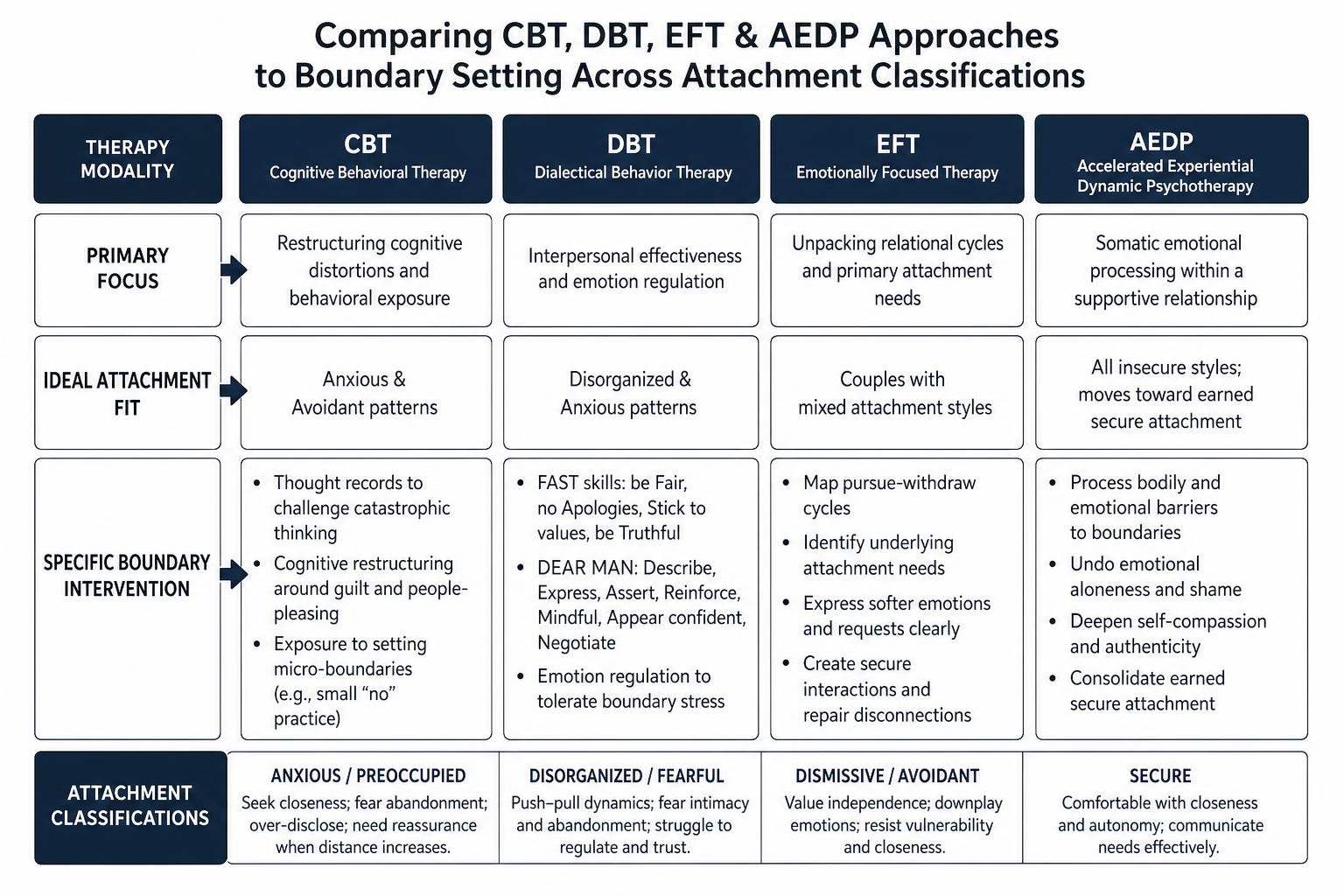
| Therapy Modality | Primary Focus | Ideal Attachment Fit | Specific Boundary Intervention |
|---|---|---|---|
| Cognitive Behavioral Therapy (CBT) | Restructuring cognitive distortions and behavioral exposure | Anxious & Avoidant patterns | Thought records, exposure to setting micro-boundaries |
| Dialectical Behavior Therapy (DBT) | Interpersonal effectiveness and emotion regulation | Disorganized & Anxious patterns | FAST and DEAR MAN interpersonal effectiveness scripts |
| Emotionally Focused Therapy (EFT) | Unpacking relational cycles and primary attachment needs | Couples with mixed attachment styles | Mapping pursue-withdraw cycles, expressing soft emotions |
| Accelerated Experiential Dynamic Psychotherapy (AEDP) | Somatic processing and dyadic affect regulation | Insecure & Traumatized attachment patterns | Metaprocessing present-moment safety and undoing aloneness |
In relational practice, we often combine these techniques to help clients explore personal limits comfortably. You can read more about how custom clinical frameworks work in our guide Relational Therapy: How It Helps.
Practical Strategies for Communicating Boundaries Without Guilt
Learning to set and enforce limits without guilt or panic requires clear, practical communication strategies. When you understand your personal attachment style, you can anticipate your nervous system’s instinctual reactions and choose a healthier response.
If you have an anxious attachment style, your main hurdle is tolerating the temporary discomfort of setting a limit. Remind yourself that setting a boundary is not an act of rejection; it is an invitation for clear communication. If you have an avoidant attachment style, your challenge is staying emotionally present while asserting your need for space, rather than simply shutting down or walking away.
If you are securely attached and partnered with someone who has an insecure style, clear communication is essential:
- With an Anxious Partner: Pair your boundary statement with explicit emotional reassurance. For example: “I love you and want to discuss this, but I am exhausted tonight. Let’s talk tomorrow at 10 AM over coffee.” The specific time frame reassures their nervous system that you are not abandoning them.
- With an Avoidant Partner: Give them advance notice and honor their need for processing time. For example: “I want to check in about our weekend plans. Take an hour to unwind first, and let me know when you are ready to talk.”
Here is a quick reference guide for asserting healthy limits based on your attachment tendencies:
- Anxious Attachment Assertions:
- “I care about our relationship, but I need some quiet time to rest right now.”
- “I cannot take on this task today, but I am happy to help later this week.”
- “I feel anxious when we don’t communicate clearly, so I am taking a pause to ground myself.”
- Avoidant Attachment Assertions:
- “I am feeling overwhelmed by this conversation, so I am taking a 20-minute break to clear my head, and then I will come back.”
- “I value our connection, but I process my thoughts best when I have some physical space.”
- “I want to hear how you feel, but please speak calmly so I don’t feel defensive.”
- Disorganized Attachment Assertions:
- “I feel conflicting emotions right now, so I need to step back for a moment to understand what I need.”
- “I want to stay close to you, but I need us to slow down this discussion.”
For more step-by-step guidance, explore our practical resources on How to Set Boundaries in Your Relationship Without Being a Jerk and Protect Your Relationship: 6 Boundaries Every Couple Needs.
Frequently Asked Questions About Attachment and Boundaries
How do I distinguish between a healthy self-protective boundary and avoidant detachment?
A healthy self-protective boundary is designed to preserve your wellbeing while maintaining the connection. It is communicated clearly, with flexibility, and leaves room for ongoing dialogue.
Avoidant detachment, by contrast, is a defense mechanism meant to eliminate emotional vulnerability. It usually manifests as stonewalling, sudden ghosting, or rigid rules that keep people at a distance. A healthy limit says, “I need some space right now, but I value you and want to reconnect soon.” Avoidant detachment says, “You are asking too much of me, so I am shutting down.”
Can a person with insecure attachment develop earned secure attachment in therapy?
Yes. Attachment styles are dynamic cognitive and emotional working models, not rigid lifelong traits. Longitudinal research shows that while roughly 64% of people maintain their childhood attachment patterns under standard conditions, significant life experiences and targeted therapeutic work can create lasting positive change.
By experiencing consistent empathy, clear limits, and attunement within the therapeutic relationship, clients re-wire their nervous system’s expectations around trust and emotional safety.
How can a secure partner set boundaries with an anxiously attached partner without triggering panic?
The most effective way is to combine clear boundary setting with explicit emotional reassurance. Anxiously attached individuals hyperactivate because their nervous system misinterprets a boundary as impending abandonment.
When you communicate a boundary, clearly state what you are doing, validate their feelings, and confirm when you will reconnect. Saying, “I need two hours of uninterrupted work time, but I am excited to have dinner with you tonight” offers the exact clarity their nervous system needs to stay calm.
Conclusion
Understanding how your attachment style shapes your personal limits is one of the most practical tools for emotional growth. Whether you find yourself people-pleasing out of a fear of abandonment or pulling away to maintain control, these patterns are learned responses, and they can be unlearned. Building healthy boundaries is not about building walls or pushing people away; it is about creating enough emotional safety to let people truly in.
At Beyond Therapy, we specialize in helping individuals and couples in Redondo Beach and across the South Bay navigate complex relational dynamics, break old attachment loops, and step into earned secure attachment. If you are ready to build healthier limits and improve your relationships, we offer a free 15-minute consultation with our therapists to answer your questions and guide your path forward.
Take the next step in your relational journey today and explore our specialized Relationship and Relational Therapy services.
Recent Posts


