
July 6, 2026
Empathetic Listening Techniques Guide: Learn the Skills

Key Takeaways
- Empathetic listening goes beyond hearing words to understand the emotions and intentions behind them
- Core techniques include reflecting feelings, asking open-ended questions, and validating emotions without judgment
- Avoiding common mistakes like giving unsolicited advice or asking “why” questions makes listening more effective
- Personal boundaries protect you from emotional burnout while still offering genuine support
- Empathetic listening is a learnable skill that improves with consistent, mindful practice
Why an Empathetic Listening Techniques Guide Can Transform How You Connect
This empathetic listening techniques guide gives you a clear, step-by-step framework for becoming a listener people genuinely trust.
Here are the core techniques at a glance:
- Be fully present — remove distractions and give the speaker your complete attention
- Use open-ended questions — ask “what” and “how” questions instead of “why”
- Reflect feelings — say back what you heard, including the emotion (e.g. “It sounds like you’re feeling overwhelmed”)
- Validate without judgment — acknowledge the speaker’s experience without agreeing or disagreeing
- Paraphrase to confirm — use phrases like “If I understand correctly…” and check you got it right
- Allow silence — give space for the speaker to process and continue
- Follow up — check in after the conversation to show you genuinely care
Most of us were never taught how to truly listen. We were taught to read, write, and speak. But listening? That was assumed to come naturally.
It does not.
When someone in your life is struggling, the instinct is often to fix, advise, or reassure. But research consistently shows that most people who are suffering are not looking for solutions. They want to feel heard.
Empathetic listening is the skill that makes that possible. It goes deeper than simply paying attention. It means tuning into the emotions behind someone’s words, reflecting those feelings back, and creating a space where the other person feels safe enough to open up fully.
The good news: this is a learnable skill. Whether you are navigating a difficult conversation at home, supporting a colleague at work, or working through conflict in a close relationship, the techniques in this guide can help you show up in a way that genuinely matters.
Easy empathetic listening techniques guide word list:
- Effective Communication
- reflective listening practice exercises
- assertive speaking practice exercises
What is Empathetic Listening and How Does It Differ?
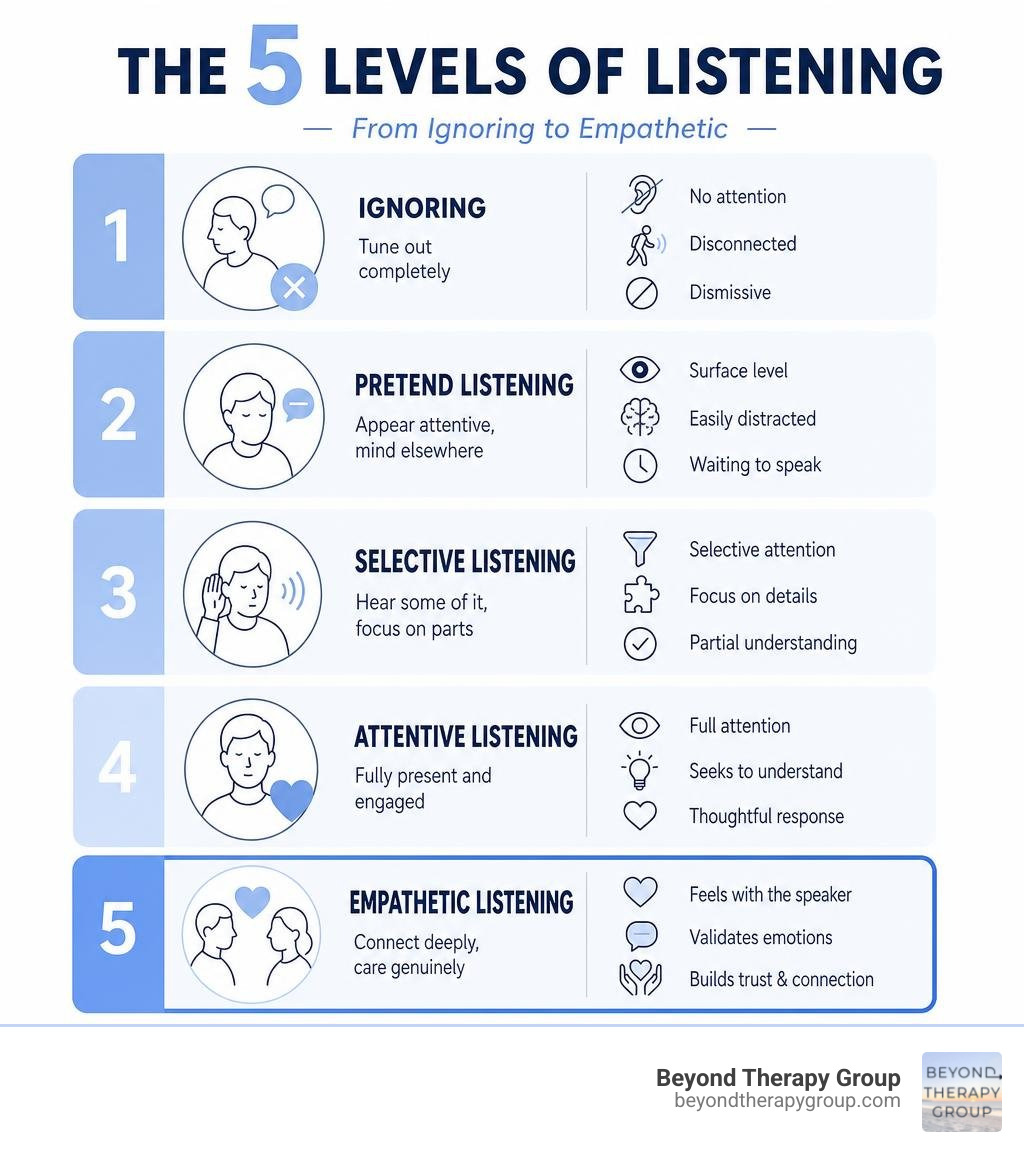
To truly master the art of communication, we must first understand that not all listening is created equal. Most daily interactions fall into passive or active listening, but empathetic listening takes the process to a much deeper level.
Historically, the concept of empathy in communication traces back to the German word Einfühlung, meaning “feeling into,” which was introduced to English psychology by Edward B. Titchener in 1909. Decades later, legendary psychologist Carl Rogers transformed how we view human connection by defining empathetic understanding as entering the private, inner world of another person without judgment, while maintaining one’s own identity.
To see how these concepts function in everyday life, let us break down the three primary levels of listening:
- Passive Listening: This is superficial hearing. The listener is physically present but emotionally and intellectually disengaged. They might nod or say “uh-huh” while scrolling through their phone, but they only capture a fraction of the message. The emotional connection here is virtually non-existent.
- Active Listening: This style is highly focused and structured. The active listener concentrates entirely on the speaker’s words, repeats back key points to confirm understanding, and avoids interrupting. While highly effective for project management and clear instructions, active listening can sometimes focus heavily on mechanics and logistics rather than the heart of the matter.
- Empathetic Listening: This is active listening with a soul. It requires you to use your eyes, ears, and heart to absorb not just the facts, but the deep emotions and unspoken motivations behind the words. You are not listening to formulate a brilliant rebuttal or offer a quick-fix solution. Instead, you are projecting yourself into the other person’s reality to understand their perspective.
| Feature | Passive Listening | Active Listening | Empathetic Listening |
|---|---|---|---|
| Primary Goal | Directing minimum energy to hear | Accurately capturing and organizing facts | Understanding feelings, needs, and perspective |
| Response Style | Nodding, minimal verbal cues | Paraphrasing facts and asking clarifying questions | Reflecting emotions, validating, and holding space |
| Focus Area | The listener’s internal thoughts | The speaker’s literal words and content | The speaker’s emotional state and underlying needs |
| Ego/Judgment | High (frequently distracted) | Medium (focused on accuracy and logic) | Low (completely suspended to prioritize the speaker) |
When you commit to this deeper level of engagement, you establish what Stephen Covey described as a robust “emotional bank account” with the other person. By showing that you care enough to understand their inner world, you build a foundation of trust that makes navigating future conflicts much smoother. You can Learn more about empathic listening to see how this shifts personal and professional dynamics.
Core Steps of the Empathetic Listening Techniques Guide

Becoming an empathetic listener is not about following a rigid script. It is about adopting a supportive, compassionate mindset. However, having a structured approach helps when emotions run high.
Here is the step-by-step process of our empathetic listening techniques guide to help you navigate your next deep conversation.
1. Center Your Attention and Quiet Your Mind
Before you say a single word, you must prepare your internal environment. We live in a world of constant digital noise, which makes sustained attention a rare gift.
- Remove physical barriers: Close your laptop, put your phone on silent and place it face down, and turn away from screens.
- Take a centering breath: If you feel your mind racing or planning what to say next, use a simple “one-breath reset.” Inhale for four seconds, exhale for six, and remind yourself: My only job right now is to understand.
- Adopt open body language: Maintain comfortable eye contact, uncross your arms, and lean slightly toward the speaker to show you are fully engaged.
2. Listen for Both Facts and Feelings
An empathetic listener acts as a detective of the human heart. You are listening to two parallel tracks: what happened (the facts) and how it felt (the emotions).
- Track nonverbal cues: Notice the speaker’s tone of voice, the pace of their speech, facial expressions, and physical posture. A coworker who says “I’m fine” with a sigh and slumped shoulders is telling you two very different stories.
- Bookmark feeling words: When the speaker uses words like frustrated, exhausted, worried, or excited, mentally bookmark them. These are the keys to unlocking their true experience.
3. Reflect and Paraphrase with Tentative Language
Instead of simply parroting back what the speaker said, reflect their message in your own words. This shows you are processing their experience, not just recording it.
- Use tentative phrases: Leave room for error so the speaker can correct you if you misunderstand. Use openings like:
- “It sounds like you felt really let down when…”
- “It seems to me that you’re carrying a lot of pressure right now. Is that correct?”
- “If I’m hearing you right, you’re feeling torn between…”
- Reflect the emotion first: If a friend is complaining about a chaotic schedule, do not focus on their calendar logistics. Reflect the feeling: “That sounds incredibly overwhelming.”
4. Validate Their Experience Without Needing to Agree
Validation is the “secret sauce” of deep connection. It allows two truths to coexist: you can validate someone’s emotional reality even if you would have handled the situation differently.
- Acknowledge their right to feel: Use simple, powerful phrases that normalize their reaction.
- Avoid “but” statements: Saying “I understand you’re upset, but…” completely erases the empathy you just built. Replace “but” with “and” to keep the validation intact.
- To explore how to cultivate this level of presence and acceptance, you can Discover the secret to deep presence and learn to quiet your own inner monologue.
How to Use This Empathetic Listening Techniques Guide in Relationships
In our personal lives, empathetic listening is the ultimate tool for de-escalating tension and restoring intimacy. When partners, family members, or close friends argue, they are rarely fighting about the dishes or the household budget. They are usually fighting to see if they still matter to each other.
By applying these techniques, you can transform repetitive arguments into opportunities for growth. When your partner shares a frustration, suspend your ego. Instead of defending your actions, focus entirely on validating their perspective first.
Validation does not mean you are admitting defeat or agreeing that you are entirely in the wrong; it simply means you care enough to understand why they are hurting. Once they feel heard, their nervous system will settle, making collaborative problem-solving much easier. If you want to learn how to express your own needs while holding this space for your partner, you can Read about speaking your truth to build a balanced, resilient partnership.
Implementing the Empathetic Listening Techniques Guide at Work
Empathetic listening is not just for personal relationships; it is also a vital professional competency. In fact, research shows that 75% of employees with highly empathic senior leaders report being consistently engaged at work, compared to only 32% of those with less empathic leaders.
At work, empathy translates to better collaboration, higher retention, and more innovative problem-solving.
- For Leaders: When a team member expresses concern about a tight deadline, avoid the urge to lecture them on time management. Use empathetic listening to explore the root cause. Ask: “What is the most bottlenecked part of this project for you right now?”
- For Coworkers: If a colleague seems irritable or disengaged, we rarely know the full story of what someone is carrying. Practicing rational detachment—managing your own reactions and recognizing that their behavior may stem from external stress—helps you respond with kindness rather than defensiveness.
To learn more about how to weave these supportive habits into your daily professional life, you can Explore the secret sauce of communication and watch your workplace relationships thrive.
Common Barriers and Mistakes to Avoid in Deep Listening

Even with the best intentions, it is easy to slip into old habits that block deep connection. When we are tired, stressed, or eager to help, we often fall into common communication traps.
Here are the primary barriers to avoid if you want to keep your conversations open and safe:
- The “Fix-It” Trap (Giving Unsolicited Advice): This is the most common mistake. When someone shares a problem, we immediately offer solutions. While well-meaning, jumping straight to advice can make the speaker feel dismissed, misunderstood, or incompetent. It sends the message: Your problem is simple, and you should have solved it by now.
- Asking “Why” Questions: Questions that start with “why” (e.g., “Why did you do that?” or “Why didn’t you just say no?”) often sound accusatory and condescending. They trigger defensiveness. Instead, use open-ended “what” or “how” questions, such as: “What was going through your mind when that happened?” or “How did you feel about that outcome?”
- Lecturing and Analyzing: Avoid playing the clinical psychologist or the stern parent. Analyzing someone’s behavior (“Well, you always do this because of your past…”) or lecturing them on how they should live their life shuts down vulnerability instantly.
- Deflecting and “Story-Topping”: When someone shares a painful experience, do not respond with a story of your own to prove you understand. Saying, “Oh, I know exactly how you feel, the same thing happened to me…” shifts the spotlight back to you and minimizes their unique experience.
- Flat-out Agreeing or Moralizing: While validation is crucial, blindly agreeing with everything the speaker says (“Yeah, she’s completely evil, you did nothing wrong!”) can sometimes fuel unproductive anger or prevent them from seeing the situation clearly. Aim to validate the emotion (“It makes sense that you felt incredibly hurt by that”) rather than taking sides or moralizing.
Recognizing these barriers is especially important when you are trying to establish clear limits in your life. To understand how to protect your own peace while remaining a supportive listener, you can Learn how to set healthy boundaries without pushing the people you love away.
How to Develop and Improve Your Listening Skills Over Time
Like any physical or mental discipline, empathetic listening requires consistent, deliberate practice. You cannot expect to run a marathon without training, and you cannot expect to hold perfect emotional space during a crisis if you do not practice in low-stakes, daily conversations.
Here are practical ways to build your listening muscles over time:
- Practice Daily Mindful Presence: Start small. During your next casual conversation—whether with a barista, a neighbor, or a family member—vow to give them your undivided attention for just two minutes. Notice their tone, match their eye contact, and practice silencing your internal monologue.
- Regulate Your Own Nervous System: When someone shares heavy, difficult emotions, your own body might go into a mild fight-or-flight response. You might feel your chest tighten or your heart rate increase. Practice “discreet grounding” techniques: lengthen your exhales, feel your feet flat on the floor, and remind yourself that you are safe.
- Prioritize Self-Care and Self-Love: You cannot pour from an empty cup. If you are emotionally exhausted, chronically stressed, or overwhelmed, you will not have the cognitive or emotional bandwidth to listen to others. Setting aside time for your own mental wellness is a prerequisite for sustainable empathy.
- Seek Honest Feedback: Ask a trusted friend or partner: “How do you feel when you talk to me about hard things? Do you feel heard, or do you feel like I try to fix things too quickly?” Use their honest input to refine your approach.
To build a reliable routine for practicing these communication habits, you can Try reflective listening exercises that you can easily do at home or with a trusted communication partner.
Frequently Asked Questions about Empathetic Listening
To help you integrate these tools into your daily life, we have compiled answers to the most common questions people ask when developing their empathetic listening skills.
What is the difference between active empathy and active listening?
While active listening focuses primarily on the mechanics of communication—such as paying close attention, paraphrasing, and avoiding interruptions—active empathy goes a step further. Active empathy combines those structural mechanics with deep emotional reflection, genuine validation, and an awareness of the speaker’s underlying needs. Active listening ensures you hear the words correctly; active empathy ensures the speaker feels deeply understood, valued, and respected.
How do I show empathy without absorbing other people’s emotions?
This is a vital question, especially for naturally sensitive individuals or caregivers. To support others without experiencing compassion fatigue or emotional burnout, adopt a supportive three-part stance:
- Observe: Listen intently to their emotional state.
- Reflect: Validate their feelings using kind words and supportive body language.
- Remain Grounded: Maintain a clear internal boundary. Remind yourself: This is their storm to navigate, and my job is to hold the flashlight, not to drown with them.
Using brief mindfulness resets and practicing rational detachment will help you keep your own nervous system calm and steady.
Can empathy be learned if it does not come naturally?
Absolutely. Empathy is not a fixed personality trait; it is a communication habit that anyone can develop. By breaking the process down into repeatable, actionable steps—such as using open-ended questions, intentionally pausing before responding, and reflecting emotions—you can train your brain to default to empathy over time. To explore the broader qualities that make someone an exceptional communicator, you can Discover essential traits of great communicators and see how these skills fit into your overall personal growth.
Here is a quick-reference list of simple validation phrases you can use in high-emotion moments:
- “That sounds incredibly hard. I’m so sorry you’re going through this.”
- “It makes complete sense that you’d feel that way.”
- “I’m here with you. Thank you for trusting me with this.”
- “I want to make sure I understand. Tell me more about the part that hurts the most.”
- “That sounds really overwhelming, and I can see how much pressure you’re under.”
Conclusion
Learning to listen with empathy is one of the most transformative commitments you can make for your relationships, your career, and your personal peace. When we slow down, quiet our minds, and choose curiosity over judgment, we create a safe space where healing and genuine connection can begin.
At Beyond Therapy, we know that learning these communication habits can feel challenging, especially when navigating long-standing relationship patterns or personal stress. Our licensed therapists in Redondo Beach and the South Bay are here to support your journey toward healthier, more fulfilling connections.
If you are ready to take the next step in your personal growth, we invite you to reach out to us. We offer a free 15-minute consultation with our therapists to answer your questions and guide your booking process. You can Schedule a consultation with our therapy services today to begin building the meaningful, connected life you deserve.
Recent Posts


