
October 9, 2026
An Essential Guide to Understanding Boundary Therapy Basics

Key Takeaways
- Definition of Healthy Boundaries: Boundaries define personal limits to protect well-being while allowing open, authentic connection.
- Boundary Types: Limits range from rigid to porous, with healthy boundaries striking a clear, flexible balance.
- Therapeutic Approaches: Boundary therapy blends cognitive restructuring and somatic awareness to overcome guilt and people-pleasing.
- Actionable Limit Setting: Effective boundaries focus on clear personal follow-through rather than attempting to control the reactions of others.
What Are Healthy Boundaries and Why Do They Matter?
Personal boundaries are the emotional, physical, and mental limits we establish to safeguard our well-being. They define where you end and where another person begins. Rather than functioning as barriers to keep people out, healthy limits serve as guidelines that teach others how to interact with you safely and respectfully.
At their core, boundaries are rooted in personal values and self-advocacy. When you understand your core priorities, you gain clarity on what you can comfortably give and when you must decline. Grounding your actions in your internal locus of control allows you to take full responsibility for your choices rather than attempting to manage the reactions of others. Anyone seeking greater clarity can start by defining personal boundaries to understand how their daily choices align with their long-term mental health.
Rigid vs Flexible vs Healthy Boundaries
Boundaries exist along a spectrum. Some people build fortress-like barriers that prevent connection, while others have limits so open that their energy is constantly drained. Healthy boundaries strike an intentional balance by maintaining clear self-definition while remaining open to meaningful intimacy.
| Boundary Type | Defining Characteristics | Interpersonal Impact |
|---|---|---|
| Rigid | Walls kept high, rarely asks for help, avoids emotional closeness, highly protective of privacy. | Protects against vulnerability but often leads to profound isolation, loneliness, and relationship friction. |
| Porous (Overly Flexible) | Difficulty saying no, over-involvement in other people’s problems, high fear of rejection, overshares personal details. | Breeds chronic exhaustion, resentment, codependent dynamics, and high susceptibility to manipulation. |
| Healthy (Balanced) | Clear sense of personal limits, communicates needs assertively, values own opinion while respecting others, accepts when others say no. | Fosters mutual trust, authentic intimacy, emotional safety, and sustainable personal energy. |
Common Psychological Barriers and Signs of Unhealthy Boundaries
Many people struggle to maintain balanced limits due to deep-seated emotional hurdles. Common psychological barriers include:
- People-Pleasing: Believing that your worth depends entirely on keeping everyone else comfortable.
- Conflict Avoidance: Fearing that any disagreement will permanently destroy a relationship.
- Internalized Guilt: Feeling responsible for other adults’ emotional reactions and choices.
- Chronic Relational Anxiety: Worrying constantly about abandonment if you express an authentic need.
When these patterns dominate, you may notice physical fatigue, quiet resentment, or a tendency to swing between tolerating poor behavior and suddenly cutting people off. To evaluate your own patterns, working through a structured boundaries worksheet PDF can help you pinpoint exactly where your energy is being compromised.
Core Modalities and Approaches Used in Boundary Therapy
Boundary therapy integrates several evidence-based clinical modalities to help clients recognize, communicate, and maintain limits. Modalities like Cognitive Behavioral Therapy examine the unhelpful beliefs that generate guilt, while relational approaches explore how childhood attachment patterns influence adult relationships. In practice, boundary work in psychotherapy gives individuals a structured, supportive space to explore why setting limits feels dangerous and how to build healthy communication skills.
How Boundary Therapy Addresses People-Pleasing and Anxiety
Anxiety is fundamentally driven by uncertainty and a perceived lack of control. When individuals lack clear boundaries, they often feel at the mercy of everyone else’s demands. In therapy, we help clients understand that avoiding a boundary is usually an attempt to prevent short-term discomfort at the expense of long-term self-respect.
Through cognitive restructuring, clients learn to dismantle beliefs such as “saying no makes me selfish” or “I must fix their bad mood.” Therapists introduce exposure principles by encouraging clients to practice micro-boundaries, such as waiting an hour before responding to a non-urgent text or declining a minor invitation. Experiencing the initial wave of anxiety without giving in teaches the nervous system that holding a limit is safe.
Integrating Somatic Techniques into Boundary Therapy
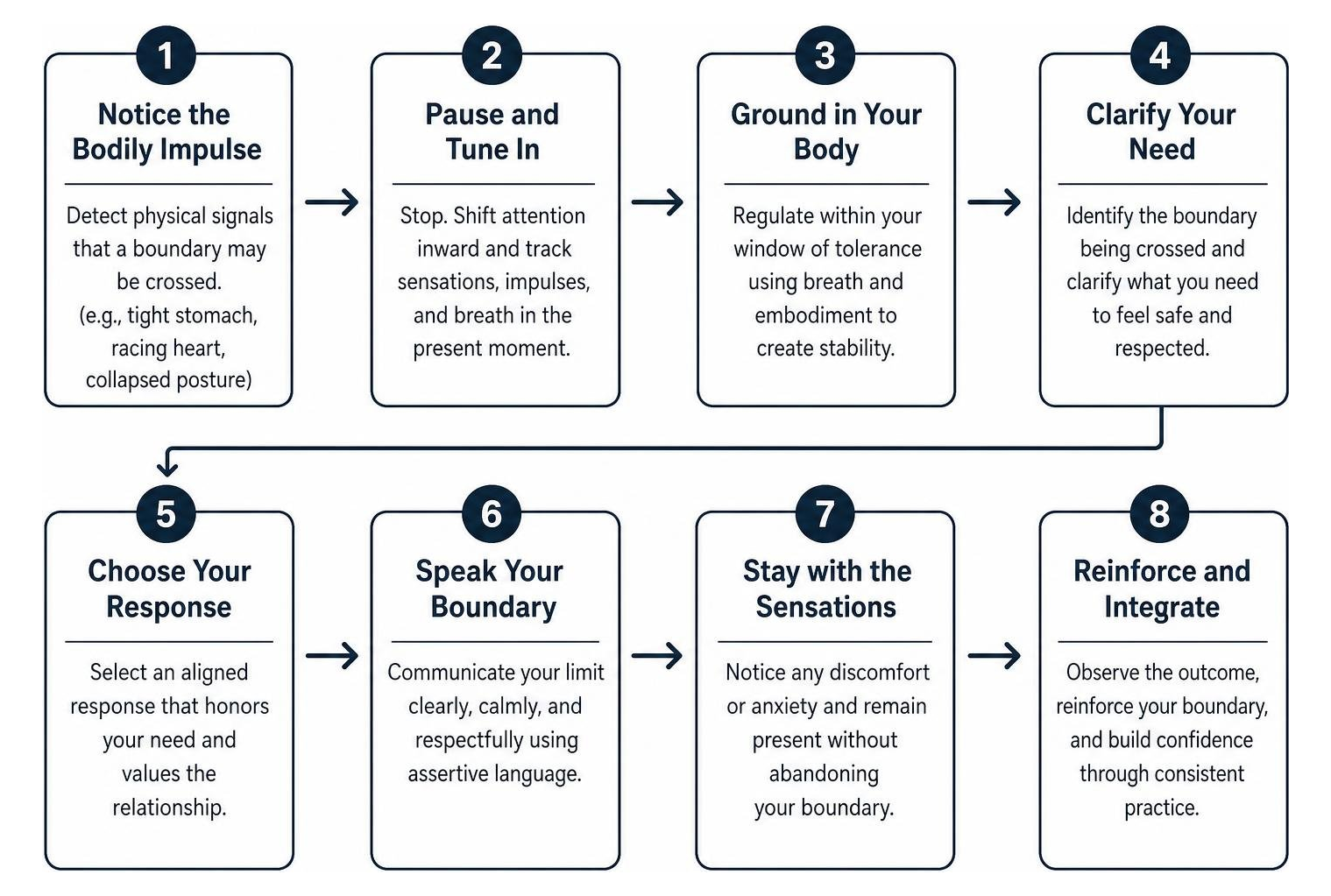
Verbal insight alone is not always enough to shift deeply ingrained boundary patterns, particularly for individuals carrying stored physical tension or trauma. Integrating sensorimotor methods allows clients to notice physical warning signs such as a tightening stomach, elevated heart rate, or collapsed posture when a boundary is crossed.
Through Sensorimotor physical boundary exploration, a therapist guides the client to track bodily sensations, physical impulses, and breath changes in the present moment. By learning to stay within their window of tolerance, clients can physically ground themselves before speaking up, making their verbal boundaries far more rooted and stable.
The Dynamics of Boundary Negotiation in the Clinical Relationship
The therapeutic container itself serves as a living laboratory for boundary development. In clinical practice, clear agreements regarding session times, appointment cancellations, payment terms, and contact methods create the psychological safety required for deep exploration. When exploring boundaries in a counselling relationship, both practitioner and client navigate limits collaboratively to ensure safety and mutual respect.
The Boundary Seesaw Model and Therapist Roles
Qualitative research on boundary negotiation synthesizes findings across 25 studies, revealing seven primary themes in clinical practice, including therapist unease, intentional self-restraint, and the tension between rigidity and flexibility. This literature review highlights the Boundary Seesaw Model, which outlines three relational roles clinicians might adopt:
- The Security Guard: Emphasizes rigid boundaries and strict enforcement, which provides containment but can sometimes limit warmth.
- The Pacifier: Adopts overly flexible limits to soothe client distress, which risks blurring professional lines.
- The Negotiator: Balances firm non-negotiables with collaborative, exploratory dialogue when boundary dilemmas arise.
The study notes that psychodynamic (n=9) and cognitive-behavioural (n=7) models represent the most common orientations in boundary research. Interestingly, 14 out of the 25 reviewed studies (56%) lacked comprehensive documentation of ethical procedures, emphasizing the ongoing need for rigorous boundary frameworks. Clinicians consistently report that internal feelings of unease serve as helpful diagnostic indicators that a limit is under pressure, prompting thoughtful self-restraint rather than reactive decision-making.
Ethical Considerations: Beneficence, Non-Maleficence, and Dual Relationships
Therapists navigate complex ethical territory whenever boundary adjustments occur. Every decision must be anchored in classic bioethical principles:
- Beneficence: Acting in ways that actively promote client welfare.
- Non-Maleficence: Ensuring that actions do not harm the client.
- Autonomy: Encouraging the client’s capacity for independent decision-making rather than fostering dependency.
- Fidelity and Justice: Honoring professional commitments and distributing therapeutic resources equitably.
A clear distinction exists between a boundary crossing and a boundary violation. A crossing is a deliberate, clinically justified departure from standard practice designed to help the client, such as extending a session during an acute crisis or accepting a small cultural token of appreciation. A violation is an exploitative breach that harms the client and serves the therapist’s needs.
Dual relationships, where a therapist holds an overlapping personal, financial, or social role with a client, require careful management to avoid conflicts of interest. Incidental community encounters, such as passing a client at a local market in the South Bay, are navigated with pre-planned agreements to maintain confidentiality.
Actionable Frameworks for Asserting Boundaries in Daily Life
Setting a limit does not require hostility or defensive arguments. Clear, calm communication delivered with warmth allows you to state your limits without escalating conflict. Developing skills in assertive boundary setting helps transform boundary anxiety into predictable, manageable action steps.

The Three-Step Boundary Method: Requests vs Consequences
Many people confuse making a request with setting a boundary. A request asks another person to change their behavior, which remains outside your control. A boundary states what you will do if your limit is not respected.
- Make a Direct Request: Use clear “I” statements to state your preference without unnecessary justification.
- Example: “I need quiet time to rest after work, so I cannot take phone calls after 7 PM.”
- Establish an IF-THEN Limit: Frame an actionable limit centered on your own behavior.
- Example: “If you call me after 7 PM, I will not answer and will reply the following morning.”
- Consistently Follow Through: Enforce the consequence every single time the line is crossed, without lengthy debates. Consistency transforms your words into reliable limits.
Role-Playing, Rehearsal, and Managing Pushback
It is completely normal to face resistance when you begin setting limits with people accustomed to your silence. Pushback often sounds like guilt trips, anger, or accusations of being uncaring.
In clinical sessions, behavioral role-play allows you to practice delivering boundary scripts under mild stress. Rehearsing non-reactive responses helps build emotional stamina. When someone pushes back, simple neutral phrases help you stay grounded:
- “I understand you are disappointed, but my answer remains no.”
- “I care about our relationship, and I am stepping away right now so we do not speak in anger.”
- “I am not asking for permission, I am letting you know what I am able to do.”
Cultural, Relational, and Contextual Factors in Limit Setting
Boundaries do not operate in a vacuum. What feels like an empowering limit in one environment may be perceived as rude or inappropriate in another. Culturally responsive boundary therapy respects the nuances of collectivist family traditions, workplace hierarchies, and unique relational systems.
Family Systems and Relationship Nuances
In closely knit family dynamics, establishing personal boundaries can trigger fears of enmeshment or rejection. Differentiating your own identity while remaining connected to your family requires patience.
Intergenerational habits often view individual limits as a rejection of family loyalty. Navigating these dynamics involves honoring family bonds while clarifying what you can realistically offer without emotional burnout.
Cultural Expectations and Workplace Boundaries
Work environments present distinct boundary challenges due to performance pressure and professional power structures. Chronic workplace overextension often leads to exhaustion and career dissatisfaction.
Establishing balanced boundaries at work might mean declining projects that fall outside your job scope, keeping communication within standard business hours, or seeking support for unsustainable workloads. Learning techniques for emotional boundaries at work helps you remain productive while protecting your personal time and well-being.
Frequently Asked Questions About Boundary Therapy
What is the primary goal of boundary therapy?
The primary goal is to help you build self-advocacy, self-awareness, and emotional agency. It helps you recognize your authentic capacity, express your needs assertively, and develop sustainable relationships built on mutual respect rather than resentment or people-pleasing.
How do you know if your boundaries are too rigid or too porous?
If you find yourself constantly overwhelmed, saying yes when you want to say no, and feeling responsible for other people’s happiness, your boundaries are likely porous. If you avoid emotional closeness, rarely ask for help, and instantly cut people off at the first sign of discomfort, your boundaries lean toward rigidity. Healthy limits allow you to say no clearly while remaining open to connection.
Can setting boundaries ruin personal relationships?
Setting a boundary does not damage a healthy relationship. While it may create temporary discomfort as people adjust to your new limits, healthy connections adapt over time. If a relationship ends solely because you established a basic boundary of respect or rest, it indicates that the dynamic was likely maintained by your self-sacrifice.
Conclusion
Building healthy boundaries is a continuous practice of self-respect and emotional resilience. Learning to state your limits calmly allows you to preserve your energy, reduce chronic anxiety, and cultivate deeper connections with the people in your life.
At Beyond Therapy, we provide compassionate, personalized support to help you navigate relational challenges and assert your needs with confidence. Whether you are addressing people-pleasing, work stress, or family conflict, our team in Redondo Beach and the South Bay is here to support your growth. We invite you to schedule a free 15-minute consultation with our therapists to ask questions, explore your goals, and discover practical ways to protect your relationship with essential boundaries starting today.
Recent Posts


