
August 19, 2026
7 Small Boundary Changes That Have Big Results

Key Takeaways:
A list of healthy boundaries in relationships helps you protect your emotional well-being without controlling your partner
- Boundaries cover five main areas: emotional, physical, digital, financial, and time
- Small, specific changes tend to have the biggest impact on daily relationship health
- Setting limits early and calmly makes them far easier to maintain long term
- Pushback from a partner when you set a boundary is worth paying attention to
What Is a List of Healthy Boundaries in Relationships and Why Does It Matter?
A list of healthy boundaries in relationships is more useful than most people expect. Not as a rulebook. Not as a weapon. But as a practical guide for protecting your own well-being while staying connected to the people you love.
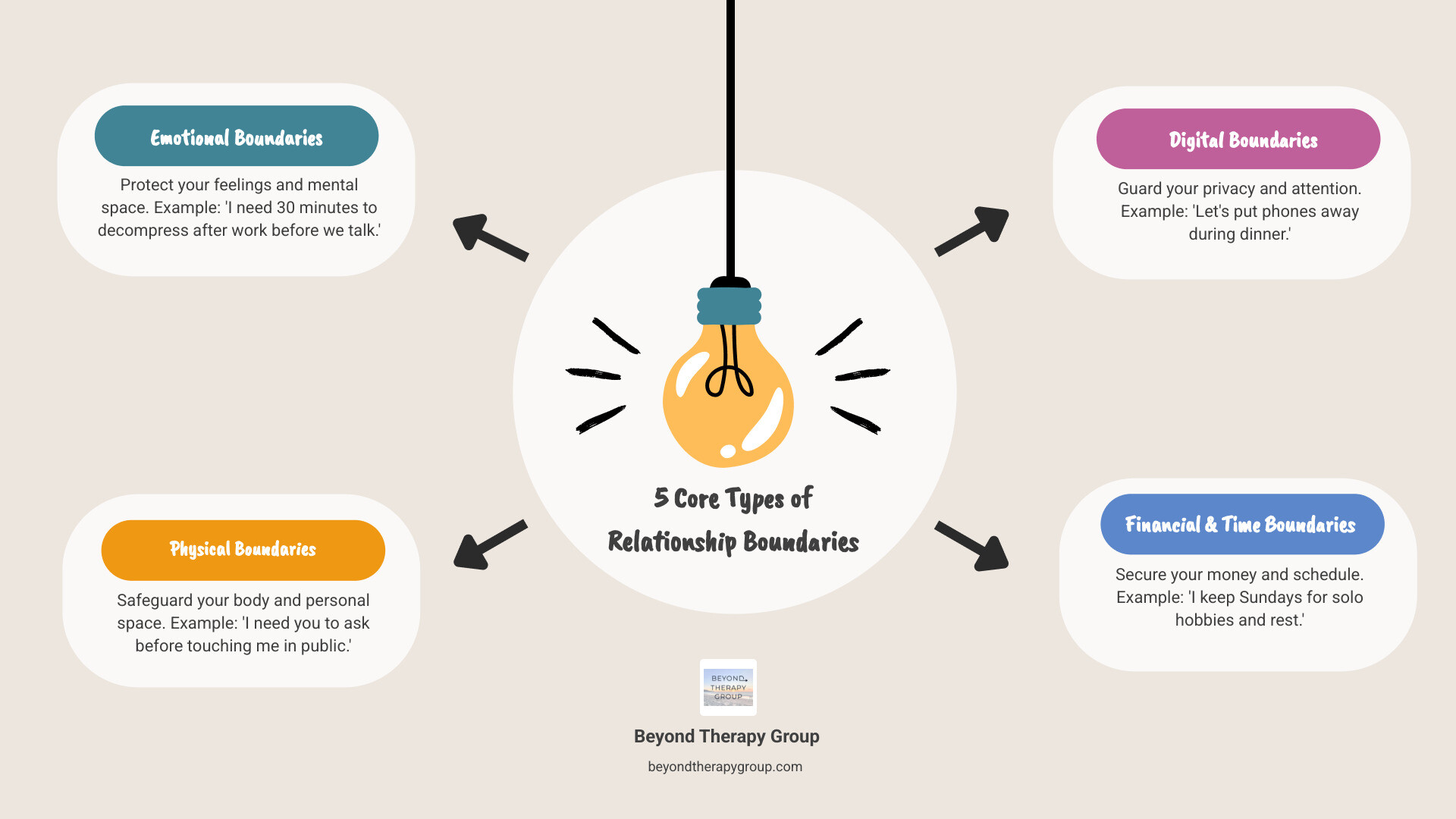
Here is a quick overview of the core boundary types and what they look like in real life:
| Boundary Type | What It Protects | Simple Example |
|---|---|---|
| Emotional | Your feelings and mental space | “I need 30 minutes to decompress after work before we talk.” |
| Physical | Your body and personal space | “I need you to ask before touching me in public.” |
| Digital | Your privacy and attention | “Let’s put phones away during dinner.” |
| Financial | Your money and spending autonomy | “I want us each to have personal spending money, no questions asked.” |
| Time | Your energy and schedule | “I keep Sundays for solo hobbies and rest.” |
Most people know they need boundaries. What stops them is not knowing which ones to set or how to say it without starting a fight.
Research consistently shows that without clear limits, resentment builds quietly. You start feeling exhausted, overlooked, or stuck. That is not a character flaw. It is what happens when two people share a life without ever agreeing on the rules.
The good news? You do not need a major relationship overhaul. A few small, specific changes can shift the entire dynamic.
List of healthy boundaries in relationships helpful reading:
- communicating boundaries with partner
- relationship boundaries list
- boundaries with controlling partner
What is a List of Healthy Boundaries in Relationships and Why Do They Matter?
When we talk about a list of healthy boundaries in relationships, we are talking about the invisible lines that separate your personal identity, needs, and responsibilities from those of your partner. Think of boundaries as the rules of a board game. Without them, the game becomes chaotic, confusing, and completely unfair.
Boundaries are not about building high walls to keep your partner out. Instead, they are about creating a safe space where both of you can thrive. In the field of psychology, we know that setting healthy boundaries is crucial for self-care and positive relationships. They allow you to maintain your psychological wellbeing, which is the foundation of any long-term partnership.
Without these clear guidelines, couples often fall into the trap of codependency. This is a pattern where one partner constantly sacrifices their own needs, energy, and happiness to please the other. Over time, this lack of limits leads to deep resentment and emotional burnout. You might feel like you are losing your sense of self, or like your energy is constantly being drained.
To learn more about how to identify your personal limits, you can read A Comprehensive Guide to Defining Personal Boundaries or explore the research on How to Set Healthy Boundaries & Build Positive Relationships.
Distinguishing Control from a List of Healthy Boundaries in Relationships
A common point of confusion for many couples is the difference between setting a healthy boundary and engaging in controlling behavior. It is vital to understand this distinction so you can communicate your needs without accidentally micro-managing your partner.
The difference comes down to focus and autonomy:
- A healthy boundary is about you. It defines what you will do, what you need, and what you are willing to accept. It protects your personal autonomy while respecting your partner’s freedom. For example, saying “I will leave the room if you start raising your voice at me” is a healthy boundary.
- Controlling behavior is about them. It attempts to dictate, restrict, or monitor your partner’s actions, choices, and friendships. For example, saying “You are not allowed to go out with your friends on Friday nights” is not a boundary. It is an attempt to control.
Healthy boundaries foster mutual respect and safety. Controlling behavior, on the other hand, breeds fear, anxiety, and distance. If you want to explore more examples of how to frame your needs respectfully, check out the List of Boundaries in Relationships: 80+ Examples | Boundary Playbook.
The 5 Core Types of Relationship Boundaries
To build a balanced partnership, it helps to look at the five core areas where limits are most needed. Every couple is unique, and what works for one pair might not work for another. Boundaries are highly mediated by variations in culture, personality, and social context.
Here is a breakdown of the five primary types of boundaries:
- Emotional Boundaries: These protect your right to have your own feelings, thoughts, and opinions without having to “fix” or absorb your partner’s emotional state. They also prevent you from relying on your partner as your sole emotional outlet.
- Physical Boundaries: These protect your body, personal space, and physical comfort. This includes consent for physical affection, sexual intimacy, and your need for physical privacy.
- Digital Boundaries: A relatively new but major source of modern relationship conflict, these cover how you interact online, password sharing, location tracking, and phone privacy.
- Financial Boundaries: Money is one of the top sources of relationship conflict, and unclear financial boundaries make it worse. These boundaries define how you split expenses, manage personal savings, and make joint purchasing decisions.
- Time Boundaries: These protect your schedule, energy, and need for personal downtime. They ensure you have space for solo hobbies, friendships, and rest.
For a deeper dive into these categories, you can read 20 Healthy Boundaries Examples in Relationships or consult our AZ Guide to Emotional Boundaries in a Relationship.
7 Small Boundary Changes with Big Results
When relationships start to feel strained, we often think we need to make massive, dramatic changes. In reality, it is the small, daily adjustments that yield the most significant results. By making minor shifts in how you manage your time, technology, and communication, you can build a more secure and loving connection.
Here are seven practical, small boundary changes you can introduce today.
1. Establish a Post-Work Decompression Buffer
Transitioning from a stressful workday to your home life can be difficult. Without a clear boundary, it is easy to bring your work stress, anxiety, and frustration home and accidentally take it out on your partner.
Establishing a post-work decompression buffer is a simple time boundary that works wonders. Agree to give each other 20 or 30 minutes of uninterrupted quiet time when arriving home or closing the laptop for the day.
During this transition period, you can change clothes, listen to music, or just sit in silence. This small window allows your nervous system to regulate, ensuring you can engage with your partner from a place of calm rather than exhaustion.
2. Create a Digital-Free Connection Zone
In the modern era, our phones are constant sources of distraction. When you scroll through social media or answer work emails during dinner, you are sending a silent message to your partner that they do not have your full attention.
Creating a digital-free connection zone is an easy way to protect your quality time. You might agree to keep phones away from the dinner table, or to turn off all screens 30 minutes before bed. By setting this digital boundary, you create a dedicated space to talk, laugh, and connect without the constant interruption of notifications.
3. Implement the “I Need” Communication Script
When we want to set a limit, we often start our sentences with “You.” For example, saying “You always crowd me when I get home” immediately puts your partner on the defensive.
Instead, switch to clear communication using the “I Need” script. Frame your boundary around your own experience and what you require to feel comfortable.
Instead of accusing your partner, try saying: “I feel overwhelmed after a long day, and I need 15 minutes of quiet time to unwind before we start chatting.” This simple shift keeps the focus on your self-care rather than your partner’s perceived shortcomings. To master this approach, read How to Set Boundaries in Your Relationship Without Being a Jerk.
4. Set Clear Financial Autonomy Limits
Unclear financial boundaries are a recipe for tension. To prevent money conflict, establish clear financial autonomy limits.
A great way to do this is by agreeing on a “no-questions-asked” personal spending limit. Decide on a specific monthly amount that each of you can spend on whatever you want, whether that is clothes, gadgets, or hobbies, without needing to consult or explain it to the other. This maintains your personal freedom and eliminates petty arguments about daily spending habits.
5. Protect Your Solo Hobbies and Friendships
It is easy to get swept up in a relationship and slowly let your independent friendships and hobbies slide. However, expecting your partner to be your entire world is a fast track to codependency.
Make a small change to actively protect your personal identity and social boundaries. Dedicate specific times for your own interests and friends. Whether it is a weekly sports league, a book club, or simply grabbing coffee with a close friend, maintaining your independent life actually enriches your relationship by giving you new experiences and energy to share with your partner.
6. Define Rules for Fair Conflict Resolution
Every couple fights, but how you fight determines the health of your relationship. Setting communication boundaries around disagreements is essential for emotional safety.
Sit down with your partner when you are both calm and agree on a few basic ground rules for conflict. You might agree that yelling, name-calling, and bringing up past, resolved arguments are strictly off-limits. You can also agree that if a discussion becomes too heated, either of you can call for a temporary 20-minute break to cool down before continuing. For more guidance on this, see Protect Your Relationship: 6 Boundaries Every Couple Needs.
7. Establish a Weekly Relationship Check-In
Boundaries are not set-it-and-forget-it rules. As your life, work, and family dynamics change, your boundaries must evolve too.
To keep things running smoothly, schedule a weekly relationship check-in. Spend 15 minutes asking each other simple, proactive questions: “How did our schedule feel this week?” or “Is there any area where you felt overwhelmed or needed more support?” This routine keeps communication open and allows you to make adjustments before minor annoyances turn into major fights.
How to Communicate and Enforce Your Limits
Setting a boundary is only half the battle. The real work lies in how you communicate and maintain those limits over time. Many people avoid setting boundaries because they dread the potential conflict, but speaking your mind does not have to be a painful experience.
Using a List of Healthy Boundaries in Relationships to Guide Your Conversations
When you are ready to initiate a conversation about limits, approach it with clarity, warmth, and directness. Do not wait until you are angry to bring up a boundary. Instead, choose a quiet, neutral moment when both of you are relaxed.
Use these steps to guide your conversation:
- Be direct and concise: State your limit clearly without over-explaining or apologizing. You do not need to justify why you need rest, privacy, or respect.
- Focus on the positive outcome: Frame the boundary as a tool to bring you closer. For example, “I want to set this limit because I love you and want to make sure I am fully present when we spend time together.”
- Use worksheets to gain clarity: If you struggle to find the right words, writing down your thoughts beforehand can help. You can download our Boundaries Worksheet PDF for Adults: Download Guide to practice structuring your requests.
Handling Pushback and Negative Reactions
It is completely normal to feel a little anxious when setting a new boundary. It is also common for partners to experience some initial discomfort or pushback. They might feel hurt, confused, or defensive as they adjust to the new dynamic.
However, how they react in the long run is highly telling. If your partner responds with consistent anger, guilt-tripping, or emotional manipulation, they are attempting to bypass your limits.
In these moments, a boundary is only effective if you enforce it. If you set a limit but fail to follow through with the consequence, you are teaching your partner that your needs do not truly matter. Be prepared to accept the temporary discomfort of standing your ground. For strategies on how to hold your line calmly, read The Ultimate Guide to Drawing Lines in the Sand.
Frequently Asked Questions About Relationship Boundaries
How do you know if your boundaries are being violated?
You can usually tell your boundaries are being crossed by paying attention to your body and your emotions. Common signs of boundary violations include feeling persistent resentment, experiencing anxiety before interacting with your partner, or feeling like you are constantly walking on eggshells to avoid an argument. If you find yourself consistently agreeing to things you do not want to do just to keep the peace, your boundaries are likely being compromised.
What if my partner refuses to respect my boundaries?
If you have communicated your needs clearly and your partner repeatedly and intentionally violates your limits, it is a serious warning sign. It suggests a lack of respect for your autonomy and well-being. At this stage, you must decide if this is a dealbreaker for the relationship. Seeking professional support from a relationship counselor can help both of you navigate these deep-seated communication challenges.
Can boundaries change over time?
Absolutely. Relationships are dynamic, and your needs will naturally shift as you go through different stages of life, such as changing careers, moving in together, or starting a family. Flexibility is a sign of a healthy relationship. The key is to ensure that any changes to your boundaries are made through mutual, proactive communication rather than silent erosion.
Conclusion
Building a fulfilling, long-term partnership does not require perfection. It requires a willingness to respect each other’s individuality while nurturing your shared connection. By implementing a few small changes from this list of healthy boundaries in relationships, you can protect your mental health, reduce daily friction, and foster deeper intimacy.
If you find yourself struggling to establish, communicate, or maintain these limits, you do not have to figure it out alone. At Beyond Therapy, we help couples in Redondo Beach and the South Bay navigate these exact challenges. We focus on relational wellness and provide the guidance you need to build a stronger, more balanced connection.
Ready to take the next step? Contact us today to book a free 15-minute consultation with our therapists to guide your booking and answer your questions. Explore our specialized Relationship and Relational Therapy services and start building the foundation for a healthier, happier partnership.
Recent Posts


