
October 17, 2026
A Comprehensive Guide to Assertiveness Training Techniques

What assertiveness training helps you do
- Assertiveness training helps you say what you need clearly and respectfully. Start by naming one specific issue, saying how it affects you, and making a clear request.
- Being assertive is not the same as being aggressive. You can protect your time and boundaries while still listening to the other person.
If you often say yes when you mean no, try a small step today: “I can’t take that on this week.” You do not need a long apology. With practice, direct conversations can feel less stressful and leave less room for resentment.
Understanding Communication Styles: Passive, Aggressive, and Assertive
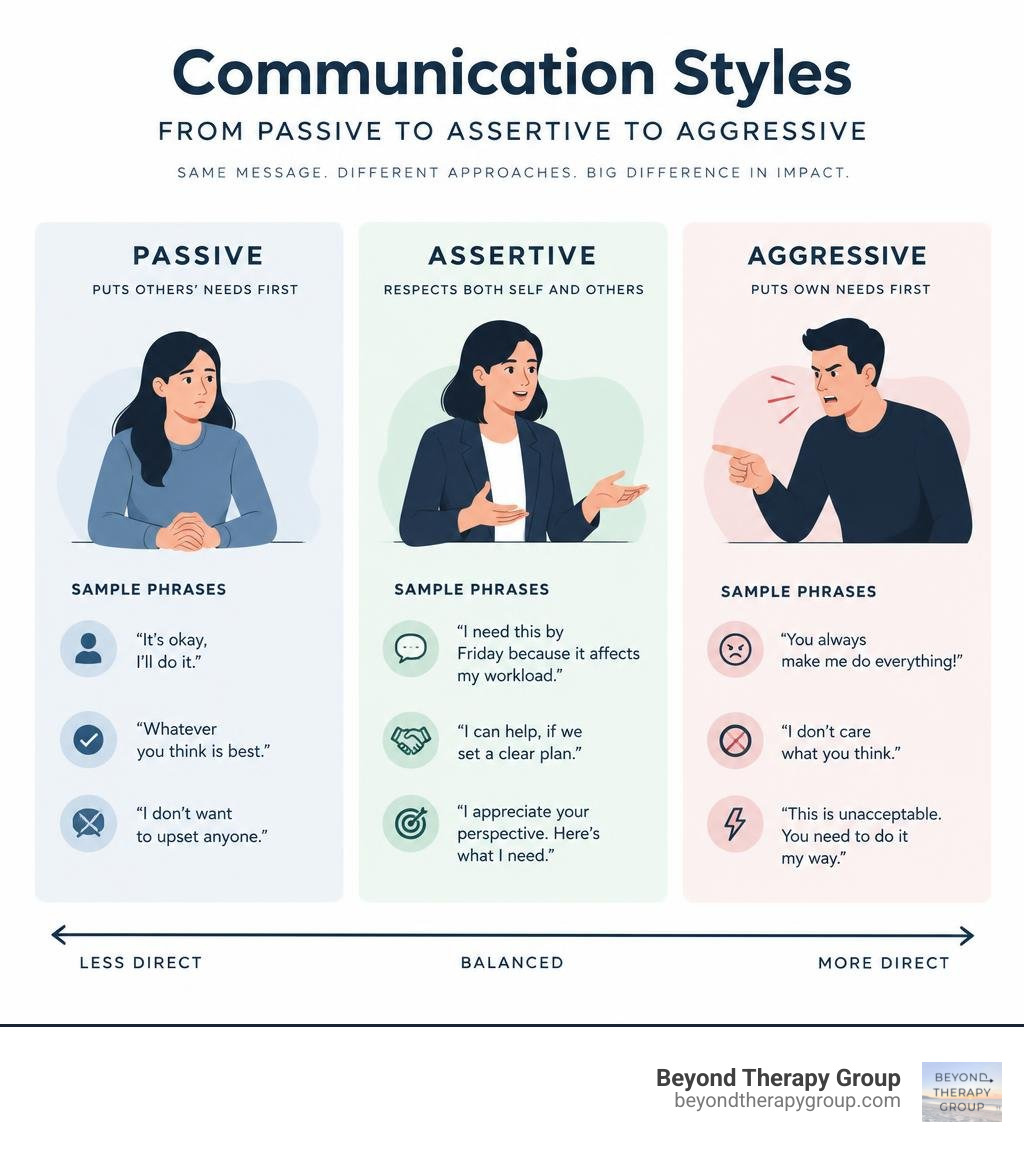
Every human interaction operates through a specific behavioral style. When we communicate, our words, tone, and body posture signal how we value our own rights compared to the rights of others. Behavioral psychologists generally divide interpersonal communication into four primary categories: passive, aggressive, passive-aggressive, and assertive.
To understand why many of us struggle to express our genuine thoughts, we need to look at how these four distinct styles operate in daily life.
| Communication Style | Core Belief | Verbal Pattern | Nonverbal Cues | Outcome |
|---|---|---|---|---|
| Passive | “Your needs matter, mine do not.” | Apologetic, indirect, self-effacing | Slumped posture, avoiding eye contact, soft voice | Internal resentment, unmet needs, chronic stress |
| Aggressive | “My needs matter, yours do not.” | Blaming, demanding, interrupting | Intimidating stance, glaring, loud volume | Broken trust, heightened conflict, alienation |
| Passive-Aggressive | “I cannot be direct, so I will act out secretly.” | Sarcasm, subtle digs, silent treatment | Smirking, eye rolling, deliberate procrastination | Confusion, unresolved tensions, lingering hostility |
| Assertive | “We both have legitimate needs and rights.” | Direct, respectful, solution focused | Upright posture, steady eye contact, calm voice | Mutual respect, clear boundaries, collaborative solutions |
Passive communicators constantly place the desires of others above their own well-being. This pattern often stems from a fear of confrontation or a desire to keep the peace at all costs. Aggressive communicators steamroll past the feelings and boundaries of others to achieve their goals, creating environments marked by intimidation. Passive-aggressive communicators mask hostility behind subtle sarcasm or deliberate delay, avoiding direct accountability while still expressing discontent.
Assertive communication strikes a healthy balance. It is an honest, direct, and respectful expression of your thoughts, feelings, and limits. When you practice assertiveness, you stand firm in your personal rights without violating the rights of anyone else. Mastering this balance is essential for long-term emotional well-being. You can explore foundational interpersonal skills in The Complete Guide to Effective Communication Skills to better understand how balanced dialogue transforms conversations. Furthermore, Mayo Clinic insights on stress reduction and assertiveness highlight how replacing passive avoidance with clear dialogue significantly lowers daily psychological strain.
The Science and Mental Health Benefits of Assertiveness Training
Assertiveness is a learnable behavioral skill rather than a fixed personality trait. When we engage in structured assertiveness training, our nervous system adapts to social conflict with greater resilience and less physiological distress.
A 2020 meta-analysis published in the Journal of Counseling Psychology revealed that structured assertiveness programs improved participants’ self-reported assertiveness by an average of 0.74 standard deviations, representing a major clinical improvement. Learning to communicate your limits directly also produces remarkable benefits for mental health. A 2019 study published in Behaviour Research and Therapy showed that assertiveness training reduced social anxiety symptoms by 40% in participants diagnosed with moderate social anxiety disorder.
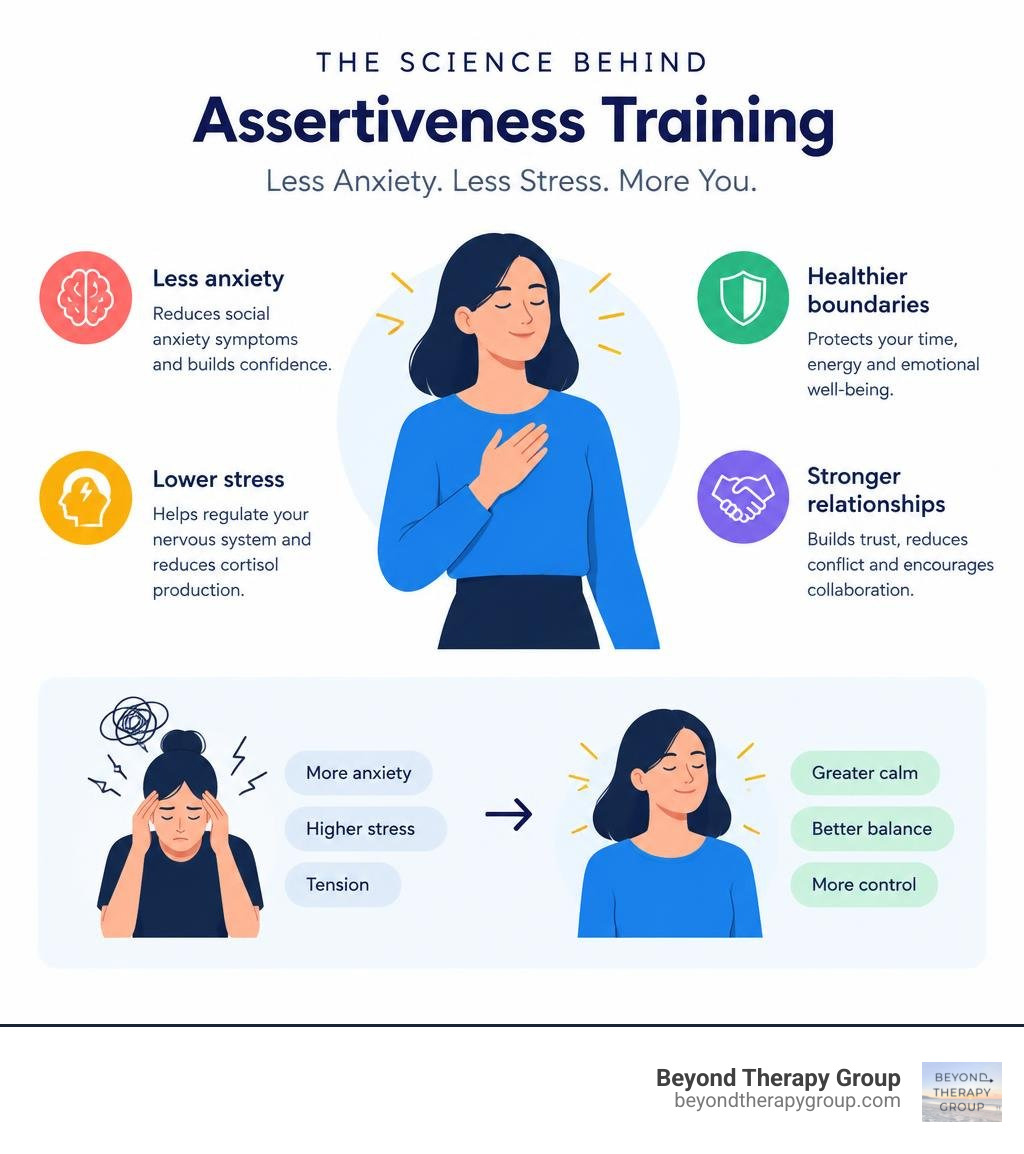
When individuals stop swallowing their genuine emotions, they experience a sharp drop in cortisol production, less muscle tension, and improved emotional regulation. Learning to speak up prevents professional burnout, deepens interpersonal trust, and protects personal time. Building confidence in self-advocacy is a transformative journey, and you can discover practical steps for finding your voice in Mastering the Art of Speaking Up for Yourself.
Overcoming Psychological Barriers and Limiting Beliefs
Most people who struggle with assertiveness do not fail because they lack vocabulary. They struggle because of deep-seated psychological barriers and cognitive distortions.
Common limiting beliefs include:
- “If I say no, people will think I am selfish.”
- “Disagreement will destroy my relationships.”
- “My feelings and preferences are not as important as keeping everyone happy.”
- “If someone is upset with me, I have done something wrong.”
These thought patterns often lead to automatic people-pleasing behaviors. Overcoming them requires cognitive reframing, which is a therapeutic process that replaces irrational fears with rational truths. For example, instead of thinking, “Saying no makes me a bad friend,” you can reframe the thought to, “Saying no allows me to show up genuinely and prevents quiet resentment.”
Building emotion tolerance is another essential pillar. When you begin setting limits, you will likely feel a brief wave of anxiety or guilt. That initial discomfort is completely normal. It is simply your nervous system adjusting to a new behavior. By separating your self-worth from external approval, you give yourself permission to hold boundaries even when others feel temporarily disappointed. For deeper guidance on protecting your mental space, explore The Ultimate Guide to Setting Boundaries for Emotional Health.
Core Frameworks and Techniques in Assertiveness Training

To communicate assertively during tense moments, having a structured framework prevents emotional reactivity and keeps the conversation productive. Several time-tested models provide straightforward steps for expressing your needs clearly.
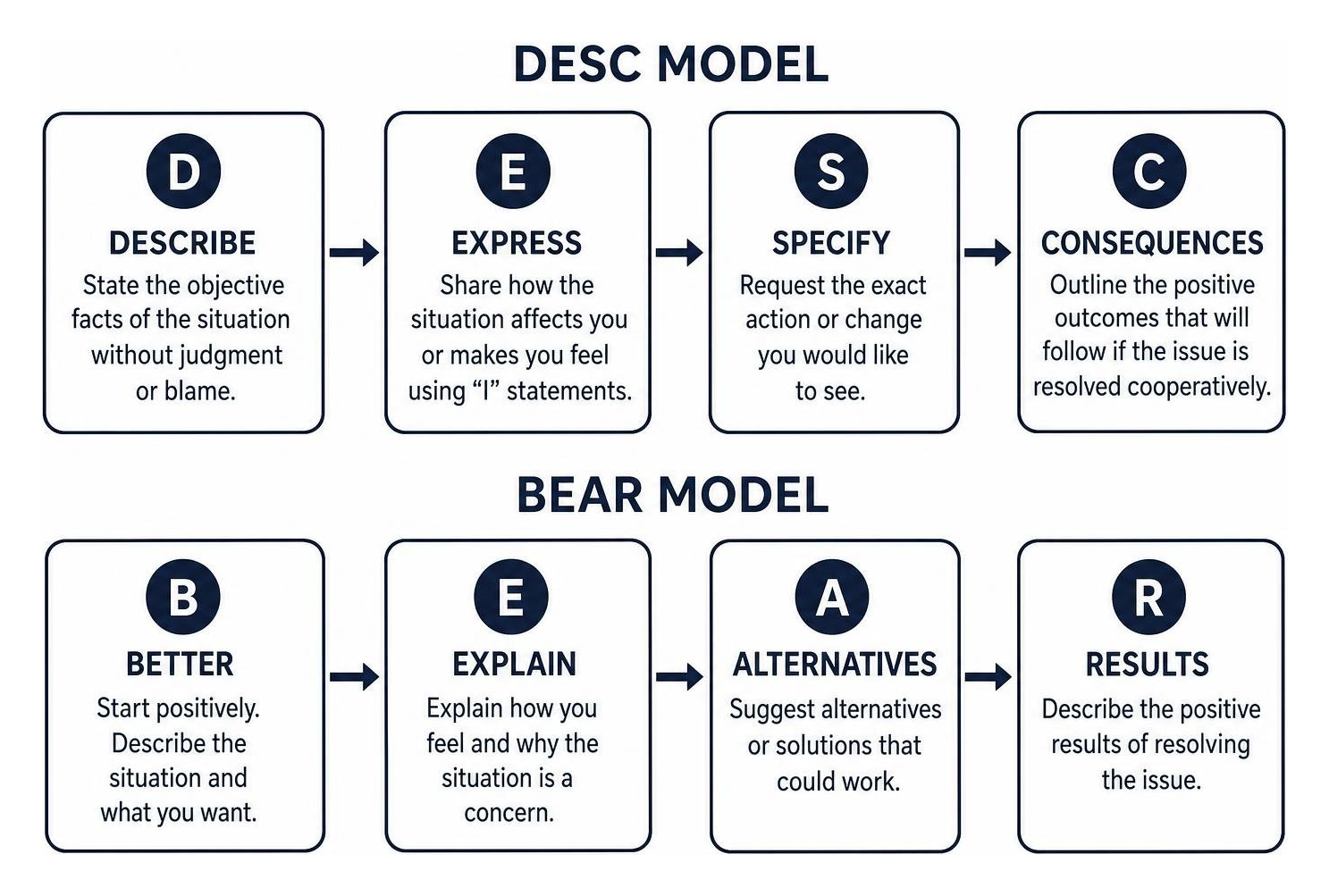
One widely used framework is the DESC model:
- Describe: State the objective facts of the situation without adding judgment or blame.
- Express: Share how the situation affects you or makes you feel using clear “I” statements.
- Specify: Request the exact action or change you would like to see.
- Consequences: Outline the positive outcomes that will follow if the issue is resolved cooperatively.
Another structured method is the L.A.D.D.E.R. technique, which incorporates comprehensive preparation:
- Look: Examine your rights, needs, wants, and feelings before initiating dialogue.
- Arrange: Set up a mutually convenient time and private space to talk.
- Define: Identify the specific problem area with precision.
- Describe: Express your feelings directly using non-blaming language.
- Express: State your requested changes clearly.
- Reinforce: Highlight the mutual benefits and positive results of finding common ground.
The BEAR method provides an equally practical approach, drawing directly from established NHS HEE Assertiveness Workbook principles:
- Behavior: Objectively state the specific action that took place.
- Effect: Explain the concrete impact or result of that behavior on your work or emotions.
- Action: Request the specific adjustment you need.
- Result: Emphasize the positive outcome and improved collaboration that will result.
Across all these models, replacing accusatory “you” language with ownership-based “I” statements keeps defenses low and invites genuine cooperation.
Verbal Strategies for Setting Boundaries and Saying No
Setting clean boundaries requires direct verbal phrasing without over-explaining. When we offer excessive justifications, we unintentionally invite the other person to debate our reasons.
Here are proven verbal scripts for delivering a clear, guilt-free refusal:
- The Clean No: “Thank you for thinking of me, but I am unable to take that on right now.”
- The Empathic Assertion: “I understand this project is running behind schedule, and I cannot work overtime this weekend.”
- The Alternative Offer: “I cannot review the full report today, but I can look at the summary section tomorrow morning.”
- The Consequence Assertion: “If we cannot agree on these deadlines now, I will need to pause my involvement on this task.”
When facing persistent pushback, you can maintain your ground using repetitive clarity. Learning how to use the broken record technique to deflect manipulators helps you repeat your core message calmly without getting sidetracked by emotional bait. For additional structured approaches, review How to Master Assertive Boundary Setting in 5 Easy Steps.
Nonverbal Dynamics: Voice, Posture, and Eye Contact
Verbal scripts only account for part of your communication. If your words say “no” while your body posture appears timid, listeners may overlook your boundaries.
Assertive nonverbal presence relies on three key physical elements:
- Steady Eye Contact: Maintain comfortable, direct gaze for roughly 60% to 70% of the conversation. This signals confidence and engagement without turning into an aggressive stare.
- Grounded Posture: Stand or sit with your shoulders relaxed, back straight, feet planted firmly on the floor, and arms uncrossed. This open posture demonstrates self-assurance and emotional calm.
- Controlled Vocal Delivery: Speak at a moderate pace with a steady, relaxed tone. Avoid rising intonation at the end of statements, which can make your requests sound like questions.
If you struggle with quiet speech or nervous pacing, targeted drills can help you find your footing. Explore Stop Mumbling and Start Speaking with These Assertive Drills to strengthen your vocal clarity. You can also examine the daily behavioral traits of persuasive speakers in Talk the Talk: Essential Traits of Great Communicators.
Practical Exercises and Daily Implementation Plans
Building assertiveness requires deliberate, progressive practice. Jumping straight into a high-stakes conversation with an intimidating boss or family member can quickly trigger old habits. Instead, use a structured 4-week progression plan to build confidence incrementally.
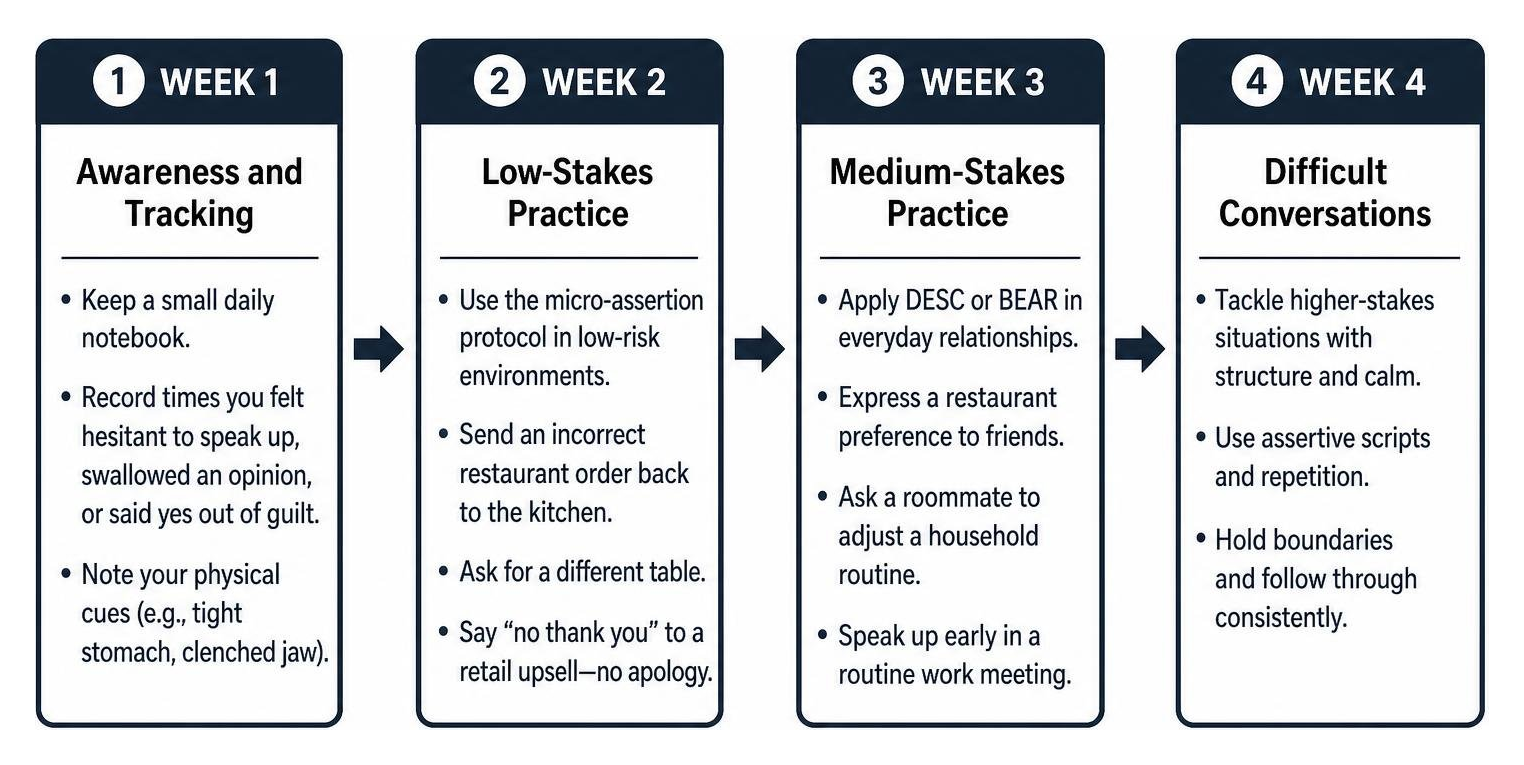
Here is a practical 4-week framework:
- Week 1: Awareness and Tracking: Do not worry about changing your behavior immediately. Keep a small daily notebook. Record every time you felt hesitant to speak up, swallowed an opinion, or said yes out of guilt. Note your physical cues, such as a tight stomach or clenched jaw.
- Week 2: Low-Stakes Practice: Begin utilizing the micro-assertion protocol in low-risk environments. Send an incorrect restaurant order back to the kitchen, ask for a different table, or say “no thank you” to a retail upsell without adding an apology.
- Week 3: Medium-Stakes Practice: Apply the DESC or BEAR formula in everyday relationships. Express a genuine restaurant preference to friends, ask a roommate to adjust a household routine, or speak up early in a routine work meeting.
- Week 4: High-Stakes Rehearsal and Action: Prepare for an important conversation. Rehearse your points aloud using role-play exercises, focus on calm posture, and implement your boundaries directly.
Daily habits such as taking a 10-second grounding breath before answering requests and conducting a nightly replay to evaluate your interactions will solidify your growth. For additional insights on relational dynamics, read Mastering Assertiveness and Boundary Training for Better Relationships and uncover The Secret Sauce of Effective Communication for Work and Life.
Real-World Applications: Workplace Negotiations and Conflict
Professional environments present some of the most challenging situations for clear self-advocacy. Applying assertiveness techniques in specific workplace moments helps you achieve positive outcomes while maintaining professional rapport.
Asking for a Compensation Adjustment
Do not approach a compensation discussion with emotional appeals or apologetic phrasing. Anchor your conversation in objective data and contributions:
- “Over the past year, I have led three major initiatives that increased team output by 20%. Based on market benchmarks for this role and my performance record, I am requesting an adjustment of my base salary to match these contributions.”
Providing Constructive Feedback to a Colleague
Use the DESC framework to keep the discussion objective and focused on problem-solving:
- “I noticed that the project files were submitted after our agreed deadline on Tuesday. When files arrive late, it creates a delay for the entire review schedule. Moving forward, I need all deliverables submitted by 2:00 PM on the deadline date so we can meet our client milestones smoothly.”
Handling Meeting Interruptions
When a coworker cuts in before you finish your point, regain the floor calmly:
- “Please allow me to finish this point, and then I will gladly open the floor for your feedback.”
Self-Directed Practice vs. Professional Assertiveness Training
Many individuals make wonderful progress through self-directed reading, behavioral workbooks, and daily micro-assertions. However, self-directed methods may feel challenging if your passivity is tied to deeper emotional roots.
Professional mental health support is particularly helpful when:
- You experience intense anxiety, panic symptoms, or physical shaking whenever conflict arises.
- Childhood trauma or past experiences make speaking up feel fundamentally unsafe.
- You notice recurring patterns of aggressive blowups after long periods of suppressing your emotions.
- Self-directed practice for several months has not created meaningful relief.
Working one-on-one with a licensed mental health professional provides a safe setting to uncover the origins of your communication habits, practice tailored role-play scenarios, and develop lasting emotional resilience.
Frequently Asked Questions About Assertiveness Training
What is the primary goal of assertiveness training?
The primary goal of assertiveness training is to help you communicate your thoughts, feelings, limits, and needs directly and respectfully while honoring the rights and perspectives of others. It replaces passive avoidance and aggressive confrontation with mutual respect and interpersonal clarity.
How long does it take to see results from assertiveness training?
Most people notice initial shifts in their awareness and low-stakes communication within three to four weeks of consistent daily practice. Consolidating these skills into automatic, comfortable habits during high-pressure situations generally takes three to six months of regular behavioral practice.
Can assertiveness training help with social anxiety?
Yes. Clinical research shows that structured assertiveness training can reduce social anxiety symptoms by up to 40%. By gradually exposing yourself to direct social interactions and discovering that setting boundaries does not cause catastrophe, your nervous system learns to experience social situations with greater calm and ease.
Conclusion
Stepping into your personal voice transforms how you interact with the world. By distinguishing between passive accommodation and aggressive control, adopting proven frameworks like DESC and BEAR, and practicing steady nonverbal habits, you can build lasting self-advocacy.
If you are ready to accelerate your personal growth and would like compassionate, licensed guidance in Redondo Beach and the South Bay, Beyond Therapy is here to help. We provide individualized mental health therapy tailored to your unique challenges and personal goals. We invite you to schedule a free 15-minute consultation with one of our therapists to answer your questions and explore the best path forward for your journey. To begin refining your daily habits right away, discover how to master assertive communication skills in 5 easy changes and start speaking with clarity today.
Recent Posts


