
August 17, 2026
A Practical Guide to Family Conflict Resolution Strategies

Family Conflict Resolution Strategies That Build Stronger Connections
Family conflict resolution strategies help people lower tension, communicate clearly, and repair trust after disagreements. The goal is not a family that never argues. It is a family that can handle hard moments without causing lasting harm.
- Pause before reacting when emotions run high.
- Talk about the problem, not the person’s character.
- Use calm “I feel” statements instead of blame.
- Listen to understand, then work toward a workable next step.
- Return to the conversation and repair after a rupture.
Family conflict can start over chores, money, parenting, boundaries, stress, or a comment that lands badly. Often, the visible argument is only part of the story. Anger may be covering hurt, fear, exhaustion, or a need to feel respected.
Disagreement is normal. Even healthy caregiver and infant relationships are in sync only about 30% of the time. What matters is the ability to reconnect after the mismatch. Repair teaches family members that conflict does not have to mean rejection or disconnection.
For busy families, these skills can turn repeated arguments into clearer conversations, stronger boundaries, and more emotional safety.
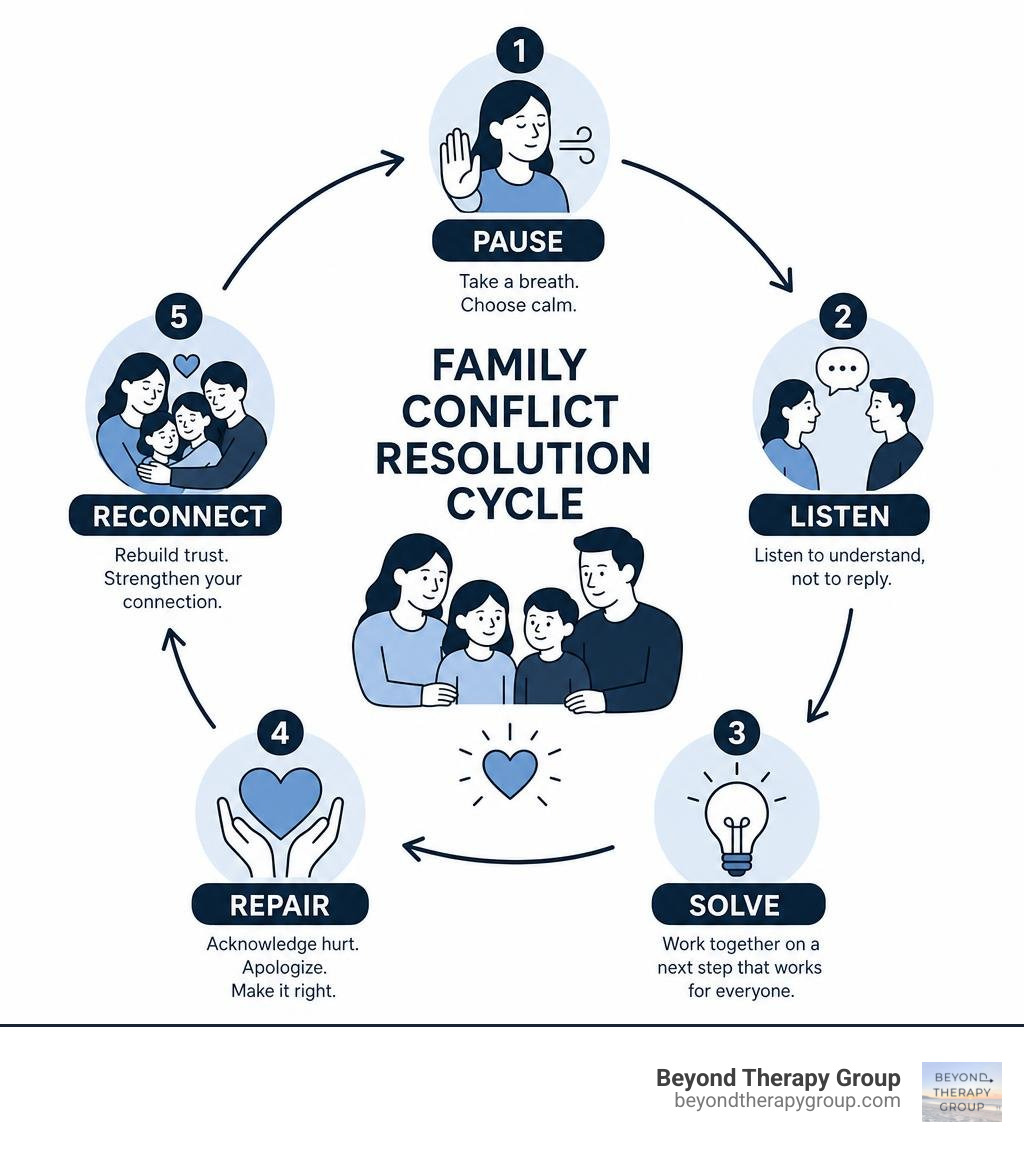
Simple guide to family conflict resolution strategies:
Causes of Friction and Healthy vs. Destructive Family Dynamics
Every household experiences arguments, but understanding where the heat comes from gives us a huge advantage. Most home disputes arise from predictable triggers. Life transitions such as welcoming a new child, launching a teenager into adulthood, moving houses, or managing aging parents put immense pressure on household routines. Financial worries, uneven division of labor, and hidden mental load imbalances often create chronic baseline irritability. When parents carry unseen mental checklists for weeks, a small comment about unwashed dishes can spark a major explosion.
It is helpful to recognize that conflict itself is not the problem. Disagreements are a natural reflection of individuals with distinct personalities living close together. The key distinction lies between constructive and destructive dynamics.
| Constructive Family Conflict | Destructive Family Conflict |
|---|---|
| Focuses on solving a specific issue | Attacks personal character and motives |
| Uses calm, assertive “I” statements | Relies on blame, sarcasm, and generalizations |
| Practice active listening and validation | Involves stonewalling, yelling, or cold silence |
| Seeks mutually satisfying solutions | Demands total surrender or focuses on winning |
| Prioritizes relationship preservation | Leaves lasting emotional damage and resentment |
Research from the Gottman Institute reveals that roughly 69% of relationship conflicts never completely vanish. They stem from fundamental personality traits, core values, or lifestyle preferences. Healthy families stop trying to eliminate every disagreement. Instead, they learn to manage ongoing differences with humor and mutual respect.
When friction turns toxic, clear warning signs emerge. Red flags include chronic hostility, personal insults, gaslighting, emotional withdrawal, and stonewalling. Recent clinical evidence on interparental conflict outcomes highlights how severe interparental fights spill over into parenting practices, creating behavioral and emotional stress for children. Recognizing toxic dynamics early allows families to shift course before long-term emotional harm takes root.
Core Family Conflict Resolution Strategies for De-Escalation
When an argument heats up, biological shifts happen inside our bodies. During intense emotional distress, the prefrontal cortex slows down while the amygdala takes over. This triggers a fight, flight, or freeze response, making logical reasoning almost impossible. Knowing this biology helps us realize that trying to win an argument while flooded is a losing battle.
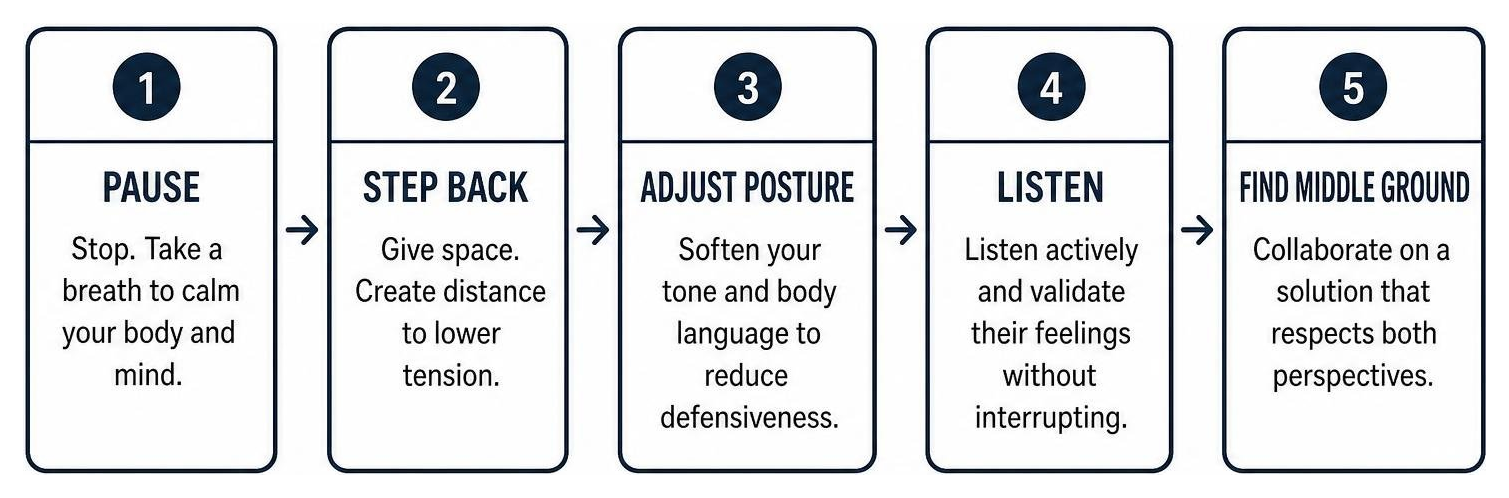
To break out of negative behavioral patterns, we must identify conversational choice points. Expert Dr. Kathleen Kelley Reardon notes that around 75% of how others treat us is within our control based on how we choose to respond. Families often fall into Unwanted Repetitive Episodes, which are predictable scripts played out over decades. By changing our response at a crucial choice point, we alter the whole trajectory of the interaction. Utilizing structured practical de-escalation steps helps reset heated moments before they spin out of control.
Practical Techniques for Micro-De-escalation
Micro-de-escalation techniques are quick behavioral shifts designed to calm the nervous system during tense conversations.
- Going to the balcony: Coined by negotiation expert William Ury, this mental exercise involves stepping back emotionally to view the interaction from an outside observer perspective. Ask yourself what a neutral third party would see.
- Tactical time-outs: When heart rates rise, pause the discussion. State clearly that you want to resolve the issue, but need twenty minutes to cool down. Always specify a time to return so your partner or child does not feel abandoned.
- Physical positioning: Avoid standing over someone or sitting directly across from them in a confronting stance. Sitting side by side on a couch or at a counter signals that you are working together against the problem, not fighting each other.
- Transition sensitivity: Transition times like hellos and goodbyes or returning home from school and work carry high emotional vulnerability. Avoid bringing up heavy subjects during these moments. Give everyone a chance to settle in first.
Communication Frameworks for Resolving Tension
How we phrase our thoughts during a disagreement can either open doors or build walls. Shifting from accusatory language to vulnerable expression is essential for domestic harmony.
Using “I” statements prevents defensiveness. Instead of saying “You always ignore the house rules,” try saying “I feel overwhelmed when household tasks fall on me, and I would appreciate help with the dishes tonight.” Sincere speech involves speaking firmly and earnestly while keeping your voice tone moderate and steady.
Active listening requires full attention without formulating your rebuttal while the other person speaks. Practice reflective summaries to confirm understanding before offering your viewpoint.
Helpful active listening phrases include:
- “What I hear you saying is that you felt left out during that decision. Is that right?”
- “It sounds like you were really stressed about school today.”
- “Help me understand what felt unfair about that boundary.”
- “I hear how frustrating that situation was for you.”
Navigating Intergenerational Gaps and Dynamics
Family systems theory teaches us that a family functions as an interconnected emotional unit. A shift in one person creates ripples throughout the system. Every household develops structural patterns and communication habits over time. When communication breaks down, it is usually because existing structures are no longer meeting the changing needs of growing family members.
Proven Family Conflict Resolution Strategies for Unique Family Dynamics
Different relationships within a home require tailored conflict resolution methods.
Parent and child dynamics often suffer when adults rely heavily on vertical authority. While parents must maintain boundaries, shifting toward horizontal communication as children grow fosters trust. Frame expectations positively by stating what you want to see rather than issuing commands.
Sibling conflicts thrive on perceived unfairness or competition for parental attention. Encourage siblings to solve problem scenarios collaboratively rather than acting as a referee who declares a winner. Teach them to separate the problem from the person.
Interparental co-parenting requires a united front. When parents argue about discipline or schedules, children feel anxious and may exploit the rift. Discuss co-parenting rules privately and present aligned decisions to your children.
Cultural Differences and Generational Gaps
Intergenerational friction frequently arises in families balancing distinct cultural models or generational values. Collectivist traditions emphasize family unity, respect for authority, and obligations to the household. Individualist cultural values prioritize personal autonomy, direct expression, and self-fulfillment.
When immigrant parents raise children in Western environments, acculturation stress can cause deep misunderstandings. Parents may perceive a child seeking autonomy as disrespectful, while the teenager feels misunderstood. Narrative externalization is a therapeutic tool that helps resolve these differences. Instead of viewing a relative as stubborn, frame the conflict as an external visitor, such as saying “The transition stress is making it hard for us to hear each other.” Following established clinical guidelines for resolving family disputes helps build bridges across generational divides.
Building a Culture of Authentic Repair and Emotional Regulation
Attachment theory shows that humans have a core need for safety and connection. When arguments happen, our attachment security feels threatened. Understanding primary emotions helps us resolve conflict at a deeper level. Primary emotions are underlying feelings like fear, loneliness, shame, or feeling inadequate. Secondary emotions are reactive feelings like anger, irritation, or resentment. Expressing primary feelings creates empathy, while venting secondary anger prolongs arguments. Exploring attachment styles in relational conflicts can help you understand why certain family members pull away while others press for immediate answers.
The Biology and Mechanics of Genuine Repair
Many people believe a harmonious family is one that never fights, but psychological research shows otherwise. Developmental studies reveal that even securely attached caregivers and infants are in sync only about 30% of the time. The remaining 70% involves mismatches that require repair. Experiencing small misattunements followed by genuine repair acts as a crucial training ground. It exposes children to manageable micro-stress, building long-term emotional resilience.

An authentic repair requires specific steps to restore trust:
- Acknowledge the offense without caveats: Own your actions without saying “I am sorry, but you pushed my buttons.”
- Express sincere remorse: Offer a genuine apology focused on the other person’s experience.
- Offer a non-defensive explanation: Share your internal context only if it helps clarify, not excuse, your behavior.
- Commit to future change: State clear steps you will take to prevent the issue from happening again.
Daily Family Conflict Resolution Strategies to Prevent Escalation
Prevention is just as important as de-escalation. By establishing proactive habits, families can handle disagreements before they turn into shouting matches.
- Proactive family meetings: Hold weekly check-ins to review schedules, chore commitments, and upcoming events. This provides a structured space to air minor complaints before they turn into resentment.
- Clear relational boundaries: Learn setting healthy relational boundaries to maintain mutual respect without resorting to hostility.
- Written agreements: For recurring disputes like teenage curfews or household chores, write down agreed-upon rules and place them in a shared space.
- Explicit repair requests: Normalize asking for redos in your home. Saying “I did not like how I spoke just now, can we try that again?” creates an environment of ongoing grace.
- Review practical communication tools: Keep 12 practical conflict resolution tips accessible to remind everyone of basic ground rules during tense moments.
Frequently Asked Questions About Family Conflict
What is the most effective way to de-escalate an argument with a family member?
The most effective way to de-escalate an argument is to take a temporary, structured time-out as soon as emotional flooding occurs. When elevated heart rates impair logical thinking, pause the discussion for at least twenty minutes. Use this time to lower your physiological arousal through deep breathing or walking. Pair this break with a clear commitment to return to the conversation, ensuring your relative feels valued rather than dismissed.
How can families tell if their conflicts have become toxic?
Family conflict becomes toxic when constructive problem-solving is replaced by persistent contempt, personal character attacks, gaslighting, or chronic stonewalling. In toxic dynamics, disagreements feel unsafe, and family members walk on eggshells to avoid unpredictable outbursts. If arguments leave individuals feeling chronically demoralized, exhausted, or emotionally unsafe, it indicates that the conflict dynamic has crossed into an unhealthy territory that may require professional support.
Why is relationship repair more important than avoiding conflict altogether?
Relationship repair is more important than conflict avoidance because avoidance creates emotional distance and unresolved resentment. Research indicates that over two thirds of relational disputes stem from perpetual differences that cannot be completely eliminated. Trying to avoid all conflict is unhelpful. Engaging in healthy disagreement followed by sincere repair teaches family members that their relationships are strong enough to withstand differences, ultimately deepening trust and emotional security.
Conclusion

Mastering effective family conflict resolution strategies is an ongoing process rather than a quick fix. By understanding conflict triggers, recognizing biological stress responses, using clear communication frameworks, and prioritizing authentic repair, your family can transform friction into opportunities for connection. Disagreements will always happen, but they do not have to disrupt the peace of your household.
When long-standing argument patterns feel impossible to break on your own, working with a compassionate professional can provide tailored guidance. Our team at Beyond Therapy offers supportive counseling services tailored to help families rebuild communication, establish healthy boundaries, and restore emotional warmth in Redondo Beach and across the South Bay area. Take the first step toward a more harmonious home life by reaching out for a free 15-minute consultation with our experienced therapists today through our professional therapy services.
Recent Posts


