
June 4, 2026
A Practical Guide to Boundary Work in Psychotherapy

Why Boundary Work in Psychotherapy Matters for Therapists and Clients
Boundary work in psychotherapy is one of the most essential skills any clinician can develop. It shapes the safety, trust, and effectiveness of every session.
Key takeaways:
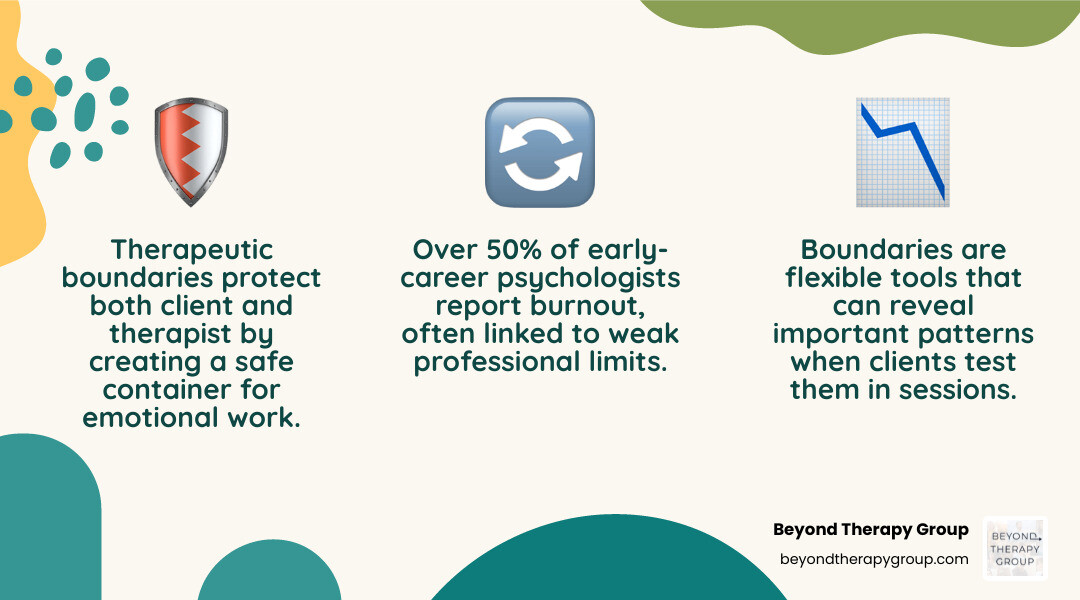
- Therapeutic boundaries protect both the client and the therapist
- Boundaries are not rigid rules but flexible, context-dependent limits
- There is an important difference between a boundary crossing and a boundary violation
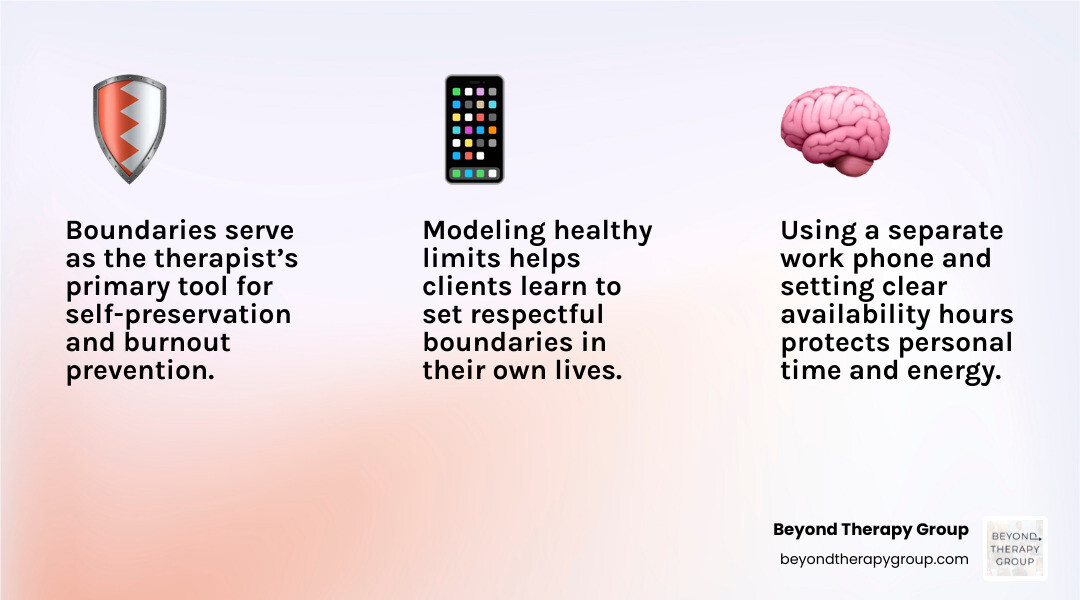
- Modeling healthy limits in therapy helps clients build better relationships outside of it
- Poor boundary management is a leading driver of therapist burnout
- Ethical codes from the APA and BACP set the outer framework for all boundary decisions
Think of a therapeutic boundary as a container. It holds the work. Without it, the relationship loses its shape and its power to heal.
The British Association for Counselling and Psychotherapy describes boundaries as agreed limits that provide safety and protect both the client and the therapist. These limits cover time, money, physical space, emotional availability, communication outside sessions, and much more.
When boundaries are unclear or poorly managed, real harm can follow. Not just for clients but for therapists too. Research shows that more than 50% of early career psychologists report feeling burned out, compared with only 18% of those in advanced career stages. Weak professional limits are a major contributing factor.
But boundaries are not just about protection. When handled with skill and curiosity, they become therapeutic tools. A client who tests the end of a session, refuses to pay, or pushes for physical contact is often communicating something important about how they experience relationships. That moment is an opportunity, not just a problem to manage.
This guide walks through every dimension of boundary work in clinical practice: how to set limits clearly, how to navigate the hard moments, and how to use boundaries to deepen the therapeutic relationship rather than shut it down.
Simple boundary work in psychotherapy word guide:
Defining the Therapeutic Frame and Professional Limits
In mental health, the “therapeutic frame” is the structure that allows deep emotional work to happen. Without a frame, a therapy session can easily slide into a casual conversation, which might feel nice but lacks the transformative power of professional care. We have a fiduciary duty to our clients, meaning we are legally and ethically obligated to act in their best interest. This duty is the bedrock of boundary work in psychotherapy.
Time and Space Boundaries
Time is perhaps our most visible boundary. Starting and ending on time provides a sense of predictability and safety. When we hold the line at the 50-minute mark, we aren’t being “mean” or rigid. We are demonstrating that the therapy space is a specialized environment where time is respected. Similarly, space boundaries involve maintaining a professional setting. Whether in an office in Redondo Beach or via a secure telehealth platform in the South Bay, the environment must remain consistent and professional.
Financial and Role Boundaries
Money is often the most uncomfortable boundary for both parties. However, clear financial boundaries—such as consistent fee collection and clear cancellation policies—prevent resentment and keep the power dynamic balanced. Mastering the Art of Speaking Up for Yourself is a skill we model for our clients when we professionally address unpaid balances or late fees.
Role boundaries are equally vital. We are therapists, not friends, business partners, or romantic interests. While we offer deep empathy, the relationship is inherently one-sided in terms of focus; the session is always about the client’s needs, not ours.
Navigating Challenges and Boundary Work in Psychotherapy Sessions

Boundaries are rarely static. They are often tested, and how we respond to these tests is where the real boundary work in psychotherapy begins. A client might arrive consistently late, send dozens of texts between sessions, or ask for a hug at a vulnerable moment.
Testing Boundaries as Communication
From a psychodynamic perspective, boundary testing is often a form of “enactment.” When a client pushes a limit, they might be subconsciously recreating a dynamic from their past. For instance, a client who refuses to leave when the session ends might be expressing a deep fear of abandonment or a need for control. Instead of simply “enforcing” the rule, we can explore the meaning behind the behavior. Psychodynamic perspective on therapeutic boundaries: creative clinical possibilities suggests that these dilemmas can illuminate a client’s most painful transferential issues.
Handling Physical Touch and Self-Disclosure
Requests for physical touch, like a hug, can be complex. While a handshake or a brief pat on the shoulder might be culturally appropriate in some contexts, more intimate touch can blur the lines of the professional relationship. We must respect our own internal comfort levels and the ethical guidelines of our profession.
Self-disclosure is another area requiring careful navigation. Sharing a personal anecdote can humanize the therapist and build rapport, but it should only be done if it serves the client’s growth. If a therapist shares their own struggles to the point where the client feels they need to “take care” of the therapist, the boundary has been compromised.
Evaluating Professional Tools for Boundary Management
How do we know if we’ve stepped over the line? The distinction between a “crossing” and a “violation” is the most important concept in professional ethics.
| Feature | Boundary Crossing | Boundary Violation |
|---|---|---|
| Intent | To help the client or enhance the alliance | To satisfy the therapist’s needs or impulses |
| Impact | Often helpful or neutral; can be discussed | Harmful, exploitative, or coercive |
| Example | Accepting a small handmade card | Borrowing money from a client |
| Action | Document and discuss in session | Seek immediate supervision/legal counsel |
Documentation and Consultation
The two “sovereign pathways” to clarity are documentation and consultation. If a boundary is crossed—for example, if a therapist gives a client a ride during a sudden South Bay storm—it must be documented with the reasoning and then discussed in the next session to explore the client’s feelings about it.
We should never keep our interventions a secret. If you find yourself wanting to hide an interaction from your colleagues or supervisor, that is a major red flag. Boundary Concerns in Clinical Practice | Psychiatric Times emphasizes that consultation is the best way to prevent a minor crossing from sliding into a major violation.
Preventing Burnout Through Sustainable Professional Limits

Therapist burnout is a quiet crisis in the mental health industry. According to the APA’s 2024 Practitioner Pulse Survey, early career psychologists report significantly higher levels of stress than their senior counterparts. Often, this is because they haven’t yet mastered the “art of the no.”
Self-Care as a Tool for Boundary Work in Psychotherapy
Boundaries are not just for the client’s benefit; they are the therapist’s primary tool for self-preservation. Setting a boundary is an act of self-care. This might mean:
- Having a separate phone for work and only responding during business hours.
- Preparing to end sessions 10 minutes early to allow for transition and notes.
- Clearly communicating availability for between-session contact.
When we ignore our own needs, we become resentful and less effective. Using the Ultimate Checklist for Healthy Boundaries can help clinicians identify where their own lines are being blurred.
Teaching Clients the Art of Boundary Work in Psychotherapy
One of the most beautiful aspects of therapy is that the relationship itself is a laboratory. By maintaining healthy boundaries, we model for our clients how they can do the same in their personal lives. We teach them that “No” is a complete sentence and that setting a limit is an act of self-respect, not an act of aggression.
We can help clients use “I” statements to express their needs clearly without being “jerks.” For example, teaching a client to say, “I need some quiet time when I get home from work,” rather than “Stop bothering me,” is a practical application of the skills learned in session. Our guide on How to Set Boundaries in Your Relationship Without Being a Jerk provides a roadmap for this transition from the therapy room to the real world.
Frequently Asked Questions about Therapeutic Boundaries
What is the difference between a boundary crossing and a violation?
A boundary crossing is a minor, often helpful deviation from the standard frame, like extending a session by five minutes for a grieving client. A violation is a harmful breach that exploits the client, such as entering a business partnership or a romantic relationship with them. Context is everything; what is a crossing in one case could be a violation in another.
How should a therapist handle after-hours contact?
It is best to set expectations during the very first session. Provide clients with crisis resources and clear instructions on when and how you can be reached. Using a dedicated work phone and setting “Do Not Disturb” hours is a practical way to maintain this limit. If a client frequently messages after hours, it should be brought into the next session as a topic for exploration.
When is therapist self-disclosure appropriate?
Self-disclosure is appropriate when it is “client-centered.” It should be used sparingly to validate the client’s experience or to model vulnerability. If the disclosure shifts the focus away from the client or makes them feel responsible for the therapist’s emotions, it has gone too far.
Conclusion
At Beyond Therapy Group, we believe that boundary work in psychotherapy is the foundation of relational health. Whether you are seeking support in Redondo Beach or anywhere in the South Bay, our therapists are committed to providing a safe, contained, and professional environment.
We understand that setting boundaries can feel uncomfortable, but it is the most direct path to personal and relational growth. If you are ready to explore how healthy limits can transform your life, we invite you to take advantage of our free 15-minute consultation. This brief call allows us to guide your booking and answer any questions you may have about our Relationship and Relational Therapy services.
By mastering the art of boundaries, we don’t just protect the therapy; we create a space where true healing can finally begin.
Recent Posts


