
September 28, 2026
The Confident Candidate’s Guide to Nailing High-Stakes Interviews

Mastering Assertiveness for Job Interviews: The Line Between Confidence and Aggression
- Key takeaway: Assertiveness treats the interview as a two-way professional evaluation, not an interrogation.
- Key takeaway: Passive, aggressive, and assertive styles differ in mindset, tone, phrasing, and boundary clarity.
- Key takeaway: Hiring teams prioritize assertive communication because it signals leadership potential and collaborative problem-solving.
- Key takeaway: Preparation frameworks like STAR and DESC help you deliver evidence-based answers with calm authority.
Many job seekers worry that standing up for themselves will make them seem difficult to work with. Others try so hard to be agreeable that they fade into the background. True assertiveness is the middle path. It treats the interview as a two-way professional evaluation rather than an interrogation.
When you communicate assertively, you respect your own professional boundaries while giving the hiring team the respect they deserve. This balance creates psychological safety in the conversation, allowing you to showcase executive presence without posturing. Learning the secret sauce of effective communication begins with understanding how these behaviors contrast in real conversations.
| Dimension | Passive Style | Aggressive Style | Assertive Style |
|---|---|---|---|
| Underlying Mindset | “I hope I am good enough for them.” | “I must win this interview at all costs.” | “We are determining if this is a mutual fit.” |
| Tone and Delivery | Hesitant, quiet, upward inflections | Sharp, interrupting, overly forceful | Steady, calm, level pitch |
| Response Phrasing | “I just helped a little bit with…” | “I was the only one who did anything right.” | “I led the project and coordinated our deliverables.” |
| Handling Pushback | Immediate backing down and excessive apologizing | Combative argument or defensiveness | Calm clarification supported by objective facts |
| Boundary Clarity | Accepts unreasonable terms on the spot | Issues rigid demands without collaboration | Clearly states needs while inviting dialogue |
The Core Spectrum: Passive, Aggressive, and Assertive
Human brains often perceive interview evaluations as social threats. This perception triggers an internal alarm system that pushes people toward fight or flight. In an interview room, flight looks like people-pleasing passivity, while fight manifests as hostile defensiveness.
Passive candidates tend to use minimizing language, nod when they disagree, and accept low compensation figures without question. Aggressive candidates over-correct by dominating the conversation, dismissing previous employers, and refusing to acknowledge areas for growth.
Assertiveness relies on constructive directness and emotional regulation. By applying proven workplace assertiveness techniques, you can turn down the volume of that internal alarm. You state your position plainly, keep your voice level, and hold your ground without raising the emotional temperature of the room.
Why Modern Hiring Teams Prioritize Assertive Communication
Hiring managers want to see how you will behave after you join the team. An interview is a preview of how you will handle client negotiations, push back on unrealistic deadlines, and collaborate with cross-functional partners.
A candidate who communicates assertively signals natural leadership potential, high emotional intelligence, and dependable problem-solving abilities. A study in the Journal of Applied Psychology highlighted evidence on debate training and career mobility, revealing that employees who completed nine weeks of debate training were 12% more likely to advance into leadership roles 18 months later.
Learning how to frame arguments respectfully directly impacts career advancement. Modern organizations need professionals who bring collaborative conviction to daily challenges instead of staying silent.
Preparation Frameworks: Structuring Your Assertive Communication Strategy
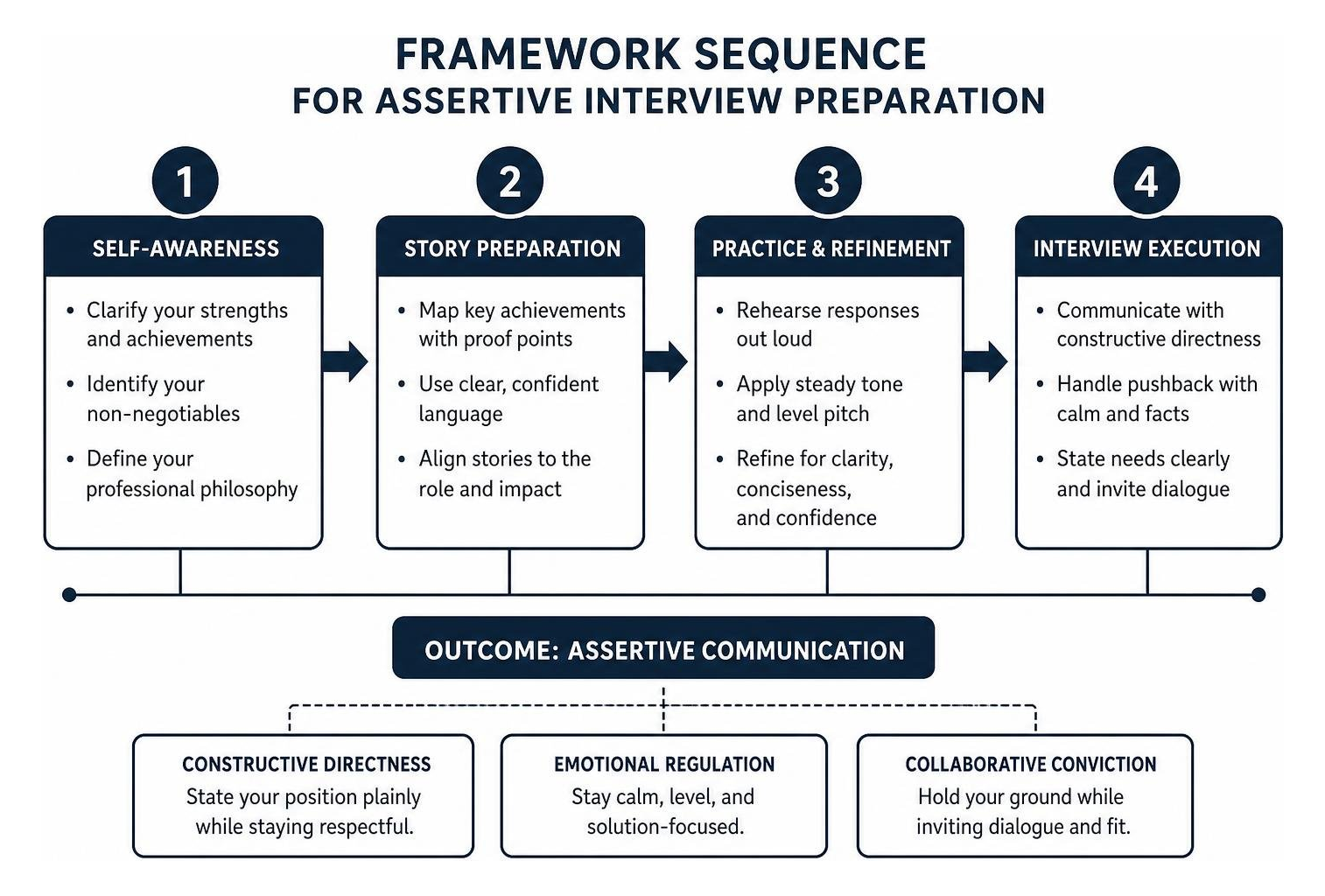
Assertiveness rarely happens spontaneously under pressure. It is built through intentional preparation and structured narrative models. When you enter an interview with clear frameworks for your stories, you eliminate the mental scrambling that leads to passive mumbling or nervous over-explaining.
Before your next interview, map out your key achievements, your non-negotiables, and your professional philosophy. By mastering the art of speaking up, you build the cognitive muscle memory needed to articulate your value smoothly.
Building Vocal Presence and Nonverbal Assertiveness for Job Interviews
Your nonverbal cues deliver your message long before your words register. Upright posture, open gestures, and steady eye contact signal comfort in your own skin.
- Posture Alignment: Keep your shoulders relaxed and back straight. Sit with both feet on the floor to remain physically grounded.
- Eye Contact: Maintain steady, natural eye contact with the interviewer. Break away occasionally to avoid an unnatural stare, but do not look at the floor when answering tough questions.
- Tone Calibration: Speak from your chest rather than your throat to keep your pitch resonant and calm. Avoid ending statements with an upward question inflection.
- Pace and Pauses: Rushing your words conveys panic. Practice vocal drills to stop mumbling and embrace deliberate two-second pauses before delivering key points.
Structuring Evidence-Based Answers with the STAR and DESC Models
To keep your answers crisp and impactful, use established communication structures. The STAR method ensures that your stories stay focused on outcomes rather than vague descriptions:
- Situation: Set the scene briefly with essential context.
- Task: State your specific responsibility or objective.
- Action: Describe the concrete steps you took, using “I” instead of hiding behind “we.”
- Result: Share the measurable outcome, data point, or organizational impact.
When you need to describe setting professional limits or addressing project scope creep in a behavioral question, pair this with practical frameworks for assertive boundary setting using the DESC model:
- Describe: Objectively outline the situation without emotional charge.
- Express: State your perspective or the impact on the work.
- Specify: Clarify the exact solution or adjustment you implemented.
- Consequence: Highlight the positive business result achieved through that boundary.

High-Stakes Scripts: Delivering Assertive Responses to Tough Prompts
Challenging moments in an interview test your composure. Whether the conversation turns to compensation, mistakes, or sudden interruptions, keeping your language clean and direct prevents misunderstandings. For deeper communication strategies, explore our complete communication guide.
Navigating Compensation and Salary Expectations
Discussing money often tempts candidates into over-justifying or accepting the first number mentioned. Assertive candidates rely on objective market research and state their expectations clearly.
- When asked for your salary range early: “Based on my research into this market and the specific scope of this role, I am targeting a base range between $115,000 and $130,000. Does that align with what your team budgeted for this position?”
- When an offer comes in below your target: “Thank you for this offer. I am genuinely excited about the role. Based on my industry track record and the measurable impact I can deliver right away, I am looking for a base of $125,000 to move forward. Is there flexibility to reach that number?”
Addressing Weaknesses, Past Mistakes, and Team Conflict
A passive candidate denies real weaknesses, while an aggressive one blames teammates. Assertive professionals own their mistakes and explain how they corrected them.
- Addressing a real weakness: “Early in my career, I found it challenging to delegate technical tasks when deadlines were tight. I realized this created a bottleneck for my team. Over the last two years, I instituted weekly capacity reviews and clear project ownership rubrics, which improved our sprint velocity by 20%.”
- Handling past team disagreements: “In my previous position, our lead developer and I disagreed on the rollout schedule for a core feature. Rather than letting the debate stall development, I scheduled a focused working session where we reviewed our performance metrics together. We aligned on a phased launch that met our reliability standards without missing the client launch date.”
Deflecting Interruptions, Aggressive Probing, and Pushback
If an interviewer cuts you off or challenges your experience aggressively, you do not need to shrink back or attack. Maintain your composure and use the broken record technique to calmly guide the focus back to your point.
- Regaining the floor after an interruption: “I want to address that specific metric in just a moment. To finish the context on our workflow design, we automated the data pipeline first, which reduced errors by 40%.”
- Handling pushback on your experience: “I recognize that my background is rooted in enterprise tech rather than consumer software. However, the core challenges of scaling server infrastructure and leading engineering teams remain identical. My track record shows I consistently adapt to new technical domains within 60 days.”

Equity and Identity: Nuanced Communication Across Diverse Candidates
Assertiveness does not exist in a vacuum. Societal expectations and systemic biases influence how direct communication is received. What reads as decisive in one person can be unfairly judged as abrasive or uncooperative in another. Applying boundary training for relationships helps candidates calibrate their self-advocacy to their environment without compromising their values.
Applying Assertiveness for Job Interviews Across Underrepresented Populations
Research indicates that women and people of color frequently face double-bind dilemmas during hiring evaluations. If they are direct, they risk being perceived as unlikable. If they are gentle, they risk being seen as unready for leadership.
Navigating this reality involves strategic framing. By pairing clear self-advocacy with communal language, candidates can protect their boundaries while maintaining rapport:
- Dual Framing: “I advocate strongly for my team’s operational needs because protecting their focus is how we delivered a 35% revenue increase last year.”
- Objective Anchoring: Grounding every salary request or strategic opinion in external data removes personal friction and highlights business logic.
Clinical Applications: Speech Differences and Communication Anxiety
For individuals with communication anxiety or speech differences, structured behavioral practice provides measurable relief. (Schloss et al., 1987) demonstrated that assertiveness training procedures incorporating instruction, modeling, rehearsal, and constructive feedback created sizable decreases in stuttering while significantly increasing interview performance scores.
By practicing structured self-disclosure, candidates take ownership of the room:
- Strategic Self-Disclosure: “Before we begin, you may notice that I speak with a mild stutter occasionally. I like to mention it upfront so we can focus entirely on how my background aligns with your team’s goals.”
This proactive transparency puts both the candidate and the interviewer at ease, demonstrating self-assurance from the very first minute.
Frequently Asked Questions About Interview Assertiveness
What is the primary difference between being assertive and being pushy in an interview?
Assertiveness is rooted in mutual respect, clarity, and active listening. An assertive candidate states their value, boundaries, and questions directly, while remaining attentive to the interviewer’s perspectives and constraints. Pushy behavior involves talking over the interviewer, demanding commitments prematurely, and ignoring organizational context.
How can candidates manage social anxiety while trying to communicate assertively?
Managing interview anxiety starts with somatic grounding and small rehearsal steps. Practice delivering your core stories out loud in low-stakes settings, such as with a friend or in front of a mirror. Before stepping into the interview, take slow diaphragmatic breaths to regulate your nervous system. Remind yourself that the interview is a mutual evaluation to see if the company is healthy for you, not a test you must pass.
What is the most assertive way to follow up after an interview without seeming demanding?
Send a concise thank-you note within 24 hours of the interview that references a specific topic discussed. If the agreed-upon decision date passes without contact, follow up with a brief, professional check-in: “I am writing to check in on the timeline for this position. I remain very enthusiastic about the work your team is doing and look forward to any updates you can share.”
Conclusion
Mastering assertive communication transforms the entire job search experience. When you stop apologizing for your experience, state your career goals plainly, and view interviewers as professional peers, you position yourself for higher compensation, healthier work environments, and long-term career growth.
Confidence is not an overnight discovery. It is a set of practical habits you build one conversation at a time. If you want to refine your vocal presence, master boundary setting, and walk into high-stakes meetings with calm authority, we are here to help. At Beyond Therapy in Redondo Beach and the South Bay, we provide personalized mental health support tailored to your unique goals. Schedule a free 15-minute consultation with our therapists today to start your journey, and take the first step to master assertive communication skills for your next big opportunity.
References
Schloss PJ, Espin CA, Smith MA, Suffolk DR. “Developing assertiveness during employment interviews with young adults who stutter..” The Journal of speech and hearing disorders, 1987. PMID 3807342.
Recent Posts