August 14, 2026
The Ultimate Guide to Setting Boundaries for Emotional Health

Why Boundaries Therapy and Emotional Health Are Inseparable
Key Takeaways
- Boundaries protect your mental well-being and foster healthy relationships.
- Childhood trauma and people-pleasing habits often make setting limits feel physically unsafe.
- Somatic awareness and assertive communication scripts help you communicate your needs clearly.
- Professional therapy provides a safe space to practice boundary-setting and manage the guilt spike.
Boundaries therapy emotional health are three concepts that belong together. Here is the short version:
What are boundaries? Boundaries are the personal limits you set to protect your well-being, safety, and comfort in any relationship. They define where you end and another person begins.
Why do they matter for emotional health?
- They reduce chronic stress and anxiety.
- They protect against burnout at work and at home.
- They build self-esteem and a clearer sense of identity.
- They make relationships healthier and more balanced.
What is boundaries therapy? Boundaries therapy is professional support that helps you identify your limits, practice communicating them, and work through the guilt or fear that comes with enforcing them.
If you have ever felt resentful after saying yes when you meant no, or exhausted from constantly managing other people’s feelings, you already know what a frayed boundary feels like in your body. That tightness in your chest. That sinking feeling in your stomach. Those are real signals.
Setting limits is not about pushing people away. It is about creating the conditions where genuine connection can actually exist.
But for many people, especially those carrying stress, anxiety, or a history of people-pleasing, the act of saying “no” can feel physically threatening. Not just uncomfortable. Threatening. There is a neurological reason for that, and it is worth understanding before jumping straight to scripts and strategies.
This guide covers all of it: what boundaries actually are, why they feel so hard, and how therapy can help you build them in a way that lasts.
Learn more about boundaries therapy emotional health:
Understanding Boundaries and the Six Key Types in Relationships
Many people think of boundaries as cold, unyielding walls designed to keep others out. In reality, healthy boundaries function more like a dynamic drawbridge. They are flexible structures that protect your personal space while still allowing for warm, meaningful connection when you give consent.
When we lack boundaries, we default to fusion or enmeshment, where we lose our sense of self in order to keep the peace. Establishing clear limits is an act of individual sovereignty. It is the capacity to say, “This is where I end and you begin, and I can hold this line while still staying connected to you.”
Without this distinction, relationships quickly become breeding grounds for resentment and burnout. By learning to define your limits, you are not punishing others. You are simply providing them with an operating manual for how to love and respect you.
To begin this work, we must look at where our lines are drawn. We can start by exploring A Comprehensive Guide to Defining Personal Boundaries to understand how our personal limits protect our mental health.
The Core Connection Between Boundaries Therapy Emotional Health
At its heart, the connection between boundaries therapy emotional health rests on what psychologists call the “law of relationships.” This law states that you cannot control what others think, feel, or do. You are solely responsible for your own thoughts, feelings, and actions.
Chronic stress and anxiety often develop when we take subconscious responsibility for other people’s emotions. If you believe it is your job to keep everyone around you happy, you will constantly sacrifice your own needs. This performance-based self-worth makes you vulnerable to toxic dynamics and exhaustion.
Through boundaries therapy, you learn to let go of this impossible burden. Therapy helps you unpack the false beliefs and perfectionism that drive people-pleasing, often using structured resources like The Better Boundaries Workbook to build self-compassion and dismantle unearned guilt.
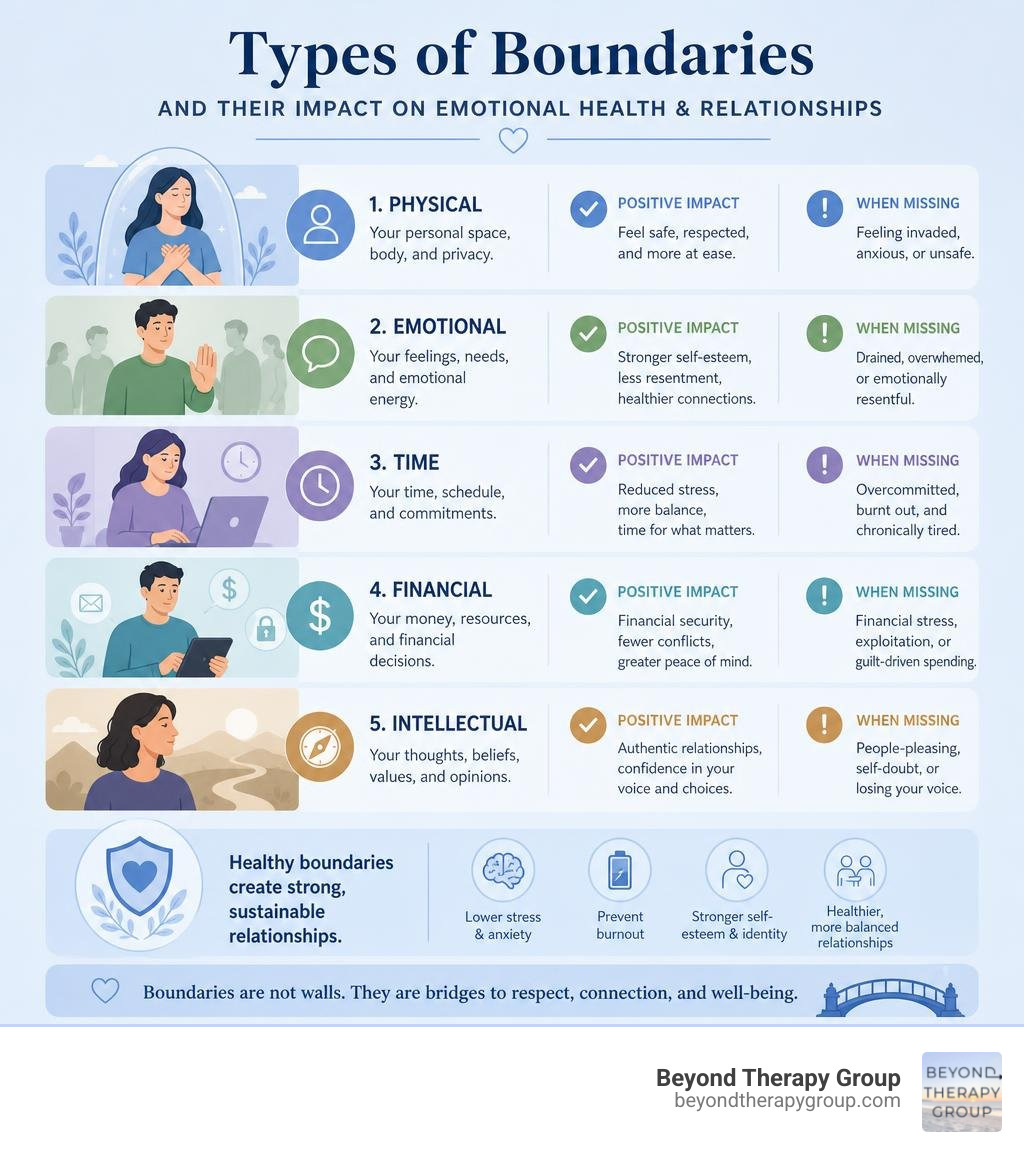
The Six Key Types of Boundaries in Relationships
To build healthy relationships, we must recognize that boundaries are not a single, vague concept. They span multiple areas of our lives.
| Boundary Type | What It Protects | Real-World Example |
|---|---|---|
| Physical | Your body, personal space, and physical comfort. | Declining a hug from a new acquaintance and opting for a polite wave instead. |
| Emotional | Your internal emotional energy and feelings. | Saying, “I want to support you, but I do not have the emotional capacity for this conversation right now.” |
| Time | Your schedule, priorities, and personal downtime. | Protecting your evening hours to rest rather than agreeing to last-minute favors. |
| Digital | Your focus and mental peace in a constantly-connected world. | Turning off work notifications after 6 PM and keeping your phone out of the bedroom. |
| Material | Your personal belongings, home, and financial resources. | Lending a vehicle only on the condition that it is returned clean and fully fueled. |
| Intellectual | Your personal beliefs, values, and thoughts. | Respectfully disagreeing with a family member without letting them dismiss your perspective. |
Each of these types plays a massive role in maintaining your overall well-being. For couples, establishing these rules of engagement is vital to prevent relationship erosion. You can explore how these play out in romantic partnerships by reviewing Protect Your Relationship: 6 Boundaries Every Couple Needs.
Why Setting Limits Feels Terrifying: Trauma and the Nervous System
If setting boundaries is so beneficial, why does it feel so incredibly difficult? The answer lies deep within our biology and past experiences.
For many individuals, particularly those with a history of interpersonal trauma, the act of saying “no” triggers an intense survival response. In fact, clinical research shows that 31.7% of psychiatric inpatients have experienced lifetime interpersonal trauma. When a person has survived environments where their boundaries were repeatedly crossed or ignored, their nervous system learns that self-assertion is dangerous.
When you attempt to set a limit, your brain does not just see a simple conversation. It detects a threat to your safety. This triggers the “fawn” response, which is a somatic survival strategy where you automatically please and appease others to avoid conflict or abandonment.
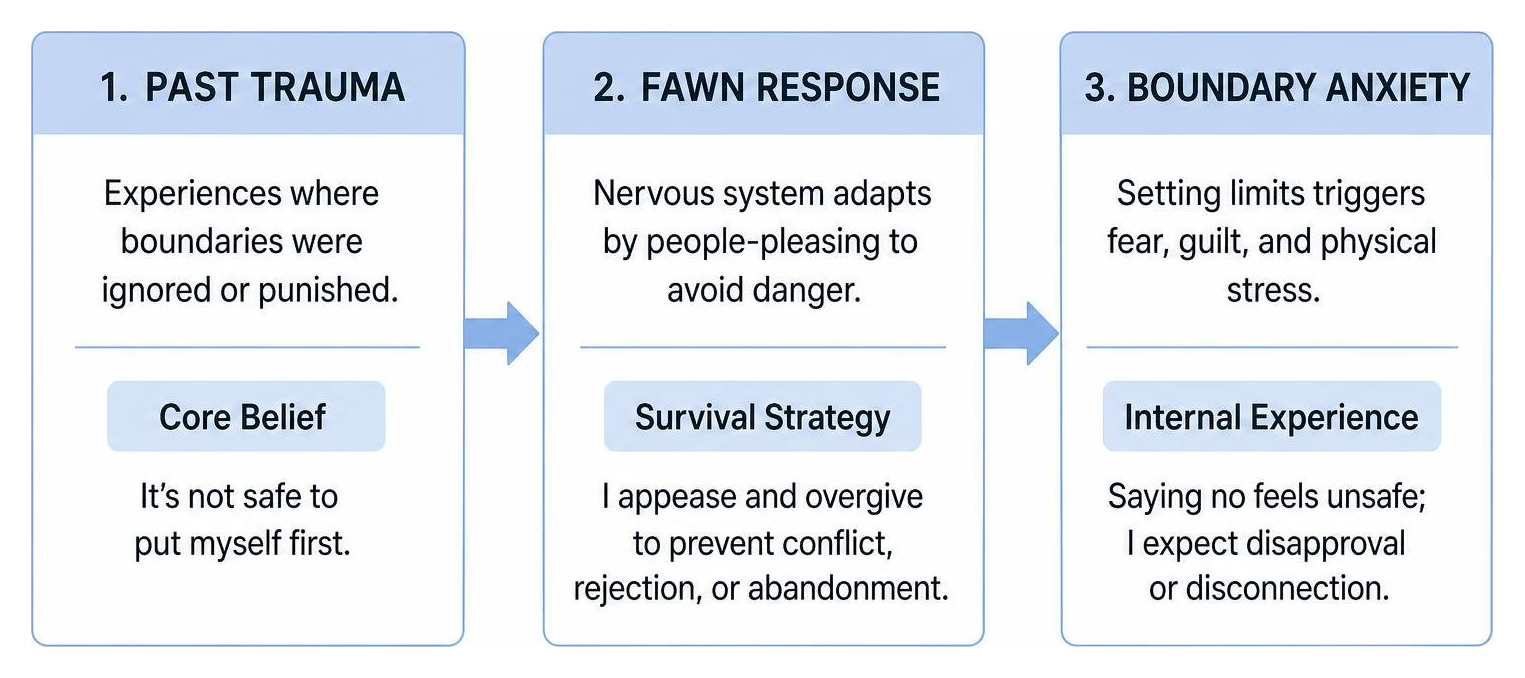
Understanding this somatic connection is the first step toward healing. Rather than seeing your difficulty with limits as a personal failure, you can recognize it as a protective mechanism that can be re-patterned over time. For a deeper clinical perspective on this process, you can read Strengthening Personal Boundaries: Psychotherapy Networker.
How Childhood Attachment Shapes Adult Boundaries Therapy Emotional Health
Our patterns of boundary-setting are almost always established in our early family systems. In healthy families, children are allowed to have privacy, express differing opinions, and say no. In enmeshed family systems, however, individuality is often viewed as a threat.
In these dynamics, parents may treat a child’s desire for privacy as a form of secrecy or betrayal. Children in enmeshed environments are often expected to manage their parents’ emotional states, learning early on that their own feelings must be suppressed to maintain attachment.
This creates a deep-seated fear of abandonment in adulthood. When you grow up believing that love is conditional on your compliance, setting a boundary feels like risking the relationship itself.
In therapy, we work to untangle these childhood attachment injuries. By examining these early relational dynamics, we can begin to build a secure sense of self. To see how these patterns show up in the therapeutic alliance, read A Deep Dive into Boundaries in a Counselling Relationship.
Recognizing the Signs of Frayed Limits and Boundary Violations
How do you know when your boundaries are weak or being actively violated? Often, your body will tell you long before your mind does.
We can look for several key indicators:
- Persistent Resentment: Feeling like you are doing far more for others than they are doing for you.
- The “Yes” Reflex: Automatically agreeing to requests before checking your schedule or energy levels.
- Physical Somatization: Experiencing unexplained headaches, neck tension, or stomach issues when interacting with certain people.
- Identity Erosion: Feeling like you have lost touch with your own hobbies, desires, and opinions because you are too busy accommodating others.
To catch these signs early, you must develop “interoception,” which is the ability to perceive and interpret your body’s internal physical signals. When someone asks you for a favor, do you feel a tightening in your chest or a sinking in your stomach? That is your body’s natural barometer telling you that a limit is about to be crossed.
For a structured way to assess your current limits, you can download and print the Ultimate Checklist for Healthy Boundaries.
Practical Strategies and Scripts for Assertive Communication
Once you have identified where you need to set a limit, the next challenge is communicating it. Assertive communication is the middle ground between passivity (ignoring your own needs) and aggression (attacking the other person).
To set boundaries effectively, you must learn to speak clearly, calmly, and directly without apologizing, over-explaining, or defending your choices. A boundary stated without rage or apology is already a complete sentence. You do not need to justify your personal limits to anyone.
To start practicing these communication skills, you can read our guide on How to Master Assertive Boundary Setting in 5 Easy Steps.
Step-by-Step Strategies for Clear Communication
When you are ready to communicate a boundary, having a structured approach can significantly reduce your anxiety. Here are three powerful techniques to keep in your communications toolkit:
1. The “I Statement” Template
Instead of accusing the other person, focus entirely on your own experience and needs. This keeps the other person from becoming immediately defensive.
- The Formula: “I feel [emotion] when [action] because [reason]. What I need is [request].”
- Example: “I feel overwhelmed when work emails are sent to my personal phone after hours because I need time to unplug. What I need is for us to keep all project updates in our shared workspace during business hours.”
2. The Broken Record Technique
If someone tries to negotiate or push past your boundary, you do not need to come up with new arguments. Simply choose one clear, kind sentence and repeat it calmly.
- The Script: “I understand this is difficult, but I am not able to take on this project right now.”
- If they push back: “I hear you, and I am still unable to take this on.”
3. The Delay Script (The 75/25 Somatic Rule)
When put on the spot, keep 75% of your awareness on your own body (your breathing, your posture, your heart rate) and only 25% on the other person. Use a delay script to buy yourself time to think.
- The Script: “Let me check my schedule and get back to you by tomorrow morning.”
By practicing these tools, you can transition from passive-aggressive hints to clear, respectful interactions. For more practical advice on refining these communication habits, explore How to Master Assertive Communication Skills in 5 Easy Changes.
Navigating Guilt and Pushback from Others
When you begin setting boundaries, you must expect pushback. People who are accustomed to your constant accommodation will rarely celebrate when you start saying no. They may use guilt, manipulation, or anger to try to restore the old dynamic.
This is where the “guilt spike” occurs. When you set a limit, your nervous system will likely trigger an intense wave of guilt. It is vital to recognize that this guilt is not a sign that you have done something wrong. It is simply an old habit of prioritizing other people’s comfort over your own safety.
When dealing with toxic partners or highly controlling family members, keep your statements brief and low-drama. If they refuse to respect your limits, you may need to limit your contact with them or walk away entirely to protect your emotional health.
To learn more about navigating these difficult relational dynamics, check out our guide on Drawing the Line with Toxic and Controlling Partners.
When to Seek Professional Support Through Boundaries Therapy Emotional Health
Building and maintaining boundaries is deep, somatic work that is incredibly difficult to do alone. If you find yourself trapped in chronic cycles of people-pleasing, staying in exploitative relationships, or feeling paralyzed by guilt whenever you say no, professional therapy can provide the support you need.
In our practice at Beyond Therapy, we treat therapy as a safe laboratory. Here, you can test out assertiveness, practice boundary-setting scripts, and learn to tolerate the temporary discomfort of the guilt spike.
We utilize evidence-based approaches like Cognitive Behavioral Therapy (CBT) to challenge perfectionistic beliefs, alongside somatic and bioenergetic techniques to help you physically experience your boundaries.
Developed by Alexander Lowen, bioenergetic therapy helps you connect your mind and body. You might practice physical grounding exercises, such as standing with your feet hip-width apart and knees slightly bent, to feel solid and anchored. Or you might practice physical limit-setting by holding your hands out, palms facing forward, while saying “stop.”
These physical movements help your nervous system realize that you have the power to protect your personal space.
If you are looking for local clinical support to guide you through this process, we offer dedicated services in your area. You can connect with our therapists in Redondo Beach, CA, or find support in South Bay, FL, to begin your healing journey.
For a comprehensive look at how professional clinical support can transform your relationships, read A Practical Guide to Boundary Work in Psychotherapy.
Frequently Asked Questions about Boundaries and Emotional Health
How do I set boundaries without feeling guilty?
The key is to realize that guilt is a natural side effect of changing long-standing relationship patterns. When you set a boundary, practice self-compassion. Remind yourself that setting limits is an act of respect for both yourself and the relationship. Over time, as your nervous system learns that you are safe, the guilt will naturally begin to fade.
What are the signs of weak boundaries in a relationship?
Common signs include feeling constantly resentful, taking responsibility for your partner’s moods, over-committing to tasks you do not want to do, and keeping people at a distance because you fear being overwhelmed by their needs. If you find yourself walking on eggshells to avoid conflict, your boundaries likely need attention.
How can therapy help me maintain my personal limits?
Therapy provides a supportive, non-judgmental space to explore the root causes of your boundary struggles. Through role-playing, somatic awareness exercises, and cognitive restructuring, a therapist helps you practice asserting yourself in low-stakes situations before you apply those skills in your everyday life.
Conclusion
Setting boundaries is not a selfish act. It is a fundamental requirement for long-term emotional health, self-care, and mutual respect. When you clearly define your personal limits, you protect your physical and emotional energy, allowing you to show up more authentically in your life and relationships.
If you are ready to move from chronic burnout to healthy balance, you do not have to navigate this path alone. At Beyond Therapy, we are dedicated to helping you build the skills necessary to protect your peace and foster healthy, lasting connections.
We invite you to take the first step toward a more balanced life. Contact Beyond Therapy today to schedule a free 15-minute consultation with our therapists. We will answer your questions and match you with the right clinician for your needs in Redondo Beach, CA or South Bay, FL.
To begin your journey toward healthier, more fulfilling relationships, Schedule a Relational Therapy Consultation with us today.
Recent Posts


