
July 28, 2026
How to Set Healthy Emotional Boundaries at Work and Thrive

Key Takeaways
- Healthy emotional boundaries at work protect your mental health and prevent burnout by separating your feelings from those of your colleagues.
- Setting limits is a professional skill that improves long-term productivity and cognitive performance.
- Clear communication and strategic frameworks help you maintain professional relationships while protecting your energy.
Why Healthy Emotional Boundaries at Work Matter More Than Ever
Healthy emotional boundaries at work are one of the most overlooked tools for protecting your mental health and staying effective in your job over the long term.
Here is a quick answer if you need it fast:
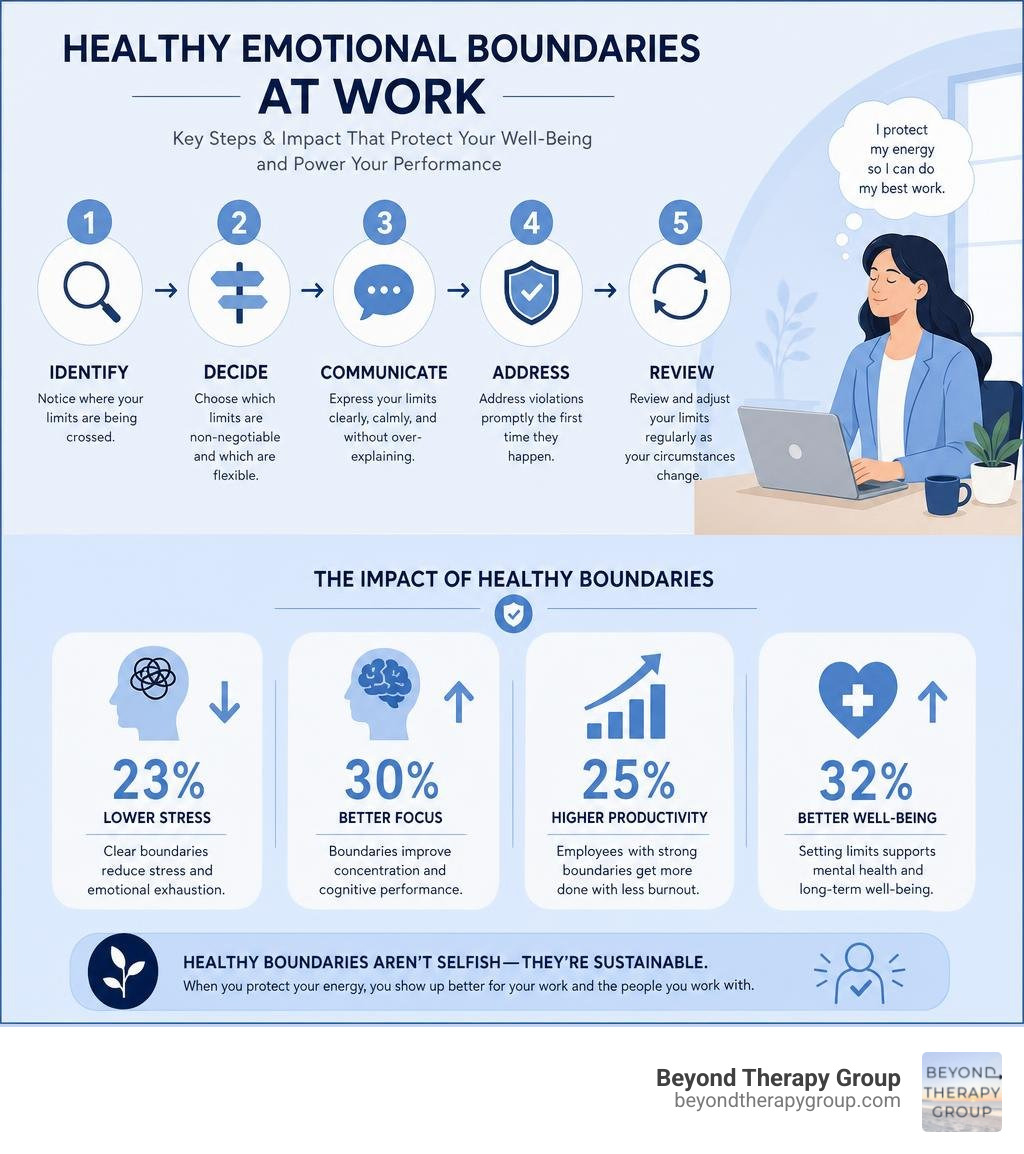
How to set healthy emotional boundaries at work:
- Identify where your limits are being crossed (resentment, exhaustion, intrusive work thoughts)
- Decide which limits are non-negotiable and which are flexible
- Communicate your limits clearly, calmly, and without over-explaining
- Address violations promptly the first time they happen
- Review and adjust your limits regularly as your circumstances change
We have all been there. The late-night Slack message you felt you had to answer. The colleague who vented to you for 40 minutes while your own work piled up. The manager who expected you to absorb their stress along with your own workload.
These are not small inconveniences. Without clear emotional limits, your body’s stress response stays in a constant state of low-grade activation. Research links this chronic stress to burnout, cognitive decline, and emotional exhaustion. The World Health Organization now classifies burnout as an occupational phenomenon, and it is far easier to prevent than to recover from.
The good news? Setting emotional limits at work is a learnable skill, not a personality trait. It does not require you to become cold or unapproachable. It requires you to get clear on where you end and where someone else’s emotional world begins.
This guide will walk you through exactly how to do that.
Relevant articles related to healthy emotional boundaries at work:
What Are Healthy Emotional Boundaries at Work?
When we talk about emotional boundaries in a professional setting, we are talking about the invisible lines that protect our emotional space and self-respect. These lines define what we are willing to accept from others and what we will not tolerate. They help us separate our own feelings, responsibilities, and sense of self-worth from the moods, demands, and crises of our coworkers or managers.
As highlighted in Setting Mental Health Boundaries at Work: A Practical Guide (2026) | Simply Psychology, establishing these limits is not an act of selfishness. It is a functional requirement and a basic precondition for maintaining your mental well-being and delivering high-quality work over time. When we protect our emotional space, we preserve the energy required to do our jobs effectively.
Emotional Boundaries vs. Other Workplace Limits
It is easy to confuse emotional boundaries with other types of workplace limits. However, they serve distinct purposes. To understand how they interact, it helps to compare them directly.
| Boundary Type | What It Protects | Common Example |
|---|---|---|
| Time Boundaries | Your schedule and personal hours | Disconnecting from email after 6:00 PM |
| Physical Boundaries | Your personal space and physical items | Keeping your office door closed during deep focus |
| Workload Scope | Your job role and capacity limits | Saying no to tasks that fall outside your responsibilities |
| Emotional Boundaries | Your internal energy and emotional state | Refusing to absorb a colleague’s panic or anger |
While a time boundary might keep you from opening your laptop on Saturday, an emotional boundary is what keeps you from worrying about a coworker’s passive-aggressive email all weekend. Both are essential, but emotional boundaries directly guard your inner peace.
The Neurological Cost of Weak Emotional Boundaries
Failing to set these limits does not just make you feel tired. It actually changes your brain chemistry. When you constantly absorb workplace stress and over-function to keep everyone around you happy, your body activates the hypothalamic-pituitary-adrenal (HPA) axis.
This chronic activation floods your system with cortisol, the body’s primary stress hormone. Over time, elevated cortisol levels lead to:
- Measurable cognitive decline, making it harder to focus or make decisions.
- Emotional dysregulation, leaving you feeling highly irritable or anxious.
- Physical exhaustion that sleep alone cannot fix.
In the business environments of Redondo Beach and the wider South Bay, where hybrid schedules and high demands are common, protecting your HPA axis from constant activation is a vital professional skill.
Signs Your Emotional Boundaries Are Being Crossed
Recognizing when your limits have been violated is the first step toward reclaiming your energy. Often, we do not realize a boundary has been crossed until we are already feeling miserable.
Some of the most common warning signs include:
- Over-functioning: Constantly stepping in to solve problems that belong to your colleagues or managers.
- Resentment: Feeling a growing sense of anger toward people who ask you for help or dump tasks on your desk.
- Intrusive thoughts: Replaying stressful work conversations in your head late at night when you should be relaxing.

Recognizing the Gradual Drift of Boundary Violations
Boundary violations rarely happen all at once. Instead, they occur through a process of gradual drift. It starts with small concessions. You answer one quick message during dinner. You listen to a coworker complain about their supervisor for five minutes. You take on a minor task that is not your responsibility.
Over weeks and months, these tiny concessions accumulate. Before you realize it, your professional standards have eroded, role creep has set in, and you are carrying an emotional load that is not yours to bear. To understand how these patterns develop, you can read more about identifying these shifts in our A Comprehensive Guide to Defining Personal Boundaries.
Emotional Contagion and Second-Hand Stress
Have you ever walked into a meeting feeling perfectly fine, only to walk out feeling anxious and tense because of the mood in the room? This is emotional contagion, also known as second-hand stress.
Human beings are wired to mirror the emotions of those around them. In a workplace without strong emotional boundaries, stress acts like a contagious virus. If a colleague is constantly venting or a manager is projecting their panic onto the team, you will naturally absorb that anxiety unless you actively choose to put up an emotional shield. Holding space for a colleague’s professional challenges does not mean you have to carry those difficulties home with you.
How to Identify Your Personal Emotional Limits
Before you can communicate your boundaries to others, you must know what they are. This requires regular self-reflection and capacity checks. You have to check in with yourself to see if you are operating from a place of genuine energy or empty obligation.
A great place to start this internal assessment is by reviewing the Ultimate Checklist for Healthy Boundaries. This tool can help you pinpoint exactly where your current limits are serving you and where they might be too porous.
Tuning Into Your Nervous System and Physical Signals
Your mind might try to convince you that you can handle more stress, but your body never lies. When your emotional limits are exceeded, your nervous system will send physical distress signals.
Pay close attention to these somatic signs of discomfort:
- A sudden tightening in your chest or throat when a certain name pops up on your screen.
- A clenched jaw or tension headaches during team meetings.
- Persistent fatigue, even after a full night of rest.
To help you track these physical reactions and connect them to specific workplace triggers, you can download and fill out our Boundaries Worksheet PDF for Adults Download Guide. Tuning into these physical cues allows you to catch boundary violations before they escalate into full-blown panic or burnout.
Differentiating Healthy Empathy from Emotional Over-Involvement
Being a supportive colleague is a wonderful trait, but there is a massive difference between healthy empathy and emotional over-involvement.
- Healthy empathy involves active listening and understanding. You can validate a coworker’s feelings (“That sounds incredibly frustrating”) while remaining grounded in your own emotional state.
- Emotional over-involvement means taking on their problem as your own. You feel responsible for fixing their mood, or you let their frustration ruin your entire afternoon.
As explored in The Win-Win of Healthy Workplace Boundaries | Psychology Today, maintaining a healthy professional distance is actually a win-win for everyone. It keeps you from burning out, and it empowers your colleagues to find their own solutions rather than relying on you to rescue them.
Practical Strategies for Setting Healthy Emotional Boundaries at Work
Setting boundaries does not require a dramatic confrontation. In fact, the most effective boundaries are set quietly, calmly, and with absolute clarity. It is about using assertive communication and direct language to state what you need.
To build the confidence required to speak up, check out our guide on How to Master Assertive Boundary Setting in 5 Easy Steps.

Scripts for Communicating with Managers and Colleagues
When you are tired or stressed, finding the right words can feel impossible. Having pre-written scripts ready can take the anxiety out of the moment. Here are a few ways to protect your emotional space and manage your capacity:
When a colleague is using you to vent constantly:
“I want to support you, but I only have a few minutes before I need to focus on this project. Let’s keep our chat to ten minutes, or we can schedule a quick catch-up later this week.”
When a manager dumps a last-minute project on you when you are at capacity:
“I want to make sure I deliver high-quality work on this. To take this on, I will need to push back the deadline on our other project. Can we look at my current task list together to see what we should deprioritize?”
When you receive a late-night message that is not a true emergency:
“Got it. I will dive into this first thing tomorrow morning when I am back online.”
Using these scripts allows you to say no or set limits without apologizing or over-explaining. If you want to refine this skill further, our resource on Mastering the Art of Speaking Up for Yourself offers excellent frameworks for clear communication.
Navigating Systemic Challenges and Backlash for Marginalized Professionals
While setting boundaries is a vital skill, we must acknowledge that it is not equally easy for everyone. Power dynamics, gender bias, and racial dynamics play a significant role in how assertiveness is received in the workplace.
Research highlights that women and people from marginalized communities often face documented social costs and backlash when they push back or assert authority. For example, studies have shown that women who express anger or set firm limits are often penalized in terms of likability and professional status, whereas men are often rewarded for the same behavior.
To navigate these complex dynamics, it helps to use highly strategic, operationally framed communication. You can find research-backed strategies and scripts designed specifically for these challenges in this guide on Practical scripts and frameworks for setting time, scope, and emotional boundaries at work — backed by research on what women face when they push back. . Framing your limits around business outcomes rather than personal preferences can help minimize social costs while protecting your energy.
How to Maintain Healthy Emotional Boundaries at Work Without Damaging Relationships
Many people avoid setting boundaries because they worry they will be perceived as cold, uncooperative, or unsupportive. However, the opposite is true. Clear boundaries actually build trust and mutual respect.
The secret is to combine firm limits with professional warmth. You do not have to be rude to be firm. You can read more about balancing these elements in our article on Mastering Assertiveness and Boundary Training for Better Relationships.
The “Positive No” and Strategic Communication
One of the best ways to maintain professional warmth while protecting your limits is by using the “Positive No” framework. This approach allows you to decline a request while keeping the relationship strong.
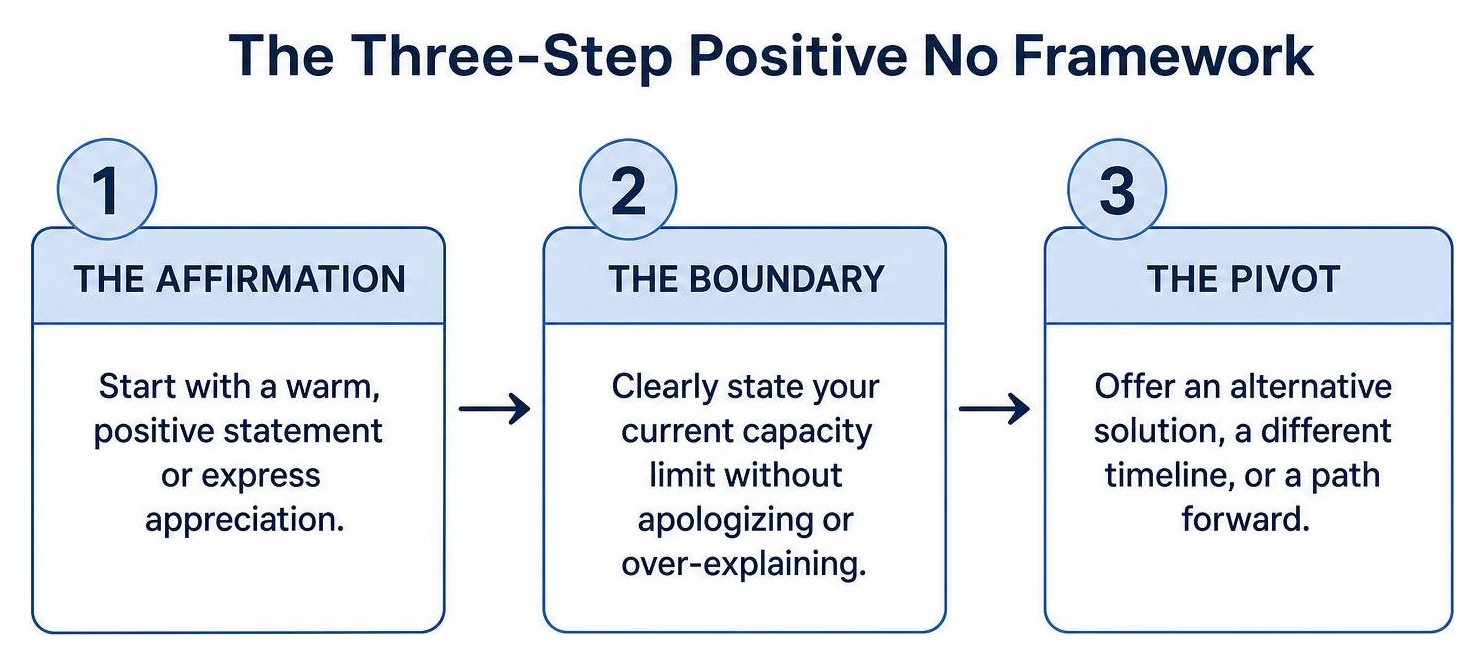
This framework consists of three simple steps:
- The Affirmation: Start with a warm, positive statement or express appreciation for being asked.
- The Boundary: Clearly state your current capacity limit without apologizing or over-explaining.
- The Pivot: Offer an alternative solution, a different timeline, or a path forward.
For example: “Thank you for thinking of me for this presentation! I am currently fully committed to wrapping up our quarterly review, so I cannot take this on this week. However, I would be happy to share my slide templates with you, or we can look at doing this next month.”
This strategy shows that you are collaborative and solution-oriented, even when you are saying no. For a deeper dive into this technique, check out The Ultimate Guide to Drawing Lines in the Sand.
Managing the Discomfort Phase of New Limits
When you begin setting new boundaries, you will likely experience a wave of internal discomfort, guilt, or anxiety. This is completely normal. Your colleagues may also experience a brief period of friction as they adjust to your new limits.
In our experience, this discomfort phase is temporary. It typically takes about two to four weeks for a new equilibrium to settle in. During this transition, consistency is your best friend. If you waiver or apologize, you teach others that your boundaries are negotiable. If you need help navigating the awkwardness of this transition, read our guide on How to Set Boundaries in Your Relationship Without Being a Jerk.
Frequently Asked Questions About Workplace Boundaries
What is the difference between healthy emotional boundaries and being emotionally detached?
Healthy emotional boundaries are about protecting your energy so you can remain engaged, empathetic, and effective in your role. You still care about your work and your colleagues, but you do not let their emotional states dictate yours.
Emotional detachment or apathy, on the other hand, is often a sign of existing burnout. It is when you completely check out, stop caring about outcomes, and isolate yourself from your team. Healthy boundaries prevent you from reaching that state of exhaustion.
How can leaders help create a culture that respects emotional boundaries?
Leaders have a massive responsibility to model healthy behavior. If a supervisor is sending emails at midnight, their team will feel pressured to answer them, regardless of what the company handbook says.
Leaders can build psychological safety by respecting off-hours, checking in on their team’s workload capacity, and explicitly encouraging employees to take their assigned breaks. When leaders prioritize organizational health, the entire team thrives.
What should I do if a manager repeatedly violates my emotional boundaries?
If a supervisor continuously ignores your stated limits, start by keeping a detailed, objective document of the incidents, including dates, times, and descriptions of the conversations.
Next, schedule a formal meeting to discuss capacity and expectations, framing the conversation around how these violations impact your output quality. If the behavior persists, it may be time to seek support from HR or consult with a professional therapist to evaluate your options and protect your mental well-being.
Conclusion
Learning to establish healthy emotional boundaries at work is not a luxury. It is a necessary step toward building a sustainable, fulfilling career. By protecting your emotional space, you protect your passion, your productivity, and your mental health.
If you are feeling overwhelmed, exhausted, or stuck in a cycle of people-pleasing, you do not have to figure it out alone. At Beyond Therapy, we provide professional support and tailored consultations to help professionals in Redondo Beach and the South Bay reclaim their energy and balance.
We offer a free 15-minute consultation with our therapists to answer your questions and guide your booking process. Let us help you draw your lines in the sand and build a career you love.
Recent Posts