
September 15, 2026
One Simple Way to Master Active Listening Feedback Methods

Active Listening Feedback Methods You Can Use Today
- Listen to understand, not to prepare your reply.
- Reflect back the key facts and feelings you heard.
- Ask one open question to check your understanding.
- Agree on a next step, then follow through when action is needed.
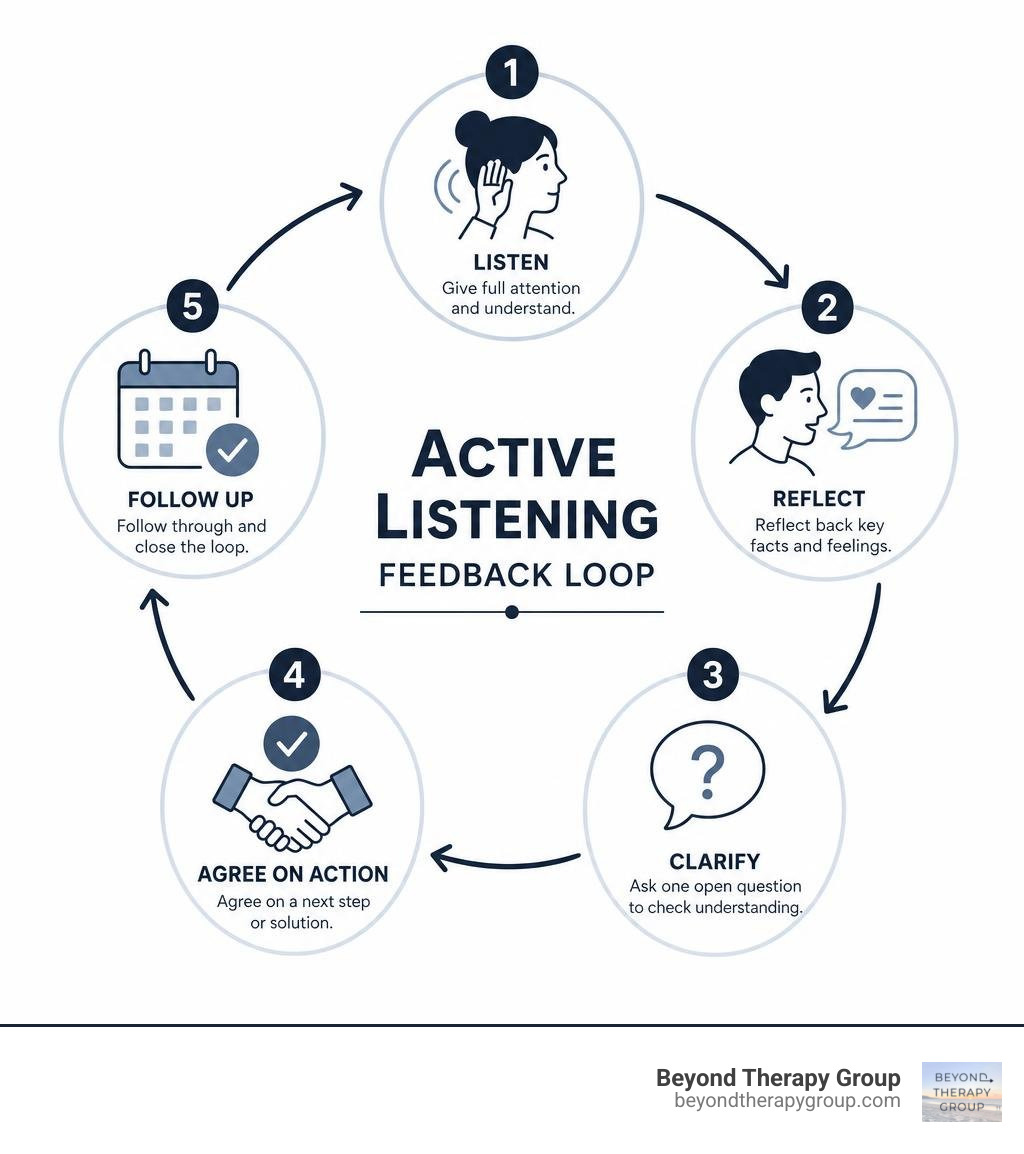
Active listening feedback methods turn a conversation into a two-way check for understanding. Start by giving the speaker your full attention. Then paraphrase their message, name the concern if appropriate, ask a clarifying question, and confirm what happens next.
For example: “It sounds like the workload and unclear deadlines are causing stress. What would make the next week more manageable?”
This approach matters at work, in healthcare, and at home. It can reduce misunderstandings, help people feel respected, and make difficult conversations less draining. Nonverbal signals count too. Open posture, an attentive expression, and a short pause can show care without interrupting.
The follow-up is what makes feedback credible. Research on leadership listening finds that employees are twice as likely to feel heard when a leader both listens and takes action. You do not need to solve every problem immediately. You do need to acknowledge what you heard, explain what you can do, and close the loop.
Active listening feedback methods further reading:
- empathetic listening techniques guide
- reflective listening practice exercises
- effective communication required
The Foundations of Active Listening and Feedback Loops
At its heart, active listening is a deliberate, two-way process rather than a passive reception of sound waves. In everyday life, many people listen simply waiting for their turn to speak. Real active listening requires cognitive congruence, where the listener works to decode the underlying message, values, and emotional context of the speaker.
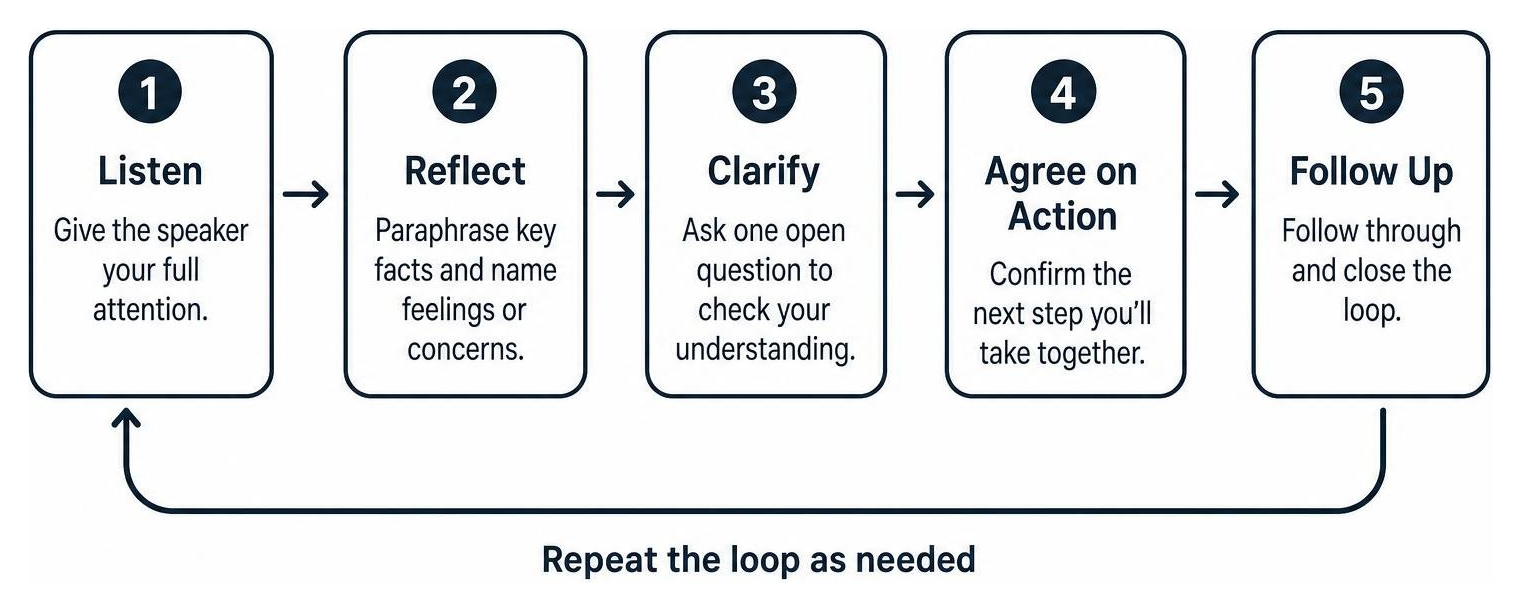
When we listen actively, we build mutual trust. Miscommunication often occurs because words carry personal associations, biases, and unstated assumptions. Clinical literature emphasizes that communication failures rarely stem from technical gaps alone (Tennant et al., 2023). Instead, they arise when the sender and receiver fail to confirm mutual comprehension. By establishing structured feedback loops during conversation, we bridge those gaps before misunderstandings cause operational errors or relational strain. To review foundational clinical research on effective dialogue, explore the StatPearls clinical communication review.
Why Two-Way Feedback Drives Mutual Understanding
A conversation without feedback is just two alternating monologues. To achieve genuine alignment, listeners must employ three core verbal tools:
- Recapitulation: Restating core points in your own words to confirm content accuracy.
- Clarification: Asking targeted questions to resolve ambiguous statements.
- Emotional Validation: Acknowledging the feelings beneath the facts, which lowers defensiveness.
Using these steps transforms the interaction. When someone expresses frustration about a delayed project, saying “You are worried the timeline puts client trust at risk” signals that you grasped both the logistical hurdle and their emotional stake.
Developing these conversational habits requires deliberate effort. To explore comprehensive frameworks for verbal interactions, review our complete guide to effective communication skills. For leadership-specific applications, the Center for Creative Leadership active listening guide details how psychological safety flourishes when managers reflect and validate before offering strategic direction.
Non-Verbal Signals and Mindful Presence
As much as 65% of interpersonal communication is nonverbal. Body language, facial expressions, and vocal cadence convey far more meaning than raw text alone. Mindful presence means bringing your whole self to the interaction and eliminating external distractions.

To communicate presence effectively, keep these behavioral principles in mind:
- The 50/70 Eye-Contact Guideline: Aim to hold eye contact for 50% to 70% of the conversation, holding each glance naturally for 4 to 5 seconds. Staring continuously can feel intense, while avoiding gaze suggests discomfort or detachment.
- Open Posture: Keep arms uncrossed, lean slightly forward, and position your body directly toward the speaker to demonstrate engagement.
- Intentional Silence: Pausing for two to three seconds after someone finishes speaking gives them space to elaborate and prevents accidental interruptions. Silence is not empty space. It provides breathing room for reflection.
For deeper insights on nonverbal attunement, consult our empathetic listening techniques guide.
Core Active Listening Feedback Methods for Everyday Conversations
Applying feedback during conversations does not mean following rigid scripts. It means selecting the right conversational model for the situation. Whether running a debrief, coaching a colleague, or supporting a partner, structured feedback methods help maintain mutual respect.
| Method | Best Setting | Core Mechanism | Key Benefit |
|---|---|---|---|
| Ask-Tell-Ask | Coaching, clinical teaching, performance reviews | Learner self-assessment followed by observation and co-planning | Minimizes defensiveness and encourages personal ownership |
| Plus / Minus / Exclamation / Question | Team workshops, interactive trainings, agile retrospectives | Rapid anonymous or open thematic categorization (+, -, !, ?) | Collects real-time team insights and flags urgent questions |
| Active Constructive Responding | Relationship building, celebrating milestones, team wins | Enthusiastic validation and emotional amplification | Builds authentic connection and reinforces positive self-worth |
The Ask-Tell-Ask Framework for Collaborative Dialogue
The Ask-Tell-Ask framework replaces outdated, manipulative methods like the feedback sandwich. Instead of burying criticism between superficial compliments, this model starts with self-assessment.
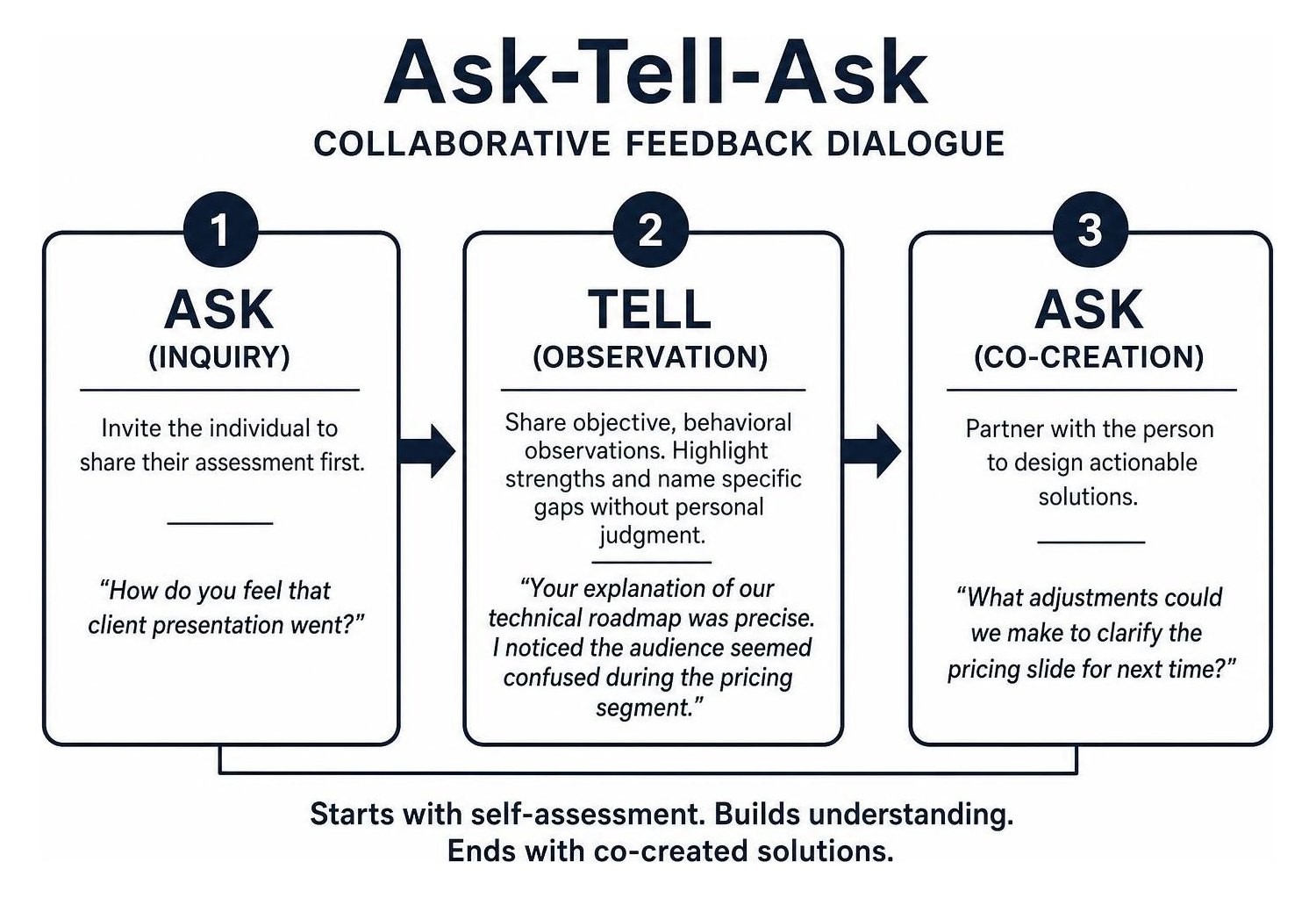
The sequence works systematically:
- Ask (Inquiry): Invite the individual to share their assessment first. For example, “How do you feel that client presentation went?”
- Tell (Observation): Share objective, behavioral observations. Highlight strengths and name specific gaps without personal judgment. “Your explanation of our technical roadmap was precise. I noticed the audience seemed confused during the pricing segment.”
- Ask (Co-Creation): Partner with the person to design actionable solutions. “What adjustments could we make to clarify the pricing slide for next time?”
Starting with inquiry allows people to identify their own missteps, which minimizes defensiveness and establishes a collaborative dynamic. For detailed educational resources on this approach, consult the Ask-Tell-Ask clinical model resource.
Implementing Structured Active Listening Feedback Methods in Teams
In team environments, relying solely on annual reviews creates communication blind spots. Real-time feedback mechanisms allow teams to adjust processes quickly while elevating employee voice.
One straightforward real-time framework is the +, –, !, ? method:
- Plus (+): What worked well during this initiative?
- Minus (–): What created friction or stalled progress?
- Exclamation (!): What surprising insight or breakthrough occurred?
- Question (?): What remains confusing or requires immediate clarification?
Using this structure during brief retrospectives ensures feedback is organized and actionable. Transparent feedback loops foster psychological safety, giving team members confidence that their observations lead to real change.
The importance of closing the loop is demonstrated in higher education research. The Students as Partners interactive feedback study showed that continuous, real-time feedback systems substantially elevated learner satisfaction and program alignment compared to traditional end-of-term evaluations (Setterington et al., 2023).
Active Constructive Responding to Reinforce Positive Experiences
Feedback is not only for resolving mistakes. How you respond to someone’s good news plays a massive role in relational bonding.
Positive psychology identifies four distinct response styles when someone shares positive news:
- Active Constructive: High energy, authentic interest, and emotional mirroring. “That is wonderful news! You spent months preparing for that promotion. Tell me all about how your manager shared the decision!”
- Passive Constructive: Low energy, pleasant support without engagement. “That is nice, congratulations.”
- Active Destructive: Pointing out downsides or risks. “Are you sure you want that extra responsibility? You will be working weekends.”
- Passive Destructive: Ignoring the news and changing the subject. “Okay. Did you see the weather forecast for tomorrow?”
Active Constructive Responding (ACR) turns everyday listening into an opportunity to deepen relationships and reinforce self-worth. To explore the psychology behind this approach, see the Positive psychology research on active constructive responding.
Practical Application: Overcoming Barriers and Closing the Loop
Even with the best intentions, everyday conversations run into real-world barriers. Common obstacles include:
- Internal Rebuttal Planning: Formulating your counterargument while the other person is still speaking.
- Emotional Reactivity: Letting personal biases distort the speaker’s actual meaning.
- Environmental Distractions: Digital notifications, background noise, and tight deadlines.
- Unclosed Loops: Gathering feedback but failing to communicate follow-up actions.
Overcoming these barriers requires deliberate habit building. When you catch your mind formulating a reply, gently bring your focus back to the speaker’s exact words. Practice summarizing their stance before offering your perspective. To build these foundational habits, check out the easiest way to practice reflective listening exercises.
Evaluating Real-Time Active Listening Feedback Methods in Healthcare
In clinical environments, communication carries high stakes. Misunderstandings between clinicians or across care teams can directly influence patient outcomes.
Practicing active listening in healthcare requires intentional dialogue and strong cultural competence. Clinicians must account for differing cultural norms regarding eye contact, vocal tone, and personal boundaries.

High-performing clinical teams rely on structured learning conversations during post-event debriefs. Rather than delivering top-down critiques, facilitators use silence, open inquiry, and advocacy with inquiry to help teams reflect on critical events (Davis & Denning, 2018). To study how structured debrief conversations improve clinical learning and patient safety, read the research on listening through learning conversations.
Step-by-Step Drills to Hone Listening Reflexes
Listening is a muscle that strengthens with regular training. Here are practical drills to refine your communication skills:
- The 3-Second Pause Drill: In every conversation today, wait three full seconds after the other person finishes speaking before you respond. Use this pause to digest their point rather than jumping in.
- Paraphrasing Exchanges: During your next one-on-one meeting, begin every second response with: “What I hear you saying is… Is that accurate?” Do not add advice until the speaker confirms your summary.
- Curiosity Over Correction: When someone presents an opinion you disagree with, ask two clarifying questions before stating your perspective. Try: “What experiences led you to that conclusion?”
- The Feedback Wrap-Up: End collaborative meetings by summarizing agreed action items and asking: “What support do you need from me to accomplish this?”
For a systematic roadmap to mastering these behaviors, refer to our A-Z guide to active listening training.
Frequently Asked Questions About Active Listening
What makes active listening different from regular listening?
Regular listening is often passive, where the listener hears words while planning a reply or letting their attention wander. Active listening is an intentional, conscious practice. It combines nonverbal presence, paraphrasing, clarifying questions, and emotional validation to ensure both participants reach a shared understanding.
How does the Ask-Tell-Ask model improve performance feedback?
The Ask-Tell-Ask model reduces defensive reactions by inviting the recipient to evaluate their own performance first. This shifts the interaction from an uncomfortable critique to a collaborative problem-solving dialogue, allowing both parties to co-create actionable solutions.
Why is silence considered an active listening tool?
Silence provides crucial cognitive processing time for both the speaker and listener. Practicing intentional pauses gives the speaker room to elaborate on complex thoughts without feeling rushed, while helping the listener process information before offering a thoughtful reply.
Conclusion
Mastering communication is an ongoing journey that shapes our professional success and personal relationships. When we replace passive hearing with structured active listening, we build genuine trust, minimize misunderstandings, and resolve workplace friction. Listening is only half the equation. To build authentic credibility, always close the loop by taking clear, follow-up action on the feedback you receive.
If you want personalized support to improve your communication habits, manage relational challenges, or build emotional resilience, our team at Beyond Therapy is here to help. We provide compassionate, evidence-based care in Redondo Beach and the broader South Bay area. Take the first step by booking a free 15-minute consultation to explore our comprehensive therapy services today.
References
Karie Tennant, Ashley Long, Tammy J. Toney-Butler. “Active Listening.” StatPearls Publishing, 2023. NBK442015. Setterington NA, McLean S, Woods A. “Design, implementation, and evaluation of Students as Partners interactive feedback model..” Advances in physiology education, 2023. PMCID PMC10010919. Davis M, Denning K. “Listening through the learning conversation: a thought provoking intervention..” MedEdPublish (2016), 2018. PMCID PMC10701807.
Recent Posts