
September 29, 2026
Why Couple Communication Dynamics Break Down and How to Fix Them

Key Takeaways
- To improve couple communication dynamics, partners must replace criticism and defensiveness with structured I statements, emotional validation, and timely physiological pauses.
- Communication breakdowns typically stem from unspoken cognitive assumptions, threat responses based on attachment styles, and physiological flooding.
- Daily habits like reflective listening drills, stress reducing conversations, and managing perpetual conflict build lasting relational resilience.
Understanding Why Couple Communication Breaks Down
To improve couple communication dynamics, partners must slow down emotional reactivity, use structured “I” statements, validate each other’s feelings, and take timed pauses when heart rates spike. By replacing defensive reactions with active listening and clear emotional boundaries, couples can de-escalate recurring conflict cycles and rebuild mutual trust.
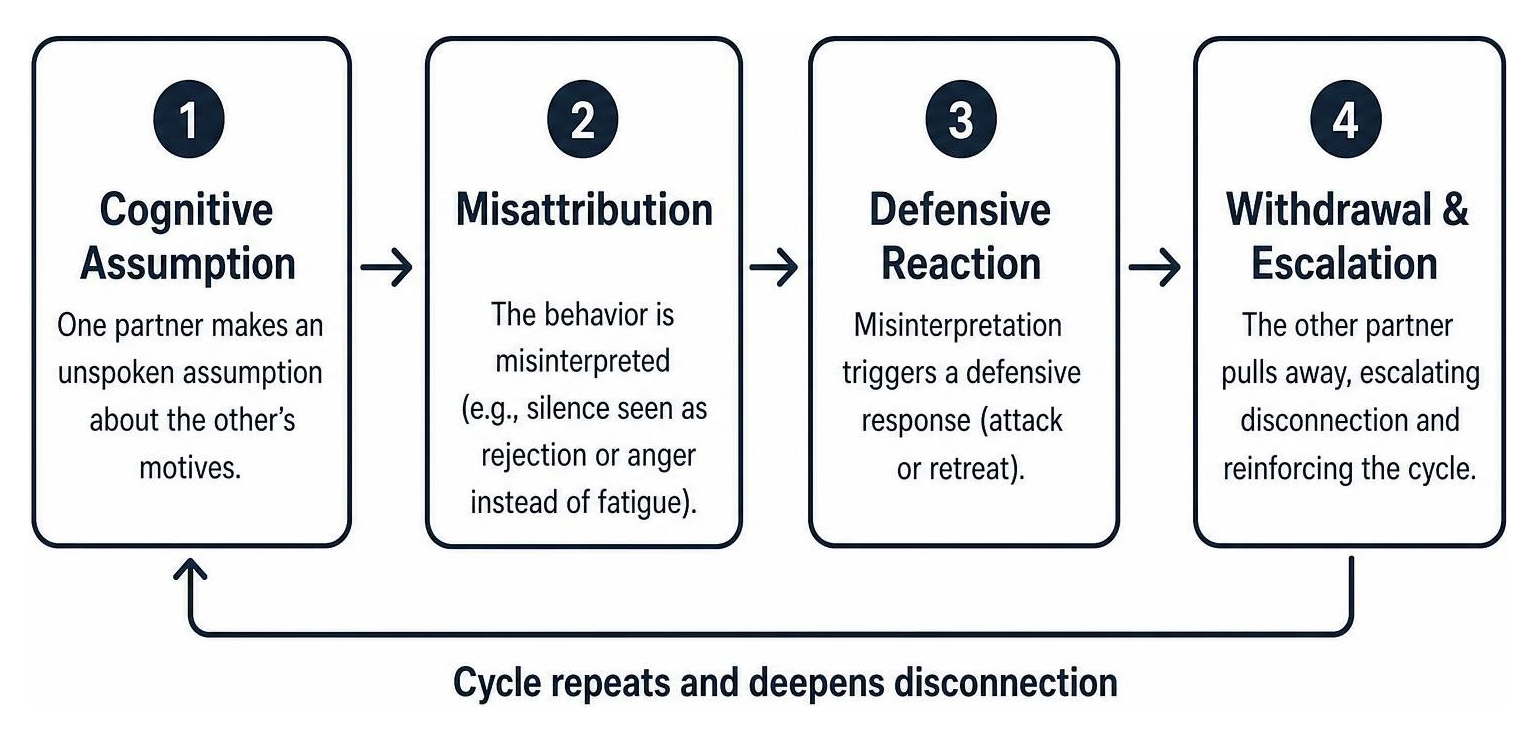
Relational miscommunication rarely happens out of nowhere. Instead, it is usually the result of predictable cycles where cognitive assumptions, emotional withdrawal, and defensive reactivity feed into one another. When stress enters the picture, partners often stop treating each other as teammates and begin reacting as adversaries.
This breakdown often begins when one partner makes an unspoken assumption about the other person’s motives. If a partner arrives home quiet and distracted, the other might interpret that silence as rejection or anger rather than work fatigue. These misattributions trigger defensive reactions, which then prompt the other person to pull away. Over time, how fear shows up in your relationship based on your attachment style dictates whether someone attacks to protect themselves or retreats into complete emotional shutdown.
The Four Horsemen and Physiological Flooding
Decades of relationship science show that certain communication habits are far more destructive than ordinary disagreements. Dr. John Gottman identified four destructive communication patterns, often termed the Four Horsemen: criticism, contempt, defensiveness, and stonewalling.
- Criticism: Attacking a partner’s core character rather than voicing a specific complaint about a behavior.
- Contempt: Expressing moral superiority, mockery, sarcasm, or eye-rolling, which is the single strongest predictor of relationship distress.
- Defensiveness: Making excuses, deflecting blame, or playing the victim to avoid taking responsibility.
- Stonewalling: Withdrawing completely from interaction, tuning out, and acting unresponsive.
When these behaviors occur, partners often experience physiological flooding. Flooding happens when the nervous system perceives an emotional threat, causing the heart rate to surge above 100 beats per minute, releasing adrenaline, and impairing the brain’s ability to process language or practice empathy (Johnson et al., 2022). In a state of flooding, constructive conversation is biologically impossible. De-escalation protocols, such as taking an intentional twenty-minute physiological pause to self-soothe, become necessary before any meaningful dialogue can resume.
Attachment Styles and Unspoken Relational Needs
Beneath almost every repetitive argument lies an unmet relational need. Understanding attachment styles in therapy reveals why certain conversations feel so high-stakes.
Individuals with an anxious attachment style often perceive minor shifts in tone or attention as threats of abandonment, prompting them to pursue connection through intense questioning or emotional urgency. Conversely, those with an avoidant attachment style often experience intense emotional conversations as overwhelming or suffocating, leading them to withdraw into self-reliance to feel secure. When an anxious partner pursues and an avoidant partner withdraws, both individuals are reacting to underlying attachment fears rather than the surface topic of the argument. Recognizing these hidden vulnerabilities helps couples move away from mutual blame and toward compassionate understanding.
Core Skills to Replace Negative Communication Habits

Shifting away from reflexive reactions requires intentional skill development. The foundation of any healthy dialogue rests on nonverbal attunement, emotional validation, and structured conversation tools.
A cornerstone technique is the speaker-listener method. In this approach, one person holds the floor to share their inner experience without interruptions, while the listener focuses entirely on understanding rather than preparing a counterargument. By learning practical empathetic listening techniques, the listener reflects what they heard, validates the emotional reality behind the words, and checks for accuracy before responding.
| Destructive Communication Habit | Constructive Alternative | Practical Example |
|---|---|---|
| Criticism (Character attack) | Gentle Startup (Specific complaint) | “I feel overwhelmed by the kitchen mess. Can you help me clean the counters?” |
| Contempt (Mockery or superiority) | Culture of Appreciation (Expressing gratitude) | “I appreciate how hard you worked today, and I would love some support right now.” |
| Defensiveness (Denial and excuses) | Accountability (Accepting partial responsibility) | “You are right, I forgot to call. I understand why you were worried.” |
| Stonewalling (Total withdrawal) | Physiological Self-Soothing (Timed break) | “I want to hear you, but I feel flooded. Can we take 20 minutes to reset and return to this?” |
Mastering ‘I’ Statements and Constructive Expression
Clear expression requires taking full ownership of your internal emotional state. Instead of launching into accusations with “You always” or “You never,” using structured “I” statements shifts the dialogue from blame to vulnerability.
Practicing effective communication skills means structuring difficult conversations with precision: “I feel [emotion] when [specific event occurs], and I need [clear, actionable request].” This format removes judgment and invites cooperation. When you learn how to speak your truth and save your relationship, you communicate personal boundaries and desires without diminishing the dignity of your partner.
Creating Psychological Safety and Setting Emotional Boundaries
For honest dialogue to flourish, partners must establish interpersonal safety. This means agreeing that vulnerability will not be weaponized in future disagreements, nor will either partner resort to insults or threats of ending the relationship during a fight.
Establishing healthy emotional boundaries in a relationship provides the guardrails needed for emotional containment. Boundaries are not walls designed to keep a partner out. Instead, they are clear guidelines that explain how to love each other safely. Knowing key boundaries to protect your relationship allows both individuals to express hurt without fear of retaliation, creating an environment where intimacy can deepen naturally.
Evidence-Based Strategies to Improve Couple Communication Dynamics
Longitudinal research demonstrates that relationship satisfaction is intimately tied to how couples handle everyday moments and external stress. It is not solely about grand romantic gestures, but rather about turning toward small emotional bids throughout the day. Reviewing how to communicate better with your partner shows that partners who routinely offer supportive attention during casual interactions build an emotional cushion that protects them during disagreements.
One of the most effective daily habits is the stress-reducing conversation. In this structured talk, partners spend twenty minutes discussing stressors originating outside the relationship, such as workplace pressures, parenting fatigue, or health concerns. The listener’s role is exclusively to offer solidarity, validate feelings, and take their partner’s side, rather than offering unsolicited problem-solving. This practice reinforces a shared sense of team unity against the outside world.
Practical Exercises to Improve Couple Communication Dynamics
Couples can actively rewire their relational patterns through targeted, consistent exercises:
- Building Love Maps: Spend time asking open-ended questions about your partner’s inner world, including their current goals, worries, favorite music, and daily challenges. As noted in classic communication exercises for couples, keeping this mental map updated fosters genuine intimacy.
- Practicing Reflective Listening Drills: Set a timer for five minutes. One partner speaks about a non-conflict topic while the other practices reflective listening exercises by summarizing what was said without inserting personal opinions.
- Structured Physiological Timeouts: Agree on a shared hand signal or keyword that immediately pauses a heated discussion for exactly twenty to thirty minutes, allowing elevated heart rates to return to baseline through solitary, non-ruminative activities like walking or deep breathing.
- Daily Appreciation Rituals: End each day by explicitly naming one specific action your partner took that made your day easier or brought you joy.
Managing Conflict and Perpetual Issues Constructively
Research highlights that roughly sixty-nine percent of relationship conflicts are perpetual problems stemming from fundamental lifestyle, personality, or value differences. These issues cannot be permanently solved. They must be managed through continuous dialogue and humor.
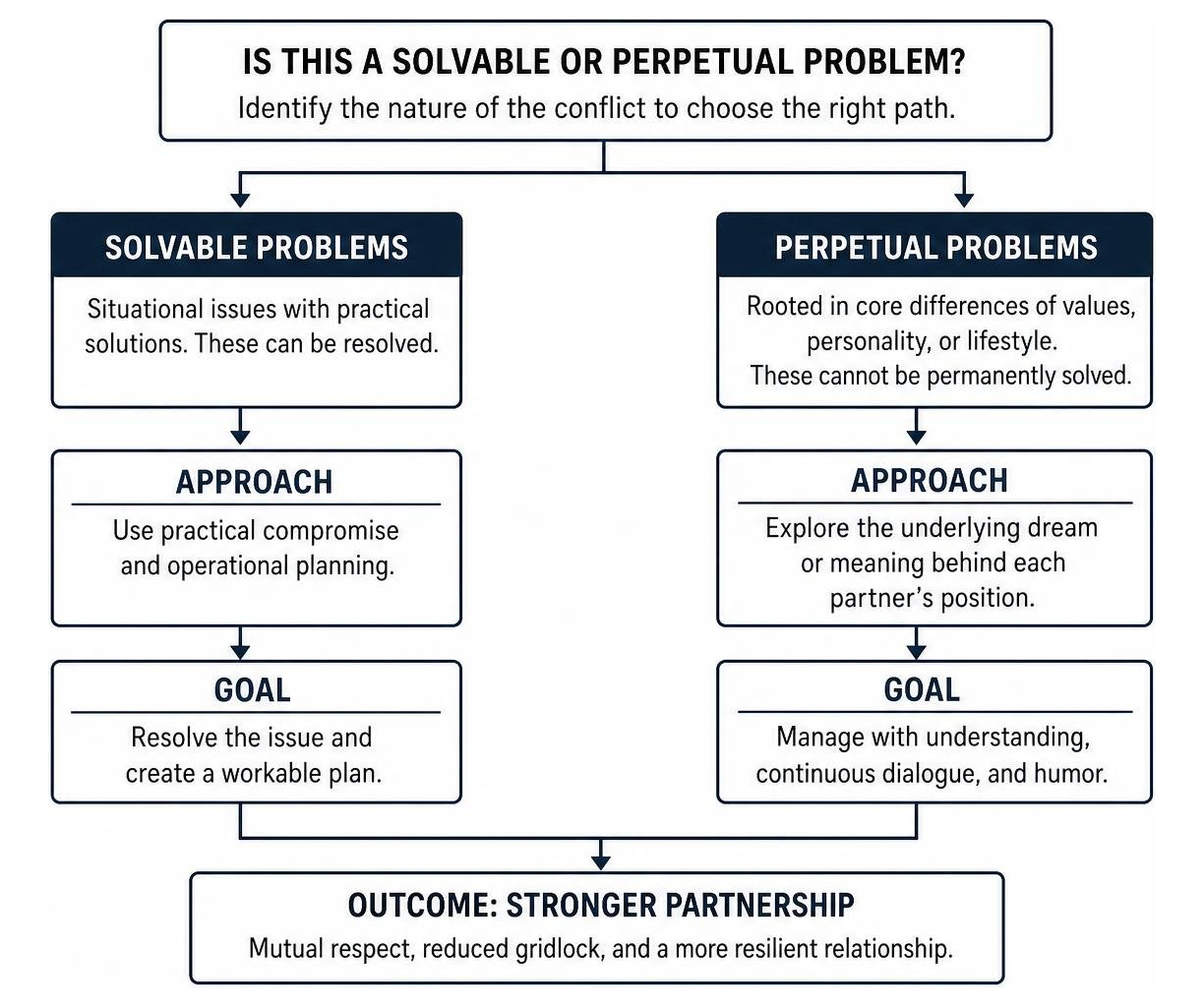
When conflicts arise, applying proven family conflict resolution strategies helps differentiate between solvable situational issues and deeper core differences. Solvable problems require practical compromise and operational planning. Perpetual problems require discovering the underlying dream or meaning behind each partner’s position. When partners understand the historical or emotional significance behind a stance, gridlock softens into mutual respect.
When to Seek Professional Support for Relationship Dynamics
While self-guided tools are valuable, certain communication dynamics become so deeply entrenched that external clinical guidance is required. Chronic resentment, recurring circular arguments that never resolve, prolonged periods of the silent treatment, and emotional detachment are signs that professional support is needed.
Understanding relational therapy and how it helps can clarify how clinicians assist couples in identifying blind spots. Seeking help early prevents destructive cycles from hardening into permanent relational apathy.
How Professional Counseling Helps Improve Couple Communication Dynamics
Professional relationship therapy provides an objective container to dissect and rebuild interpersonal patterns safely. Modalities like Emotionally Focused Therapy (EFT) help couples identify the primary emotional injuries driving their conflict cycles and guide them toward authentic vulnerability.
Clinicians also draw on Gottman Method interventions and evidence-based frameworks found in couples counseling for communication problems to teach real-time physiological de-escalation and assertive dialogue. Integrating relational life therapy approaches empowers both partners to dismantle relational grandiosity or shame, paving the way for authentic equality and collaborative problem-solving.
Frequently Asked Questions About Couple Communication
How do you fix poor communication dynamics in a relationship?
Fixing poor patterns requires slowing down conversations, recognizing physical signs of anger or overwhelm, and eliminating character attacks. Couples should practice reflective listening, express unmet needs using clear “I” statements, and set regular times to talk without distractions.
What is the 5-to-1 ratio in couple communication?
Developed through relationship research, the 5-to-1 ratio states that stable, healthy relationships require at least five positive interactions, such as validation, humor, expressions of gratitude, or affectionate touches, for every single negative interaction during conflict. During everyday non-conflict times, this ratio jumps to approximately 20-to-1.
When should a couple consider therapy for communication problems?
Couples should seek therapy when arguments repeatedly reach an impasse, discussions consistently trigger defensive shut-downs, or one or both partners feel emotionally unsafe, unheard, or chronically lonely within the partnership.
Conclusion: Sustaining Healthier Communication Over Time
Transforming couple communication dynamics is an ongoing practice rather than a one-time fix. It requires patience, personal accountability, and a willingness to stay curious about your partner’s internal world. By establishing weekly check-ins, honoring physiological limits during conflict, and prioritizing emotional validation, couples can build an enduring foundation of mutual trust and intimacy.
For couples in Redondo Beach and the broader South Bay area looking to break repetitive conflict loops, working with a relational clinician provides personalized guidance and lasting tools. At Beyond Therapy, we offer a free 15-minute consultation to help you understand our clinical approach and find the right support for your relationship goals. To take the next step toward a deeper connection, explore our therapy services today.
References
Johnson MD, Lavner JA, Mund M, Zemp M, Stanley SM, Neyer FJ, Impett EA, Rhoades GK, Bodenmann G, Weidmann R, Bühler JL, Burriss RP, Wünsche J, Grob A. “Within-Couple Associations Between Communication and Relationship Satisfaction Over Time..” Personality & social psychology bulletin, 2022. PMCID PMC8915221.
Recent Posts