
October 27, 2026
Mastering Effective Interpersonal Communication for Real Impact

How to Practice Effective Interpersonal Communication
- Understand the exchange. Communication is a continuous two-way loop of speaking, listening, and observing.
- Practice active empathy. Listen to understand whether the other person needs to be helped, hugged, or heard.
- Communicate assertively. Express your needs clearly and maintain healthy boundaries without aggression or passivity.
Effective interpersonal communication is a two-way exchange. It helps you check whether your message was understood, not just delivered. At work and at home, that habit can prevent small misunderstandings from becoming bigger conflicts.

To master these relational dynamics, explore practical assertive boundary setting tips, consult our empathetic listening techniques guide, and learn how to improve interpersonal communication skills in daily interactions.
Core Pillars of Effective Interpersonal Communication
Human connection operates as a transactional process. In every interaction, both participants send and receive messages at the same time. Rather than an isolated broadcast where one person speaks into a void, dialogue involves continuous feedback loops, environmental context, and physical channels. Developing these relational habits is key to building authentic rapport, as detailed in The Complete Guide to Effective Communication Skills.
When you speak to someone, you do not just deliver content. You read their micro-expressions, adjust your pacing, and interpret subtle shifts in their posture. This ongoing circular exchange shapes whether the interaction builds trust or creates distance.
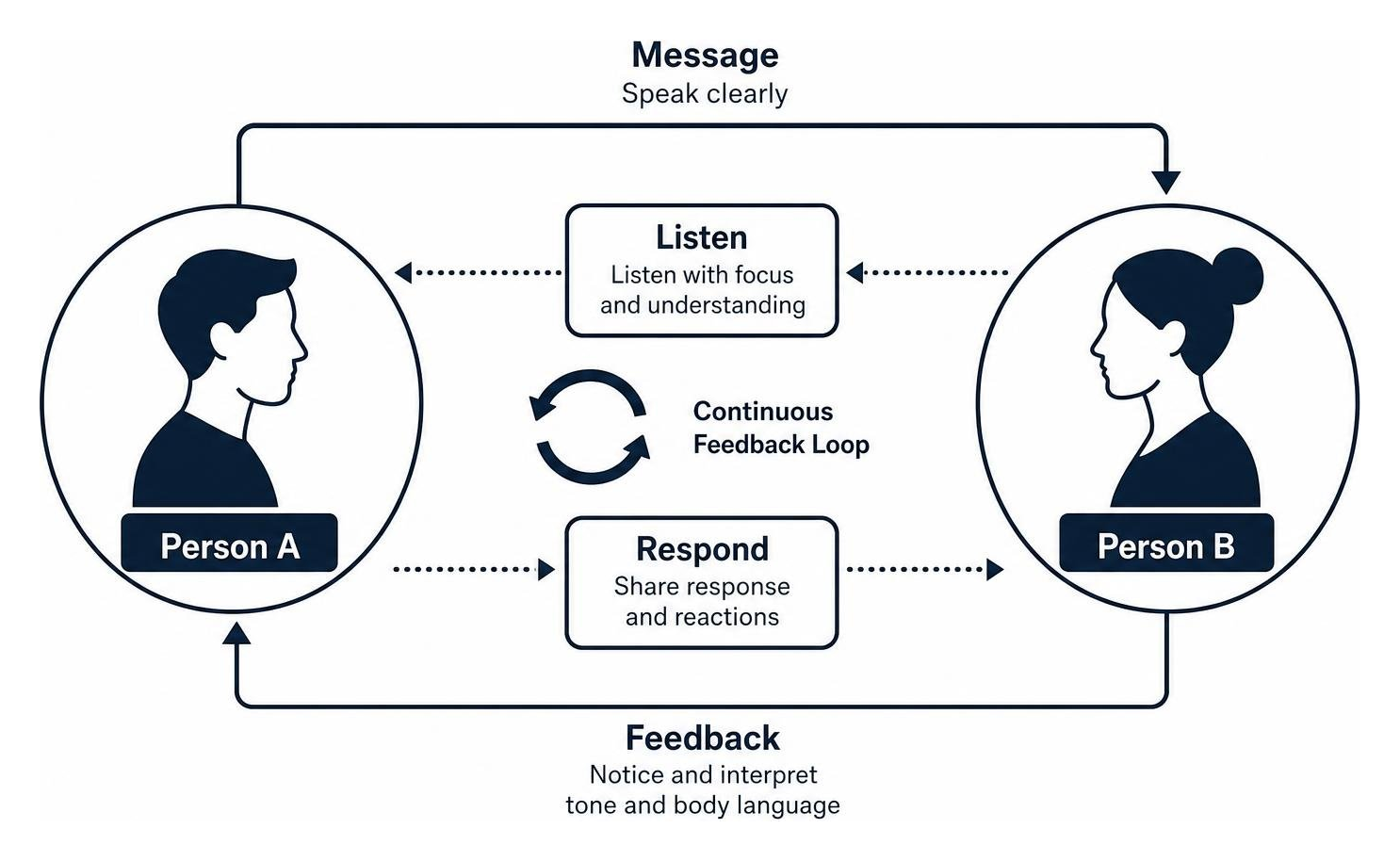
Understanding this exchange requires mastering three core foundations: verbal precision, nonverbal alignment, and psychological framing.
Verbal Clarity and Message Design
The words you choose form the structural architecture of your message. Vague phrasing, excess workplace jargon, and hidden assumptions often force the listener to guess your true intent. When individuals must guess what you mean, misunderstandings happen quickly.
To build clarity:
- State your primary point directly in your first two sentences.
- Replace industry acronyms or clinical jargon with straightforward terms.
- Ask confirming questions such as “How does this timeline fit with your priorities?” instead of passive phrases like “Does that make sense?”
When you refine your language, you create safety for the listener. Clear phrasing eliminates confusion and forms the secret sauce of effective communication for work and life.
Nonverbal Signals and Emotional Resonance
Research in behavioral psychology shows that when nonverbal signals conflict with spoken words, listeners instinctively trust the nonverbal cues. A colleague who says “I am happy to take on this project” while sighing, frowning, and crossing their arms conveys reluctance, not enthusiasm.

Key physical markers establish connection:
- Eye Contact: Natural, intermittent eye contact signals honesty and engagement without feeling confrontational.
- Vocal Prosody: The pitch, volume, and rhythm of your voice carry the emotional weight of your message. A calm, steady tone reduces defensiveness.
- Facial Micro-Expressions: Genuine smiles and relaxed facial muscles communicate safety.
- Physical Posture: An open torso and relaxed shoulders show that you are receptive to the other person.
In-depth analyses, including frameworks found in The Interpersonal Communication Playbook, demonstrate that matching nonverbal warmth with verbal clarity creates strong personal presence.
Self-Concept and Psychological Framing
How you view yourself determines how you interact with everyone around you. Your self-concept, which includes your self-esteem and internalized beliefs, acts as a filter for every conversation.
If you struggle with low self-esteem, you might interpret neutral feedback as harsh criticism. If you feel secure, you can process constructive notes with curiosity. According to social penetration theory, interpersonal closeness develops systematically as individuals peel back surface layers of self-disclosure. When you possess a stable self-concept, you can share vulnerabilities without fearing rejection, creating deeper, reciprocal connections.
Mastering Active and Empathetic Listening
True listening is a deliberate cognitive choice, not just passive hearing. Hearing is simply the physical reception of sound waves. Active listening requires full attention, cognitive presence, and intentional empathy.
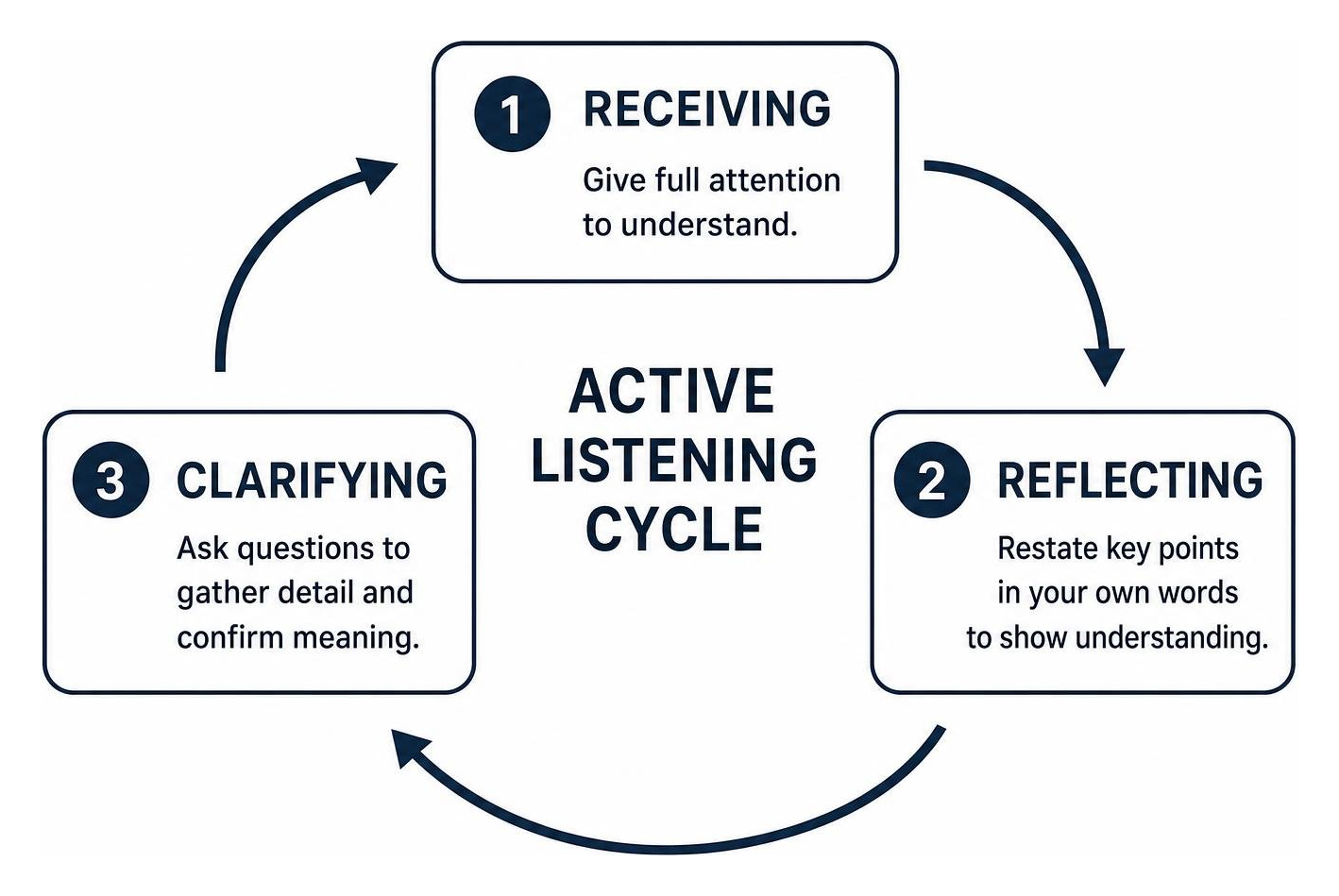
To explore structured methods for building this foundational habit, review our AZ guide to active listening training.
| Feature | Passive Hearing | Active Empathetic Listening |
|---|---|---|
| Attention Focus | Divided between speaker and inner thoughts | Undivided presence dedicated to the speaker |
| Physical Stance | Slumped, checking devices, wandering gaze | Leaning in, consistent eye contact, open posture |
| Primary Goal | Waiting for a turn to speak or debate | Understanding emotional nuance and core meaning |
| Response Style | Offering unsolicited advice or dismissals | Paraphrasing, validating, and clarifying |
The Mechanics of Reflective Feedback
Reflective feedback ensures that what you heard matches what the speaker intended. It removes assumptions by putting the speaker’s thoughts into your own words before you offer an opinion.
- Paraphrasing: Summarizing the core factual content. For example: “It sounds like the main roadblock is the tight deadline on Friday.”
- Emotion Labeling: Acknowledging the feeling behind the words. For example: “You seem overwhelmed by how many revisions were requested.”
- Perception Checking: Asking for confirmation without judgment. For example: “Am I understanding correctly that you would prefer more autonomy on this account?”
You can master these skills through reflective listening exercises and explore active listening feedback methods to prevent conversational drift.
Identifying Underlying Needs: Helped, Hugged, or Heard
A common point of friction occurs when one person seeks emotional comfort while the other immediately offers practical solutions. Before jumping into problem-solving, clarify the goal of the conversation.
Ask the speaker directly: “Do you want to be helped, hugged, or heard?”
- Helped: The person wants collaborative brainstorming and concrete solutions.
- Hugged: The person needs physical or emotional comfort, care, and reassurance.
- Heard: The person wants a safe space to vent without receiving advice.
Aligning your response with their true need creates immediate trust. Our empathetic listening techniques guide breaks down practical steps to apply this technique across your relationships.
Practical Strategies to Navigate Conflict and Emotional Triggers
Tense conversations activate the sympathetic nervous system, triggering fight, flight, or freeze responses. When your heart rate climbs, cognitive bandwidth narrows, making productive dialogue difficult.
To manage physiological arousal:
- Sensory Grounding: Feel your feet firmly planted on the floor or hold a cold glass of water to bring your focus back to the present.
- The Strategic Pause: Take a slow breath before answering to engage your prefrontal cortex.
- Curiosity Over Defense: Replace defensive thoughts with curious questions, such as “What information might I be missing here?”
Research on strengthening interpersonal skills highlights emotional regulation as a key factor in relationship longevity. Understanding why couple communication dynamics break down can help you spot these emotional triggers before they turn into major arguments.
Overcoming Common Barriers to Effective Interpersonal Communication
Several invisible barriers often undermine productive dialogue:
- Emotional Noise: Intense anger or anxiety that blocks objective processing.
- Cultural Taboos and Unspoken Rules: Avoidance of sensitive topics that leaves underlying problems unresolved.
- Premature Judgment: Deciding what the speaker means before they finish their sentence.
- Defensiveness: Treating every difference of opinion as a personal attack.
To break these destructive patterns, use tools designed to stop talking past people and refocus on collaborative outcomes.
Collaborative Conflict Resolution and De-Escalation
De-escalating conflict requires separating objective facts from subjective stories. When confronting a dispute, use structured “I” statements that describe behavior without assigning negative motives.
Instead of saying: “You always ignore my emails and disrespect my schedule.” Use this approach: “When I do not receive a reply before our morning meeting, I feel unprepared, and I need us to establish a clear communication window.”
Focusing on shared interests rather than rigid positions helps protect personal connections, as outlined in our guide to speaking your truth to save your relationship.
Developing Assertiveness and Setting Healthy Boundaries
Assertiveness sits between passivity and aggression. Passive communication ignores your own needs to please others, while aggressive communication demands your way at the expense of everyone else. Assertive communication honors your self-worth while fully respecting the dignity of the other person.

Cultivating this balanced stance is central to long-term relational health, as explored in our assertiveness training techniques guide.
Core Assertive Communication Frameworks
One effective framework from dialectical behavior therapy is the DEAR MAN technique, detailed in clinical resources like the Interpersonal Effectiveness Skills Manual.
- Describe: State the facts of the situation objectively.
- Express: State your feelings using “I” statements.
- Assert: Clearly ask for what you need or say no.
- Reinforce: Explain the positive outcome of honoring the request.
- Mindful: Keep your focus on your goal without getting distracted.
- Appear Confident: Maintain steady eye contact and an upright posture.
- Negotiate: Offer workable compromises when appropriate.
You can learn to implement this structure through five easy assertiveness changes to increase your influence in high-pressure situations.
Deflecting Manipulation and Saying No
Setting boundaries often brings pushback from individuals who benefit from your lack of limits. When someone tries to manipulate or guilt-trip you, techniques like the broken record method provide calm protection.
Repeat your boundary calmly using the exact same words, without adding excuses or apologies:
- “I understand that this timeline is tight, but I cannot take on new tasks this week.”
- “I hear your concern, but my decision remains unchanged.”
You can learn how to deflect manipulators using the broken record technique and discover strategies for mastering the art of speaking up for yourself to protect your emotional energy.
Adapting Connection for Modern Workplaces and Digital Channels
The rise of remote tools, messaging apps, and videoconferencing has transformed day-to-day interactions. Without vocal inflection and body language, text messages are easily misread as cold or critical.
Preparing for high-stakes digital conversations requires extra intentionality, a process we outline in the confident candidate guide to high-stakes interviews.
Digital Tools and Effective Interpersonal Communication in Remote Settings
To maintain clarity and connection across digital channels:
- Choose the Right Channel: Use email for concise documentation, direct messages for brief updates, and video or phone calls for nuanced or sensitive topics.
- Clarify Emotional Tone: Add polite openers and warm closings in text to prevent readers from projecting negative assumptions onto your words.
- Combat Videoconference Fatigue: Take deliberate pauses, look directly into the camera to simulate eye contact, and schedule brief screen breaks between calls.
- Establish Response Norms: Set clear expectations for asynchronous replies so team members do not mistake delayed responses for disinterest.
Frequently Asked Questions About Interpersonal Communication
What are the four primary types of interpersonal communication?
The four primary types are verbal communication, nonverbal communication, written communication, and listening. Verbal covers spoken words and tone. Nonverbal includes body posture, facial expressions, and eye contact. Written covers digital and paper messages, while listening involves active cognitive processing and empathy.
Why is interpersonal communication critical in high-stakes environments?
In high-stakes environments like healthcare and aviation, poor team communication has historically been identified as the leading cause of preventable errors. Clear, assertive communication builds operational safety, protects patient and client wellbeing, reduces turnover, and maintains team morale under pressure.
How can I quickly de-escalate tension during a difficult conversation?
To de-escalate tension quickly, pause and take a slow breath to regulate your nervous system. Lower your vocal volume, uncross your arms, and summarize the other person’s perspective using neutral phrases like “I hear how important this is to you.” Validating their feelings without immediately defending yourself lowers hostility and creates room for resolution.
Conclusion
Mastering interpersonal skills is a lifelong practice that reshapes your personal relationships and professional trajectory. When you pair active listening with clear phrasing, steady emotional regulation, and firm boundaries, you create a foundation for lasting trust.
If you are ready to overcome recurring communication challenges, strengthen your relationships, or build social confidence, our team is here to support you. We provide personalized care across our locations in Redondo Beach and the South Bay. Reach out today to schedule a free 15-minute consultation with one of our licensed therapists and discover how our tailored therapy services can help you communicate with clarity and ease.
Recent Posts